I was fixing a comic strip for one of my articles when the notice turned up. Microsoft is retiring Whiteboard for personal accounts. No new boards after 22 August 2026, and if I want to keep anything I’ve already made, I have until 5 September to export it before it’s gone for good. So here I am on a weeknight, opening board after board, saving each one to PDF and image files before the door shuts.
I love this app. I have loved it since it first appeared. It has been my scribbling pad, my drawing surface, my think-out-loud board, the most useful all-round tool I’ve put my hands on in years. When I needed to sketch an idea, rough out a diagram, lay out a comic strip panel by panel, or just make a mess on a big blank space and see what fell out of my head, this is where I went. Grown men are not supposed to grieve software. I seem to be doing it anyway.
These days the board is where a lot of my thinking starts. Before an article becomes words, it’s usually a mess of boxes and arrows on a canvas, ideas pinned up where I can shove them around and argue with myself until an order finally emerges. The comic strip I was mending when the notice appeared was sitting on there too. So the retirement takes more than a drawing app off me. It takes a room I think in.
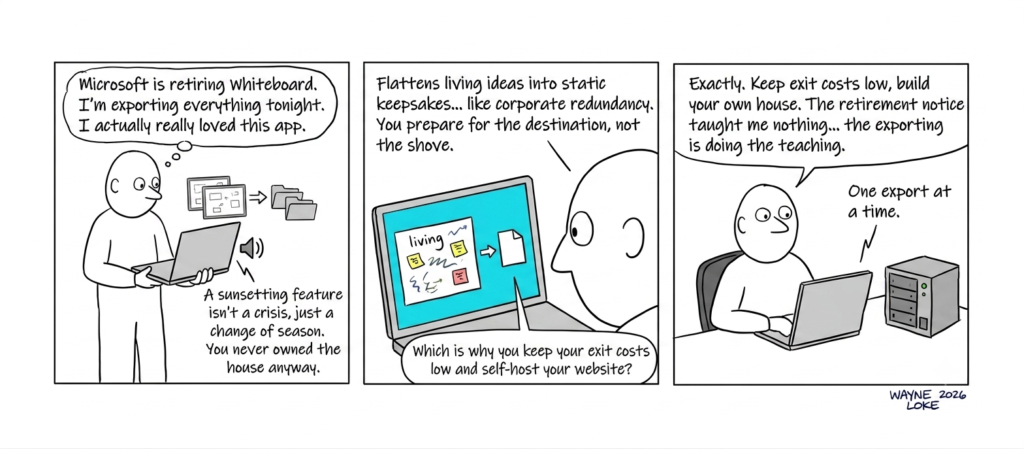
And yet, sitting here exporting, I notice I’m not angry, and I’m not even surprised. It looks like a loss, and it would read like one if I saw time as a straight line where the things I rely on are supposed to stay put and wait for me. I’ve come to see it differently. This is not the first tool I’ve had to pack up and carry off someone else’s platform, and it won’t be the last. Across nearly forty years of work, through banks in Kuala Lumpur and Amsterdam and government agencies in Wellington, I have watched the systems I depended on get switched off, deprecated, replaced, and merged into something new with a worse layout, over and over. I still remember the first time a platform I trusted was pulled out from under a team I ran, and the useless meeting where we all pretended the replacement was an upgrade. What I’m doing tonight, I’ve done many times. The notice isn’t a crack in the world. It’s a season turning, and I happen to be standing in the yard when the weather shifts.
Whose house it was
The whiteboarding itself isn’t disappearing. Microsoft is folding the capability into Loop and Teams, so the ability to draw on a shared board lives on inside other products. What retires is the standalone app I grew fluent in, the particular room I worked in, while the furniture gets carried off to buildings I don’t visit. The function survives. The home I knew for it does not.
Which brings me to the thing I got wrong for years without noticing. My boards lived on Microsoft’s servers, and somewhere along the way I started treating that as mine. It felt like a home. It was a rented plot on someone else’s land, and the export deadline is the letter reminding me whose name is on the title. I never owned the board. I rented a spot, paid nothing for it, grew comfortable in the rhythm, and mistook the comfort for ownership. That is the quiet trick of permanence. We rent it on someone else’s cycle, settle in, and forget we don’t hold the deed, right up until the landlord sends notice.
The deadline is doing something else too, something I only half enjoy. It is teaching me, and it is charging tuition in my own hours. Nobody is forcing me to save these boards. If I let the date slide past, the work simply vanishes, and no one but me will ever notice it’s gone. So I sit here, export by export, paying for the lesson with an evening I won’t get back. The retirement notice taught me nothing. The exporting is doing the teaching.
I notice, too, what the export actually does to the thing I’m saving. A board inside the app is alive. I can move a box, redraw an arrow, wipe a corner and change my mind, come back next week and keep going. The moment I save it to PDF, it stops being a place I work and becomes a picture of a place I used to work. The living surface flattens into a keepsake. That, in the end, is what keeping usually amounts to. We can’t hold on to a thing while it’s still moving, so we hold on to a still image of it and call that a memory. The boards I’m rescuing tonight will survive as pictures. Not one of them will ever be drawn on again.
Then there is the cost people underestimate when they talk about switching tools, as if moving were only a matter of matching a feature list. The cost is fluency. I didn’t just use Whiteboard, I became fluent in it. I knew without thinking where every control sat, how it behaved, what it would let me get away with when I was working fast. Moving to something else means learning a new grammar with my hands all over again, being clumsy for a while, being slow before I’m quick. That re-learning is the tax, and I’ve paid it before in far bigger denominations than a drawing app.
The bigger version
I know that cost because I’ve lived a larger version of it. My own role ended in November 2024. I was made redundant, and I stepped from there into early retirement. Here is the wrinkle. I was ready for the retirement. I was not ready for the shove that started it. Being prepared for the destination is not the same as being prepared for the hand in your back that sends you there ahead of schedule. One of those I had planned for over years. The other arrived on someone else’s timetable, decided on someone else’s ledger, and handed to me as a fact I had no vote in.
I won’t dress that up into more than it was, and it wasn’t only a line in a budget either. The same ache turns up wherever something with a rhythm ends, whether it’s a tool you loved, a job you were good at, a house you lived in for twenty years, or someone you kept close. I’ll leave that there. You can put your own face to it more accurately than I can put mine.
What I carried out of it is the same thing I’m carrying out of this small evening of exporting. The capability walked out of the building with me. Whatever made me useful was portable, even after the reason for keeping me around got closed off on an account I never controlled. From inside the notice, renewal looks like a tragedy. Step back, and it’s the cycle doing what cycles do, turning, and carrying the value that actually mattered into whatever comes next.
Keeping exit costs low
Two things this is not. It isn’t a call to nostalgia, and it isn’t a call to hoard every tool you’ve ever touched. If I tried to own everything, host all of it myself, keep a private copy of half the internet in a cupboard, I’d drown in my own caution, and I’d deserve it. The useful move is smaller than that. Keep your exit costs low.
That’s why I run my own WordPress on my own hosting rather than writing inside someone’s walled app where my words are a guest. It’s why I build network storage out of old machines that were headed for landfill, and keep my own copies of the things that matter to me. It’s why, when I make something I care about, I keep it in a format I can carry off the platform on the day the platform decides it no longer wants to host me. Not because I distrust every vendor, that way lies paranoia, but because I’ve read enough of these notices to know the ground you stand on belongs to whoever can send you one. Every notice like tonight’s is tuition for the same lesson about who controls that ground. I’ve decided to keep learning it cheaply, in advance, on my own terms, instead of expensively, in a hurry, on theirs.
So I’ll finish exporting the boards. I’ll be clumsy in whatever I use next, for a while, until my hands learn the new room. Nothing I rely on is forever, and I’ve made my peace with that, one export at a time.
[Editor’s update, 23 August 2026: Microsoft has since moved the dates. Whiteboard for personal accounts now goes read-only on 22 September 2026 and retires on 16 October 2026, a little more runway than the first notice gave. I didn’t wait for it. I’ve exported every board and deleted the .whiteboard files myself, on my own schedule instead of theirs.]