
I used to tell my teams a story from Star Trek. An officer walks up to the captain of the Enterprise and asks permission to leave the ship, to be beamed across to another starship or out to a station somewhere, because that’s where the next step in their career is waiting, and the captain agrees and wishes them well. Nobody stays on the ship forever. People come and go in any organisation; some stay until the day they retire, many more move through three or four in a working life, and I told the story so that nobody in the room felt disloyal for wanting to leave, and nobody felt abandoned when a colleague did.
What I never pointed out, because it never occurred to me, is that the officer asked.
This month my LinkedIn feed started filling up with posts from people in my network at ANZ, my old employer. Their positions have been disestablished, and they are in the holding period now, waiting to find out whether they can reapply for a role or will be made redundant. None of them asked to be beamed anywhere. The public version came out last week: ANZ New Zealand is proposing more than 100 redundancies in its technology team, with more than 400 roles affected, as it consolidates software testing under a single partner and considers moving that work offshore to India and the Philippines. The roles named include quality assurance engineers, lead engineers, product owners and project managers. It sits inside a group-wide programme to cut 3,500 jobs by September 2026, which the Chief Executive has described as simplifying the bank.
I feel for them, and it landed harder than the usual restructure headline because I’ve done the same thing at the same bank, sent the same kind of work to the same country, and back then nobody lost their job.
The same move, 18 years earlier
Between 2007 and 2009 I was the Manager for Consumer Finance Development at ANZ, and one job that came round like clockwork was Scheme Compliance. Every 6 months Visa and Mastercard revise their requirements, for security and for improvements, and every card issuer has to change its systems to match. We had to do it twice, because the bank still ran two credit card systems, National Bank’s and ANZ’s, one on Systematics and the other on Tandem with Base24. Most of the effort went into testing, and the people who could do the work were hard to find. Recruiting COBOL, Tandem and mainframe people in New Zealand was difficult then, so we relied on the old hands, the ones who had been in the organisation long enough to know every corner of both systems.
Then an idea got floated. ANZ had a growing pool of developers and testers in Bengaluru, so what if we sent the Scheme Compliance work to them? That’s what we did. We brought their developers and testers over to New Zealand and trained them on what had to be done, and we sent one of our own, the Systematics Chief Analyst Programmer, to Bengaluru to oversee the work and keep training on the ground. It was our first go at running a remote development team. The time difference was 6.5 hours, or 7.5 depending on daylight saving, and once we found the rhythm it felt like running an IT shop 16 hours a day: meetings early in the morning or late in the afternoon before we closed, work handed over at the end of our day, and results waiting for us the next morning.
We didn’t disestablish a single programmer, tester or analyst in Wellington. To us it was one technology team working from two places. To technology leadership it was a large saving, more output for the same cost, and my records put it at about $400,000 a year in development cost. The bigger effect was on the local team, who were freed from the 6-monthly compliance grind and moved onto product enhancements and new products, which was more meaningful work for them and more useful to the bank.
So the same bank has sent the same kind of work in the same direction twice. The first time, the local team moved on to better work. This time, more than 100 people are waiting to hear whether they still have a job.
Two books
Looking back, I’ve asked myself whether we kept two books in those years, and I’m not sure we did. I guess every manager keeps a first book, the people who produce and do the work. In harder times a second one appears, the list of people you aren’t so sure of. When things are going well the two books are the same book; there is more work than people, everyone is needed, and nobody has a reason to open the second. When the economy tightens, and when organisations bring in stack ranking (I wrote about how that works in The Merry-Go-Round), the second book separates from the first, and managers keep it handy, because the day a reorganisation arrives they will be asked for names at short notice and the second book is where the names come from.
The second book records who is dispensable, and salary has surprisingly little to do with it. In 2008 the most expensive people in my area were the old hands on Systematics and Tandem, and they were the least dispensable people in the building, because hardly anyone else in the country could do what they did. The market had written their entry in the first book for us.
This is what makes the second book so hard to argue with: neither book is lying. The first records something true, that this person does good work and the team relies on them. The second also records something true, that the organisation could get this work done without this person, cheaper, somewhere else, or not at all. Both can describe the same person on the same day. Nothing in ANZ’s announcement says the testing was bad; the reasons given are a cheaper place for the work to go and a cost target to meet. When an organisation is short of people, the capacity freed by sending work away goes straight into the next piece of work, which is what happened to my team in 2008, and the two books stay together. When it’s short of money, the freed capacity is the saving, and the books split.
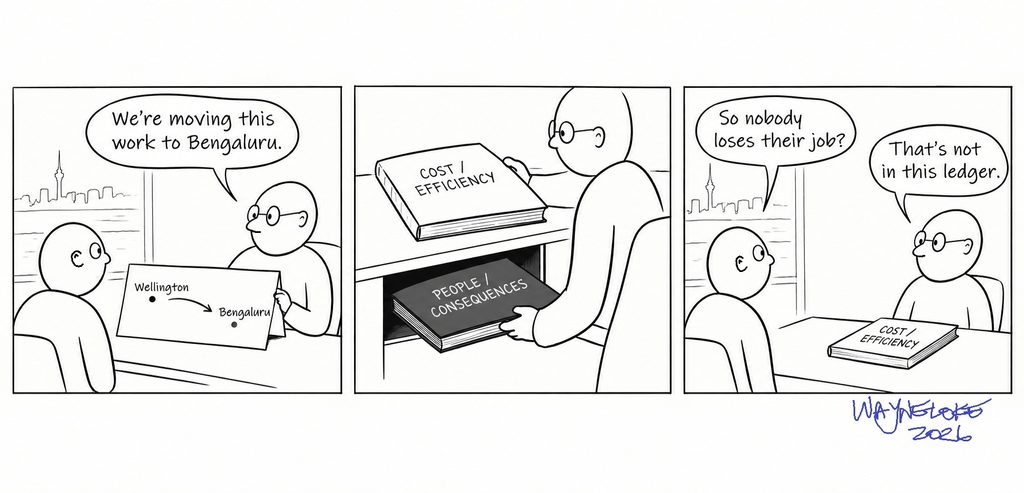
The second book is an estimate, though, and sometimes a poor one. In The Redistribution Reflex I wrote about people ANZ made redundant who came back as contractors, sometimes within months and usually at a higher rate, because the knowledge they carried couldn’t be replaced. The first book had been right all along. It just wasn’t the one being read that day.
My name in someone else’s book
If I kept two books as a manager, then someone kept two books with my name in them. Whether you land in the first or the second comes down to whether you’re dispensable or indispensable, and I guess even the indispensable eventually run out of justification. At Te Pūkenga that was literal. The government had already signalled it was disestablishing the whole organisation, and when the organisation itself comes off the government’s books, every person in it goes with it, however useful they are.
When Microsoft retired Whiteboard this year, the app was still useful to me and no longer worth it to Microsoft, and I wrote in The Whiteboard I Love is Being Retired that I’d lived a larger version of the same thing when my role ended in November 2024. I had a good plan, I was ready for retirement, and I still got shoved out unexpectedly. There was no bitterness, and there still isn’t. What I didn’t expect is how long it took to get used to the idea of being exited on someone else’s terms. I guess you have to live through it to know you come out intact.
The playing field
None of this needs a villain. Years ago I read two books that shaped my thinking more than I realised at the time. Kenichi Ohmae’s The Borderless World, published in 1990, argued that national borders were mattering less and less to how companies compete. Thomas Friedman’s The World Is Flat, in 2005, opens with Friedman on the Infosys campus outside Bangalore, as it was called then, where Nandan Nilekani told him “the playing field is being leveled.” In 2008 I was on the comfortable side of that playing field; we sent the work, kept our people and banked the saving. In 2026 my old colleagues in Wellington are on the other side of it. As long as work can move across borders there will always be a cheaper place to do it, and under the economic pressure most organisations are carrying now, it’s a race to the bottom that nobody in particular is running.
So what can anyone do about which book they’re in? In May I wrote The Four Unwritten Rules That Keep You Employed: be visible, be easy, be useful, be ready. I still think they’re right, and they will keep you in the first book for longer. They won’t close the second book, because the second book gets written about the work and its price, whoever happens to be doing it. You won’t know when your time runs out, and the only protection I know is a plan B in hand before you need it, so that when shit happens you’re still intact and moving on your own terms.
Which takes me back to the Enterprise. The officers in my story got to ask. A plan B is what lets you be the one who asks.
Always be prepared.