Category: Leadership

Teams, trust, accountability, people development.

  • What AI Exposes – Part 2 of 6

    AI inherits the operating system of the organisation.

    When I joined Stats New Zealand in October 2016, the technology staff were quick to set me straight. “Wayne, you don’t have to teach us Agile. We really know what Agile is.”

    They weren’t wrong, just years out of date about it. A senior leader had run a serious programme to introduce Scrum across the technology function sometime before March 2014, before the CDO I’d eventually report to had even started in the role. Staff were trained. They were immersed. They had the cadence, the ceremonies, the story points, the full picture. Everyone was involved, not just a small team running an experiment off to the side, but the whole technology function, committed. By any reasonable measure, the organisation had done Agile properly, at the time.

    I knew something about that period myself, from the other side of Wellington. I was at Inland Revenue from January 2013 to October 2015, and there was an active Agile community of practice running across the public and private sectors through those years, people moving between organisations, comparing notes, working out what Agile actually looked like inside companies or government work rather than in a textbook. Stats NZ’s programme would have been part of that same wave.

    And then the senior leader left.

    And Agile left with him.

    By the time I arrived, two and a half years later, the practice the staff were so proud to tell me they knew had already been gone for years. I asked, genuinely curious: how come you’re not doing Agile now? The room went quiet in the way rooms do when people know the answer but don’t want to give it. When it came, the answer was simple: leadership stopped it. The leaders above them had ended the practice, and so the practice ended.

    I found that puzzling, honestly. If the team believed in Agile, if they had the knowledge and the experience to run it well, why did they need a senior leader’s permission to continue, more than two years after that leader was gone? Why didn’t they fight for it? The answer to that question tells you more about an organisation than any strategy document ever will.

    Now contrast that with BNZ.

    BNZ Digital operated as its own self-contained unit, deliberately isolated from the traditional technology development cycles running on waterfall. They had their own product managers, their own designers, their own development team, their own mobile development team, their own leadership, their own funding allocation. They were inside BNZ but running a completely different operating rhythm, and their interaction with the broader technology function was structured around getting changes into production without the traditional organisation absorbing them back into its own slower pace.

    They weren’t waiting for the rest of the organisation to be ready. They built a perimeter and worked inside it.

    The result was visible enough that when the broader BNZ Technology function restructured, it adopted the BNZ Digital model. No mandate from above, no big transformation programme, no consultants brought in to explain why digital delivery mattered. The results made the case, and the wider organisation accepted the approach as the way forward.

    Two organisations. The same method. Completely different outcomes.

    The difference sat underneath the method, in something I’ve come to think of as the immunity system. Both organisations understood Agile, the people at Stats NZ knew it well enough to tell me I didn’t need to teach them, so knowledge was never what separated them.

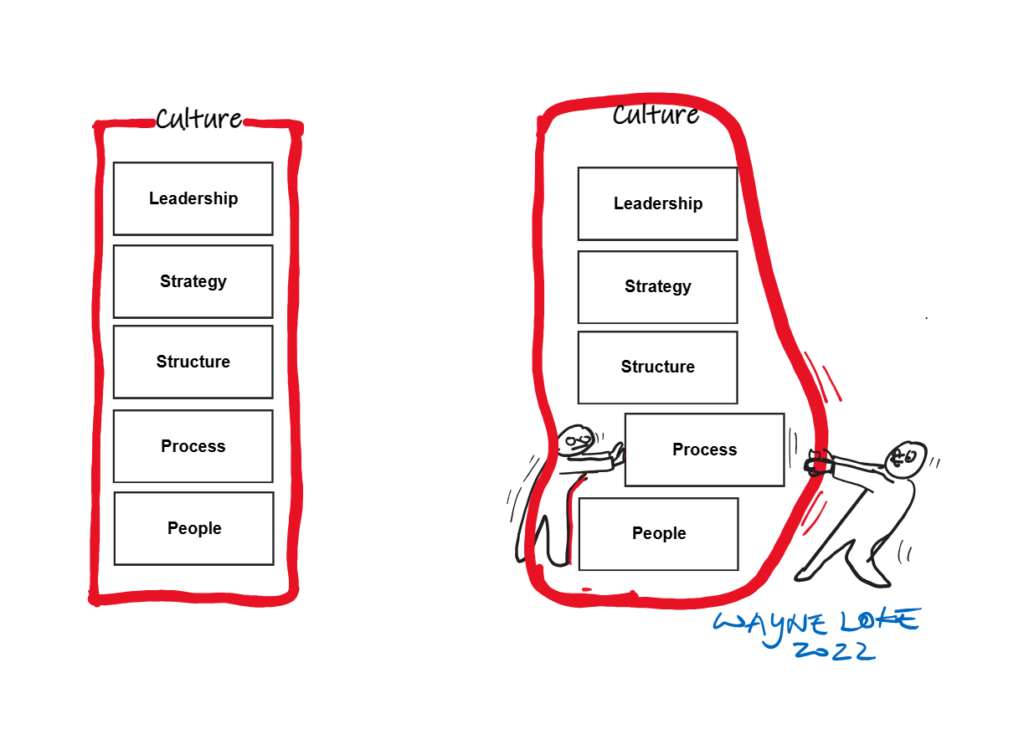
    Every organisation has one. It operates independently of the official structures, the stated values, the executive messaging, the strategy deck that gets presented at the all-hands. It’s the collection of behavioural patterns, power structures, unspoken rules, historical grievances, and self-interest calculations that determine what the organisation actually accepts and what it quietly rejects. The immunity system does not announce itself. It appears in small decisions. In which proposals get funded and which get delayed until they die of inaction. In who gets consulted and who doesn’t. In which meetings matter and which ones produce nothing except a follow-up meeting.

    At Stats New Zealand, I heard a phrase more than once: “If it’s not invented here, we don’t use it.”

    Stats is a deeply technical organisation. Smart people, rigorous people, people who deal in mathematics, statistics, census methodology, where precision matters and intellectual credibility is the currency. That culture produces excellent analytical work. It also produces a particular kind of resistance to external ideas, because if the idea didn’t originate inside the organisation, it carries a faint suspicion, a sense that it might not be suited to the specific complexity of the work, or that adopting it would imply the organisation hadn’t already solved the problem itself.

    The immunity system at Stats NZ was protecting something real: the organisation’s sense of its own expertise and identity. The logic is coherent from the inside. The cost is that good ideas, including Agile, get treated as foreign objects and rejected when the circumstances that introduced them change. When the senior leader left, the immunity system reasserted itself, and Agile, which had been tolerated because of that leader’s authority, went with him. The staff didn’t fight for it because the immunity system had never fully accepted it. They knew how to do Agile. They had just never decided it was theirs.

    BNZ Digital made a different calculation. When the restructure came, the wider technology function could see clearly enough that the BNZ Digital model was something the organisation needed for its own survival. The immunity system accepted rather than rejected, because the case for acceptance was strong enough, and because the threat was positioned as a competitor in the market rather than a threat to the people inside the building.

    This is the deeper mechanism, and I think it leads back to people’s own self-interest. If something new is introduced and it affects the livelihood and power structure of people in an organisation, there will be resistance. The polite word is resistance to change. The more accurate word, and I’ll say it plainly because I’ve watched it happen, is sabotage. It’s rarely dramatic. It’s the report that doesn’t get filed, the meeting that gets rescheduled until the momentum is gone, the budget approval that keeps getting pushed to the next quarter. It happens in organisations more often than leadership is willing to acknowledge, and it almost never shows up in the post-implementation review.

    Now consider what AI introduces into this same system.

    AI redistributes cognitive work. It compresses tasks that previously required specific expertise. It changes who can produce what and at what speed. An analyst who spent years building the ability to synthesise large volumes of information is looking at a tool that can do a version of that in minutes. A manager whose authority came partly from controlling access to information now operates in an environment where information is far less scarce. These are real shifts, and the immunity system in most organisations will register them as threats to livelihood and power, because that is exactly what they are.

    Only this time, the disruption shows up on an invoice as well.

    This is already playing out, and it’s more underreported than it should be. Uber reportedly exhausted its entire annual AI coding budget by April 2026, because adoption was higher than expected and nobody had modelled what happens when engineers start using agentic workflows at scale, where a single task can trigger multiple model calls, repeated context loads, verification loops, and retries. The budget assumption was built on a SaaS licensing model. AI behaves more like cloud infrastructure: usage-based, scaling with adoption, and expensive in ways that only become clear after the bill arrives.1

    A KPMG survey found that only a minority of organisations have a comprehensive understanding of their AI costs, with many discovering the numbers after the fact. KPMG’s own global head of AI has said some of their clients exhausted annual token and cloud budgets within months, one of them watching usage climb sixfold.2 CFOs are getting surprised. This is an organisational maturity problem more than a technology one, the same governance gap that Agile exposed a decade ago, now running at the speed of token billing.

    There is a term circulating in enterprise AI circles now: tokenmaxxing. Organisations, in some cases deliberately, encouraging employees to maximise AI usage. Some built token-consumption leaderboards, rewarding the most active users. Replit’s own AI head has called these leaderboards “very dystopian,” arguing publicly that more tokens do not equal more business value.3

    The Agile comparison is almost too clean. Messy Agile measured velocity instead of value, and teams ran sprints full of story points that delivered nothing useful. Tokenmaxxing measures consumption instead of outcome, and organisations run up bills generating AI-produced work that doesn’t change anything meaningful downstream. The metric changed. The dysfunction is the same.

    The games an organisation chooses to play internally with AI will be its own demise if the path is wrong. And the path is almost always determined not by the technology but by the invisible operating system underneath it.

    In organisations whose immunity system is oriented toward protecting existing power, AI generates a particular kind of dysfunction: the theatre of adoption without the substance. Tools purchased, training announced, dashboards built, constraints untouched. In organisations with a healthier operating system, AI costs get managed the way cloud infrastructure costs eventually got managed: per-team budgets, model routing, usage governance, ROI tracking per workflow. What is now being called AI FinOps. The discipline looks familiar because the problem is familiar. Every time a new technology scales faster than the operating model around it, the organisation has to build the governance infrastructure after the fact, and the bill for that delay is always larger than expected.

    The technology doesn’t determine which path an organisation takes. The invisible operating system does.

    Two organisations can buy the same tools, run the same training, appoint the same internal AI champion, and arrive at completely different results, because the immune response they brought to the implementation was different. One accepted. One rejected. And neither the acceptance nor the rejection showed up in the original business case.

    The question worth more time, before any AI rollout, is not the technology question. The technology question gets answered relatively quickly. The organisational question is harder: what does this institution’s immunity system protect, what will it accept as necessary for survival, and who controls the informal decisions that will actually determine whether this takes root or gets quietly extinguished?

    Most organisations don’t ask it. They buy the tools, announce the programme, train a cohort, and spend the next eighteen months wondering why adoption is low and the results are thin.

    I’ve seen this before. The technology was different. The immunity system was the same.


    1. Uber capped AI coding spend after exhausting its annual budget by April 2026: PYMNTS, CryptoBriefing. ↩︎
    2. KPMG AI Quarterly Pulse Survey on AI cost visibility (only around 26% of firms report a comprehensive view), plus KPMG’s global head of AI on clients exhausting budgets within months: Implicator.ai, KPMG. ↩︎
    3. “Tokenmaxxing” and Replit AI head Michele Catasta calling consumption leaderboards “very dystopian”: AOL, CIO, Pragmatic Engineer. ↩︎
  • The Coach Said Ageism is a Myth

    I’ve been on both sides of this. At Stats NZ, at ANZ, I sat in rooms where hiring decisions were made, and I listened to managers explain, without much discomfort, why certain candidates had filtered themselves out before the conversation even started. Too old. Too expensive. Too set in their ways. I filed those observations away as a feature of how organisations work, the kind of thing you absorb without examining closely when you’re on the side where it doesn’t cost you anything. I never thought I’d be the person they were describing.

    Then Te Pūkenga restructured, and I found out what the view looks like from the other direction.

    What made that redundancy different wasn’t the experience of losing a role. I’ve navigated that before, and so has anyone who’s spent a career moving through organisations. What made it different was the scale of what arrived at the same time. New Zealand’s unemployment rate was rising. SMEs were closing. Retail strips were emptying. Office blocks across Auckland and Wellington sat vacant. The government had already signalled it was disestablishing Te Pūkenga entirely. Geopolitical pressures were moving through GDP numbers, and GDP numbers were moving through hiring decisions, producing fewer roles at every level, not just at the top. A single professional or individual contributor role could attract 200 to 300 applications or more. These weren’t forces I could network or position my way around. When conditions compress that hard, across that many variables at once, you stop asking what you did wrong and you start asking what is actually happening.

    What is actually happening, it turns out, is not what the advice industry says.

    At one of the career transition forums that came with the redundancy package, I raised ageism directly. The coach running the session disagreed. Ageism is a myth, he said, because experience is value and the market rewards it. His prescription was presentation: revise the CV to be value-focused, strip graduation dates and anything older than 15 years, reframe long tenure as transferable skills, apply for roles one or two ranks below where you were, consider fractional or part-time arrangements to make yourself more affordable, offer reduced hours to lower the risk for potential employers. I’ve since seen the same prescription in outplacement guides, HR publications, YouTube channels aimed at “professionals in transition,” and LinkedIn posts about managing redundancy over 50. The advice is consistent across all its sources. It travels well because it sounds reasonable, and because it gives people something to do while they wait for the outcome to change.


    The outcome doesn’t change. The advice is solving the wrong problem.

    The moment you walk into an interview room, the CV has done its job and stopped mattering. The panel sees you, not your document. Your age is in the room whether your graduation date is on the page or not, and the panel’s response to it has already formed before you’ve opened your mouth. If the panel is younger, which it usually is, their assumptions about what you represent have been running since you came through the door. Older applicants move more slowly. Older applicants are set in their ways. Older applicants have seen too much, and “I’ve been there, I’ve done that, this won’t work” reads as obstruction in an organisation that needs to believe it’s trying something for the first time.

    The irony is plain once you see it. The pattern recognition that comes from 30 years of watching the same decisions play out, which is the thing you’re supposed to be selling as value, is exactly what reads as resistance to someone who hasn’t yet sat through the cycle. A younger hiring manager who hasn’t watched a rebranding exercise fail twice, or a restructure reduce headcount without changing anything structural, or a digital transformation stall in precisely the way the last one stalled, cannot easily distinguish between an older employee who is obstinate and one who is simply right. And here’s the part that makes this genuinely hard: they may never know the difference, because every generation of employees has to learn certain lessons by living them, regardless of what the previous generation already knows. The pattern recognition is real. The inability to transfer it is also real. So the panel defaults to the safer assumption. You get filtered out, and the exit is labelled overqualified.

    Overqualified is a polite word. In most of the cases I’ve experienced or observed, it doesn’t mean your experience exceeds what the role requires. It means the panel has run a calculation that won’t survive being said aloud. You might leave once something better surfaces. You might be harder to manage if the manager is 15 years younger. You might not adapt quickly enough to how the team prefers to work. None of those concerns appear in the feedback, because none of them would survive a formal grievance process. Overqualified covers them cleanly, and the conversation ends there.


    A better CV doesn’t reach any of this. Perception doesn’t change in a 45-minute interview, regardless of how well the transferable skills are packaged.

    Some advice goes further. Career coaches recommend working personal networks, reaching out to contacts who might know of opportunities, letting people in your industry know you’re available. I understand the theory. But what I’ve found is that professional relationships don’t carry the weight that word “network” implies. The people you work alongside are colleagues while you share the same floor. Once you leave, most of that contact fades, and fades faster than most people want to admit. And where a genuine relationship does exist, a peer-level contact inside another organisation has limited reach. The hiring decision sits with someone more senior. A peer’s recommendation rarely travels far enough up the chain to change what the panel has already decided, especially when that panel is already running the calculation I’ve just described.

    Applying a rank lower doesn’t escape it either. A junior role attracts more applicants, not fewer, both younger candidates and older ones in the same situation as yourself, and the same cost and perception logic runs again, except now you’re competing against people who represent lower salary expectations and carry none of the assumptions that follow seniority. The advice to lower your sights is framed as widening your options. In practice, it narrows the corridor and adds more people to it.

    What surprises me is not that the advice fails. What surprises me is how long the mechanism has been running without anyone naming it cleanly.

    At Stats NZ, I had hiring managers tell me, without lowering their voice, that certain candidates were too old and had effectively removed themselves from consideration. This wasn’t a crisis conversation. It was a routine observation, offered the way you’d note a missing qualification, and then the meeting moved on. At ANZ, I watched older employees, some past their own stated retirement age and still contributing meaningfully, get quietly sidelined before restructures arrived. The restructure wasn’t the cause. The sidelining came first, and the restructure was the instrument. In both cases, the organisation wasn’t responding to any particular economic event or technology disruption. It was running a function it runs continuously, as a matter of normal operations, well below the level of deliberate policy.

    Ageism is the current word for that function. The word is useful in the sense that it gives people a shared language for an experience that is real and measurable. Research confirms what many people already knew from inside it: people over 50 face lower callback rates and higher rates of underemployment than their credentials alone would predict, and the gap is consistent across OECD countries. But the word also carries an implication I find misleading, that this is a problem generated by contemporary conditions, one that could be addressed through better hiring practices, stronger legal enforcement, or, as the coaches would have it, a more strategically constructed CV.

    The function predates the word. Organisations were running it in the 1990s, in 2005, in 2015. What changes across those periods is the economic context that makes it more visible to more people at once, and the vocabulary available to describe it. The function itself is stable. It’s closer to an immune response than a crisis, the organisation’s natural mechanism for cycling through generations of people, managing cost and perception thresholds in ways that rarely get said plainly. Like most immune responses, it operates below the level of deliberate decision-making. Nobody sits in a room and decides to discriminate. They make a series of smaller judgements about fit, energy, risk, and cost, and the accumulated weight of those judgements produces a consistent result. The result has a name now. It had the same shape before it had the name.

    The coach who told me ageism is a myth wasn’t lying. He was describing the system he believed he was operating in, one where experience carries value, the market is rational, and presentation determines outcome. That version of the system does exist in certain organisations, for certain roles, under certain conditions. I’ve seen it. But it is the exception, not the default. The default is what I watched at Stats NZ and ANZ before I had any personal stake in understanding it, and what became undeniable during the Te Pūkenga redundancy when every economic force in the country arrived at the same moment and left very little room for alternative explanations.

    I’m not writing this to argue that older employees should stop applying, or that the coaching advice fails in every situation. I’m writing it because there’s a real cost to explaining a structural function as an individual presentation problem. When the mechanism operates at the level of the organisation and the advice operates at the level of the CV, the only explanation available when the advice doesn’t work is that the individual didn’t execute well enough. Try harder. Polish the story again. That conclusion suits the system perfectly.

    I’ve been on both sides of the table. I know which side has more information.

  • The Cover Story

    ABN AMRO ran a three-day programme for every officer at manager rank and above. The subject was this: what makes a bank a bank.

    I attended it in the early 2000s. The facilitator opened with a question, and answers came back the way they always do in a room full of experienced people who haven’t been asked this before. Deposits. Savings accounts. Housing loans. Payment transactions. The facilitator let the room finish, then said: No. The business of banking is brokering. You take money as intermediary, you lend long, you borrow short, and you extract the margin between. Every ratio the organisation tracks, every headcount cost you manage, every basis point on a loan portfolio, it traces back to that one mechanism. Understanding it changed how I read every decision I was part of after that, because I finally knew what the decision was in service of.

    I remember thinking: I’ve been in financial services for years, and nobody has ever explained this to me.

    This was not a welcome-to-the-company session. The room was full of ranking officers, some with years of service already behind them. ABN AMRO ran it because knowing your own function and understanding the business you’re working inside are two different things, and they had decided the second one required deliberate instruction, regardless of your tenure.

    That is what succession planning looks like. The real version, where an organisation takes responsibility for making sure its people understand what they’re contributing to, how the organisation survives as a going concern, and why developing someone through the ranks is an obligation rather than an optional bet. I attended that programme once, at a Dutch bank in the early 2000s, and I have not seen anything approaching it in any organisation since.

    Every organisation I worked in after ABN AMRO shared a condition so common it stopped being remarkable. Most people had no idea what made the organisation viable. They knew the process they ran, the team they sat in, the system they operated. They did not know how the organisation generated its revenue or delivered on its purpose, what the unit economics looked like, or why any of it depended on them staying and growing rather than leaving when a better offer arrived. Nobody had explained it to them, because nobody had been tasked with doing so.

    At ANZ National the closest attempt existed. There were frameworks, names in boxes, readiness ratings reviewed on a quarterly cycle. The structure was on paper. The problem is that a real succession pipeline requires sustained capital and sustained effort, and when the cost and effort came into focus, it didn’t fly. What happened every time a senior role opened was the same: the market. External hire, premium cost, cycle repeats.

    At Stats NZ, BNZ, and Inland Revenue, the situation was simpler: there was no attempt at all. When roles opened, the organisation looked outside, paid more than an internal candidate would have cost, and called it efficient resource management. I watched that pattern hold consistently across every organisation I worked in, and the common element in each case was that nobody had ever explained to their people what business they were actually in.

    The argument against investing in people has a surface logic. You develop someone, they build capability, and then they leave. The benefit flows to whoever hires them next. So the conclusion most organisations land on is to hire capability rather than develop it: bring someone in who already knows the job, carry the salary premium, avoid the development risk.

    Follow that logic downstream and the flaw becomes visible. Workers trained somewhere, at some point, by someone. That somewhere has to exist. If every organisation applies the same reasoning and nobody trains, the pool of experienced talent available to hire from starts thinning, salaries at the experienced end inflate because demand accumulates without supply to match it, and the organisations that chose never to invest in developing people find themselves competing to pay for people that some earlier employer, somewhere, did invest in.

    There is a fear underneath this that I’ve heard stated plainly enough over the years: if I train my people, I’m training them for my competitors. That fear isn’t irrational in isolation. Acting on it at scale creates the exact problem it was trying to avoid, a labour market full of people with skills but no organisational depth, moving from role to role because no organisation has ever given them a structural reason to stay.

    The mechanism that resolves this tension does exist. Service bonds tied to development investment: the organisation funds a significant programme, the employee commits to a minimum tenure in return. Blunt instrument, but it aligns the incentives honestly. Chartered accountancy uses a version of this through its apprenticeship model, supervised work with a qualified firm before you can qualify fully. That pipeline is still functioning well enough in New Zealand that the programme is oversubscribed, hundreds of applicants competing for limited positions. The model works. It’s just not replicated at any scale elsewhere.

    The default everywhere else is that development happens incidentally, through work, without structure. The organisation assumes the education system has done the foundational work. Graduates arrive, enter a role, and build from there. What the education system cannot do is teach someone the specific business of the specific organisation they’ve joined. That knowledge is internal. It requires someone to take the time to explain it, the way that facilitator at ABN AMRO took three days to explain what makes a bank a bank. Without that, you get people who are technically employable and organisationally adrift, contributing to a process without understanding what the process is part of, with no anchor deep enough to keep them there long enough to be developed into something the organisation actually needs.

    Youth unemployment in New Zealand sits at 15.9% as of March 2026, per Stats NZ. Three times the national rate. The explanation most prominent in media and political commentary is AI. The story is that AI is absorbing entry-level roles, particularly in office environments where decisions are process-driven and binary, and the jobs that used to give young people a first foothold are disappearing.

    There’s something in it. Roles built on processing work where the majority of decisions follow a predictable path and exceptions are all that require human judgment, those roles are genuinely exposed. Some of those positions were entry-level, and they’re thinning. That’s real.

    But AI is a convenient story. It’s external, it’s technical, and it removes the organisation from the chain of causation. The economy plays the same role. When a commenter in my LinkedIn post that prompted this piece wrote that she hadn’t seen evidence of AI replacing entry-level jobs in practice, she was pointing at something real. I asked her whether she’d ever been on a succession plan in her organisation, or whether her company simply hired someone to replace her when she left. Her answer: she had not been on any succession plan, nor seen one in any organisation she’d worked for.

    She runs her own contracting company now, which changes the equation for her. She keeps her skills current because she has to. But she had years of employment inside organisations before that, and the pattern she described is the one I’ve heard consistently across several sectors: no pipeline, no structured development, no explanation of what the organisation was actually trying to do. Just a job, adjacent to other jobs, in a structure nobody took the time to explain.

    AI and the economy are cover stories. They describe conditions that are real enough. They do not account for the pipeline that organisations chose, over decades, not to build.

    The mechanism isn’t complicated. An organisation that never explains to its people what it’s actually in the business of doing will not retain those people through difficult periods, will not develop them into the roles it needs filled at the next level, and will not be able to backfill from inside when the time comes. It will go to the market, pay the premium, and describe what follows as a talent shortage.

    There is a talent shortage. It was constructed, incrementally, by organisations that treated succession planning as a compliance exercise and development as a cost to be deferred. The young people at 15.9% unemployment are the visible end of a problem that runs through every level of the workforce. The entry-level jobs are where the pipeline starts. If they’re shrinking, some of that is economic conditions, some of it is genuine automation, and a significant portion of it is that organisations have no structural incentive to create them when they’ve never built a development pipeline to justify the investment in the first place.

    You can’t extract from the talent market indefinitely without anyone replenishing it, then reach for an external explanation when the extraction catches up with you.

    I sat in that room at ABN AMRO for three days and came out knowing what I was part of. Every organisation I joined after that, I was still asking the same question.

    Nobody offered the three days.

  • What Nobody Talks After A Restructuring

    On 19 May, Finance Minister Nicola Willis announced the NZ public service will cut roughly 8,700 roles by 2029, taking headcount from around 64,000 down to 55,000. $2.4 billion in savings. Agencies merging. AI and digital tools named as part of how the remaining workforce will cope.

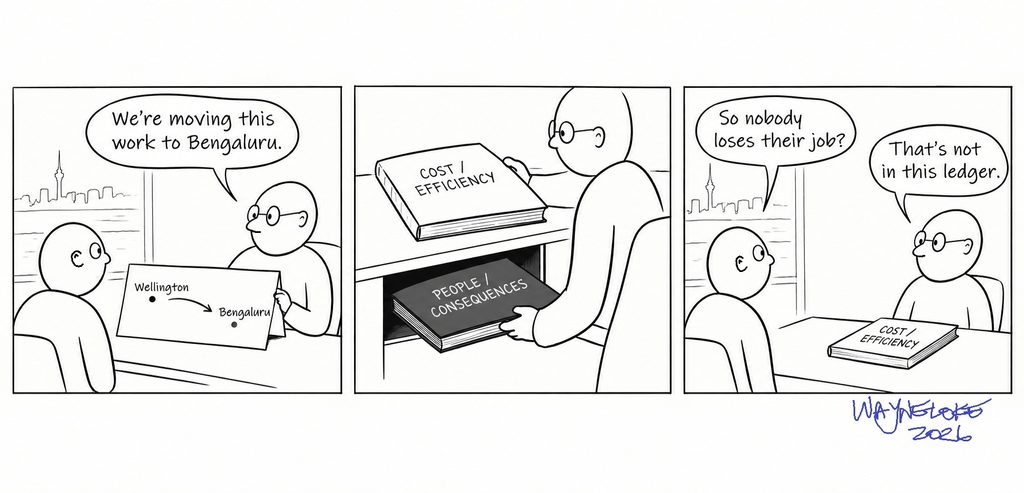
    The coverage since has been predictable. The PSA calling it reckless. Worried workers. The human cost, which is real and I won’t dismiss it.

    But this article is for the people who don’t lose their jobs.

    Post-restructuring is its own kind of hard. And almost nobody talks about it.

    I’ve been through enough restructures to know how this goes. The affected people get the attention, rightfully. HR runs the process. The communications go out. And then, fairly quickly, everyone turns back to the work, except now there are fewer people doing it, and the assumption, unstated but real, is that things will carry on more or less as before, just with more pressure per person.

    That assumption is wrong. And acting on it is how you burn out your best remaining people.

    The first thing I’d do is stop. Not literally, but mentally. Before you redistribute tasks, before you absorb someone’s workload, before you do anything, sit down and ask: what does this team actually need to deliver now?

    Not what it was delivering before. Now.

    Here’s what I’ve seen in every restructure I’ve been through: organisations shrink the headcount but keep the workload intact. They split it across fewer people. That’s not doing more with less. That’s just doing the same with less, and it collapses within a year.

    The restructure is, whether you asked for it or not, a forcing function to review everything. Use it.

    When I was at the bank, we had a report. Weekly or monthly, I can’t recall exactly. Generated by the technology team for a specific person in the CFO’s office. A proper report, formatted, tracked, sent on schedule. The kind of thing that takes someone a few hours to pull together each cycle.

    We interviewed that person. Asked what they used it for.

    They’d never actually looked at it. A safety net, they said. Just in case something came up. When we went back through the history, that something had never come up. Not once.

    That report was what I call shelfware. It looked like work, consumed resources, produced nothing. And in every organisation I’ve worked in, across 30 years, I’ve found versions of it. Reports, approval chains, coordination meetings, processes left running because stopping them would require someone to make a decision.

    The question after a restructure is whether you have the courage to find yours.

    The lens I use for this is simple. Which 20% of what your team does actually drives 80% of the outcomes? Find that 20% and protect it. Everything else is a candidate for consolidation, elimination, or redesign.

    I won’t pretend this is easy. People are attached to their work. Some of what looks like shelfware is someone’s entire job identity. Having the honest conversation, directly, without dressing it up as anything other than a resource reality, is probably the hardest part of surviving leadership.

    But the alternative is distributing the same furniture across a smaller room and wondering why everyone feels crowded.

    There’s another thing worth paying attention to: the people who stayed.

    The research has a name for it, survivor syndrome, and it shows up as guilt, anxiety, low-grade dread that another round is coming. What the data also shows is a short-term productivity bump after layoffs, followed by a significant fade as engagement drops. People feel the loss of colleagues. They feel the weight of expanded roles. They feel uncertain.

    The instinct from leadership is to focus forward. Get moving. Don’t dwell. I understand that instinct, and I’ve felt it myself.

    But skipping over it doesn’t make it go away. It surfaces later, as quiet disengagement, or as your best remaining person leaving on their own terms at the worst possible time.

    A direct conversation is better than a perky all-hands. Acknowledge what happened. Say what the plan is. Ask what people need, specifically, and then actually follow through.

    Here’s what this looked like in practice for me. After a restructure at an education business, the service desk team was down to a handful of people. The old workload, staging and imaging laptops, managing logistics across 45 locations with 80 campuses nationwide, calling couriers, handling returns, would have crushed them if we’d pushed it forward unchanged.

    So we redesigned the supply chain. Partnered with the hardware supplier to do the imaging at source. Laptops arrived at users already configured. The courier handled distribution. Returns went directly back to the supplier’s offices, of which there were locations nationwide anyway.

    The cost per device for the entire arrangement, imaging, logistics, the whole thing, came out around $50. Less than 5% of the laptop price.

    The team didn’t shrink further. But what they spent their days doing got materially better. They went from robotic, time-consuming logistics to overseeing a mostly automated process and handling the exceptions that actually needed a human brain.

    That’s the real opportunity inside a restructure, if you’re willing to use it. The pressure to reduce forces a review you probably should have done years earlier. Most organisations accumulate work the way houses accumulate furniture, gradually, without realising how much space it takes up.

    The question is whether you use the review to redistribute the same furniture, or to actually clear the room.

    I’ve done both. One of them works.