
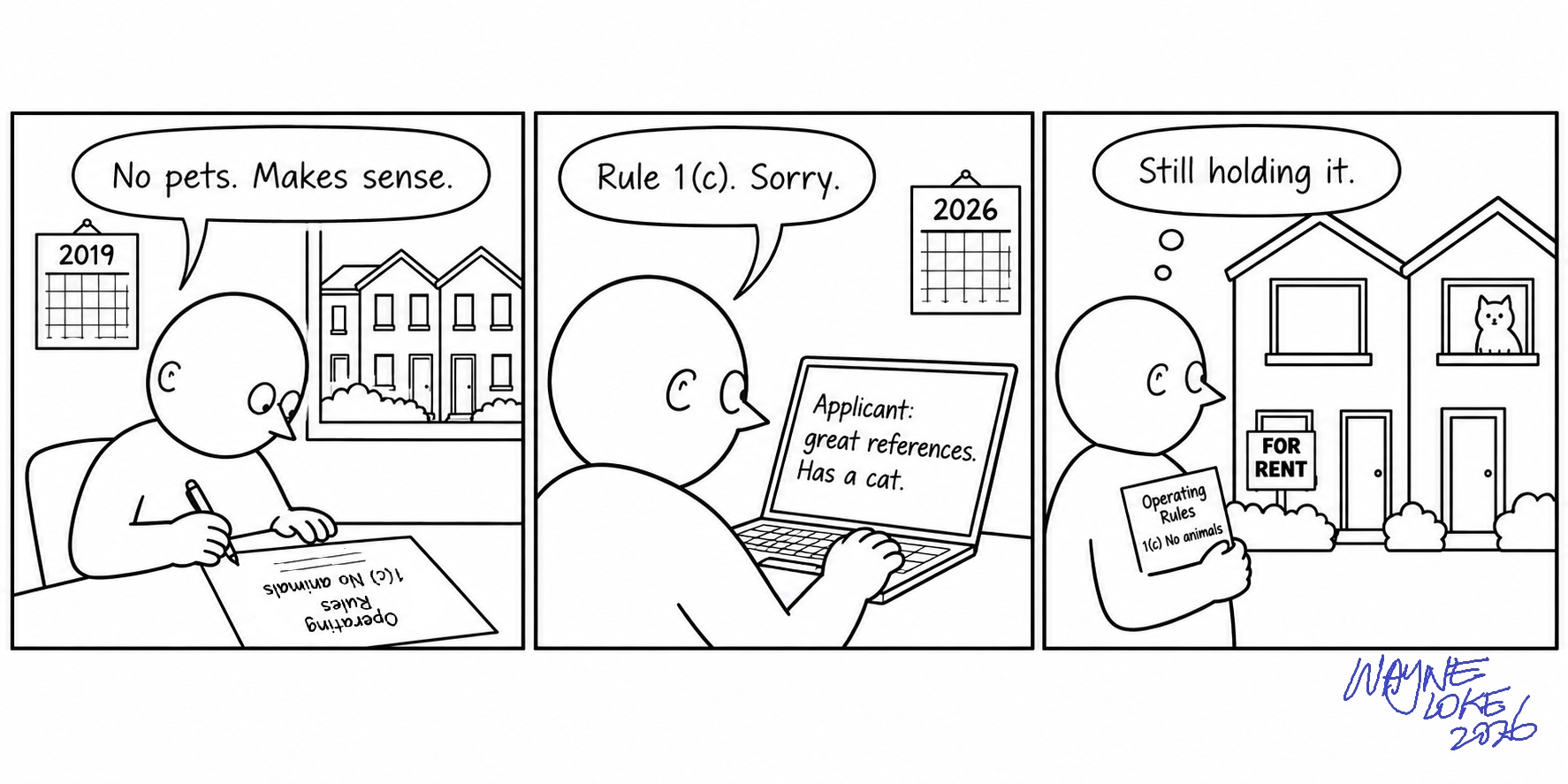
My signature is on the rule that cost me a tenant. I lived in our 25-unit townhouse complex in Wellington from 2015 to 2021, and in October 2019, as a committee member, I witnessed the notice the body corporate lodged with Land Information New Zealand changing its operating rules. One line in it, rule 1(c), says an owner or occupier shall not keep any animal in the unit or on the common property. I agreed with it. Most owners rented their units out, pets mean wear and damage inside the units, and as someone living there I liked the quiet. It didn’t occur to me that the rule would one day land on me from the other side. In 2022 I moved to Hamilton and my unit became a rental, and this August a qualified applicant had a cat. I declined, because I’m the chairperson, and I can’t ask 24 other owners to keep the rules while bending one for myself. Every week it sat empty cost me a week’s rent. Around the same time, letting advertisements for other units in the complex were telling tenants pets were fine.
I’ve done the chair’s work since December 2025: under the chair’s delegation at first, as chair from an EGM in June, and re-elected when the AGM reconvened in October. There are four of us, all volunteers, with a quorum of three, and a professional manager on contract runs the day to day. In a committee that size, the person who does the work ends up holding the decision as well. A listed company has independent directors, an audit committee and a company secretary between the person who prepares a paper and the people who decide on it. We have four volunteers and an email thread. The only thing separating the work from the decision is the discipline of whoever is doing the work, and this year I’ve watched that discipline hold, and I’ve watched mine slip.
The work
The insurance was the first big job. Our sum insured had climbed from about $20.8 million in 2021 to $30.68 million, and the premium for 2025-26 was $143,074. Everyone on the committee knew it was too high, and nobody could explain it. Our treasurer had spent three years asking for an explanation of the $30 million and been brushed off, partly because the renewal papers kept arriving in the last few days before the policy ran out, too late to argue with.
So in February I went through the past valuations line by line. The $30 million was three numbers stacked: a reinstatement cost of about $25 million, an inflation provision of $4 million on top of that, and demolition. Divide the reinstatement cost by our 2,946 square metres and it comes to about $8,500 a square metre, which is what you’d pay for high-end commercial building, for three- and four-storey timber townhouses built in 1996. I wrote a position paper, proposed a reinstatement range of $13 million to $16 million, and drafted an instruction asking the valuer to show the cost per square metre they’d adopted and to state fees, contingency, demolition and inflation as separate lines.
The valuer who had done the earlier reports declined. Their reason, passed on through our manager, was that a request to discuss and review their report would compromise their independence. Two more firms declined to quote, and one never replied. The only one who said yes was a registered valuer who adopted $5,000 a square metre for the base build, taking Wellington costings for townhouses of $5,200 to $6,300 and allowing for the internal garages. His reinstatement estimate came to $16.37 million, about $5,550 a square metre once fees and contingency are in, and the total to insure fell from $30.68 million to $18.02 million. The broker’s renewal premium for 2026-27 was $66,113, down 54%.
Note 6 of that renewal report says our previous manager had a service contract with the broker and would receive a share of the broker’s commission or fee on any policy we placed through them. It was disclosed, in writing, in the report itself. I’ll leave the business practice for others to judge. The incentive is plain enough: the people we relied on to explain the premium were paid more when we bought, and nobody in that chain had a reason to work the number down for us.
I sent the position paper to the committee on the evening of 3 February. Within two days everyone had endorsed it and the instruction had gone to the manager, and one member thanked me for setting it out because he was green on insurance. That’s how a committee should work, and it’s also where the risk sits. By the time the committee approved the instruction, I’d made the decision in every practical sense, because I was the only one who had read the old valuations closely enough to hold a view. The independent valuer was the only check on my paper that didn’t depend on me. When the expertise isn’t on the committee, we pay for it and verify what we’re told, or we get taken for a ride.
The decision I shouldn’t have held
The second piece of work landed on my own unit. Gutters and water getting into some of the units, mine among them, came to the committee in July. I declared a conflict of interest at the 24 July meeting, it went on the interests register, and our treasurer took over the workstream: she instructs the manager, and I take no part in discussion or decisions on investigation, repair, funding, insurance or contractors. At the AGM I stepped aside for the guttering item and she led it. That part worked.
Twice since then it hasn’t. On 21 September I replied to one of her emails with my view on whether the gutters should be funded from the long-term maintenance fund, and funding sits squarely inside my declaration. Then on 27 October the committee met to approve the contractor for the exterior painting, and the approval included relaying the roof and balcony membranes. Membranes are what keep the water out. That’s my conflict, and I voted.
Three of us were in that meeting. The treasurer, who leads the water work, logged in after it had closed. A quorum is three, so if I had stepped out there would have been no quorum. The structure pushed me to stay: in a committee of four, the conflicted member is often the one who makes the meeting legal, and stepping out would have held the decision up for a fortnight. On 11 November I’ll declare it, and the other three will confirm or revisit the membrane part without me.
The same thing, higher up
On 30 October Stuff reported, and B2B News followed up, that the chief executive of Venues Ōtautahi, the council-owned company that runs six Christchurch venues including One New Zealand Stadium, declared a potential conflict in August 2024: the husband of a personal friend was bidding for the beverage contract. The arrangement she and the board agreed kept her on the scoring panel, scoring but not moderating, and she ranked his company first of the four beer finalists. It won after a tie-break. The board chair called the conflict minor and rejected any suggestion she’d influenced the result unfairly. Her own account was that good governance means you declare it, document it and manage it.
In February the Public Service Commission released its investigation into the Teaching Council. It found a significant conflict involving the chief executive that wasn’t properly identified, documented or managed, procurement that skipped the Council’s own rules, and a poor tone from the top. Sir Brian Roche, the Public Service Commissioner, said the shortcomings created avoidable organisational and reputational risks.
On 23 October Kerry Gregory resigned as chief executive of Fire and Emergency New Zealand, after the Minister of Internal Affairs said she no longer had confidence in him. Her stated reason was that he had known about a serious matter for more than a year and hadn’t told her, even after external advice that the organisation should. The matter has gone to the Serious Fraud Office.
The oldest case is from a bank I used to work for. I left ANZ in January 2013, and I read about this one in the papers like everyone else. In June 2019 David Hisco stepped down as ANZ’s New Zealand chief executive after an internal review of his personal expenses: chauffeured cars and wine storage in Australia, recorded as business costs over his 9 years in the role. The chair, Sir John Key, said the problem was how they’d been recorded. Hisco reportedly believed he was entitled to them, and whatever approval existed had been given orally, so nobody could check it. He forfeited $6.4 million in shares.
Four organisations of very different sizes. In each one, the person with the most authority was also the person closest to the work or to the information, and the check depended on that person choosing to step back, speak up or write it down. The higher you sit, the fewer people can check you, and the more the check rests on you.
The rule nobody can police
Which brings me back to the cat. Our operating rules go back to the 2011 AGM, before I bought in 2015, and the version I witnessed was passed at the AGM on 22 August 2019. Nobody thought much about 1(c) at the time. It sits under the good neighbour provisions, the thinking was a barking dog or a cat on the common property, and an aquarium or a budgie wouldn’t have troubled anyone. It assumed every owner would keep the rules for everyone’s benefit, which is how most of the other rules are written too. The committee has made one exception that I know of: a cat for an owner whose GP supported the request on medical grounds.
Two things have changed since. From 1 December 2025, tenants need their landlord’s consent for a pet and landlords can refuse only on reasonable grounds, and Tenancy Services lists body corporate rules as one of them. The first Tenancy Tribunal ruling under the new rules, over a Labrador puppy in Christchurch, said a written body corporate ban is still a legitimate reason to refuse, while a landlord’s own worries about barking have to be met with conditions such as a pet bond. So the rule still does its job for any owner who follows it. The other change is that some owners don’t. When agents ask through the manager whether pets are allowed, I send the operating rules with the pre-contract disclosure and the answer is no, and I’ve done that many times. Meanwhile the advertisements keep offering pets, and I don’t live in Wellington any more, so I can’t walk past 25 front doors to see who’s breaking it. Rule 19 lets the committee fix a breach at the owner’s cost after written notice and a reasonable time to fix it. That works for a dumped mattress. I can’t see how it works for a cat living with someone else’s tenant.
So I’m keeping a rule that costs me rent when I keep it and costs the owners who ignore it nothing. I raised it at the AGM in October, said first that I have an interest because I own a tenanted unit, and it now goes to the committee. Changing it takes an ordinary resolution at a general meeting and a notice lodged with LINZ, and legal advice before that, because the law on blanket bans isn’t settled. A 2025 District Court decision upheld one, and lawyers writing in Law News argue it was decided without considering section 106 of the Unit Titles Act, which limits the rules a body corporate can make. Whether we remove it or refine it is for the owners to decide. Until they do, I keep the one we have.
On 11 November, when the membranes come up, I’ll leave the call.