Author: Wayne Loke

  • What AI Exposes – Part 2 of 6

    AI inherits the operating system of the organisation.

    When I joined Stats New Zealand in October 2016, the technology staff were quick to set me straight. “Wayne, you don’t have to teach us Agile. We really know what Agile is.”

    They weren’t wrong, just years out of date about it. A senior leader had run a serious programme to introduce Scrum across the technology function sometime before March 2014, before the CDO I’d eventually report to had even started in the role. Staff were trained. They were immersed. They had the cadence, the ceremonies, the story points, the full picture. Everyone was involved, not just a small team running an experiment off to the side, but the whole technology function, committed. By any reasonable measure, the organisation had done Agile properly, at the time.

    I knew something about that period myself, from the other side of Wellington. I was at Inland Revenue from January 2013 to October 2015, and there was an active Agile community of practice running across the public and private sectors through those years, people moving between organisations, comparing notes, working out what Agile actually looked like inside companies or government work rather than in a textbook. Stats NZ’s programme would have been part of that same wave.

    And then the senior leader left.

    And Agile left with him.

    By the time I arrived, two and a half years later, the practice the staff were so proud to tell me they knew had already been gone for years. I asked, genuinely curious: how come you’re not doing Agile now? The room went quiet in the way rooms do when people know the answer but don’t want to give it. When it came, the answer was simple: leadership stopped it. The leaders above them had ended the practice, and so the practice ended.

    I found that puzzling, frankly. If the team believed in Agile, if they had the knowledge and the experience to run it well, why did they need a senior leader’s permission to continue, more than two years after that leader was gone? Why didn’t they fight for it? The answer to that question tells you more about an organisation than any strategy document ever will.

    Now contrast that with BNZ.

    BNZ Digital operated as its own self-contained unit, deliberately isolated from the traditional technology development cycles running on waterfall. They had their own product managers, their own designers, their own development team, their own mobile development team, their own leadership, their own funding allocation. They were inside BNZ but running a completely different operating rhythm, and their interaction with the broader technology function was structured around getting changes into production without the traditional organisation absorbing them back into its own slower pace.

    They weren’t waiting for the rest of the organisation to be ready. They built a perimeter and worked inside it.

    The result was visible enough that when the broader BNZ Technology function restructured, it adopted the BNZ Digital model. No mandate from above, no big transformation programme, no consultants brought in to explain why digital delivery mattered. The results made the case, and the wider organisation accepted the approach as the way forward.

    Two organisations. The same method. Completely different outcomes.

    The difference sat underneath the method, in something I’ve come to think of as the immunity system. Both organisations understood Agile, the people at Stats NZ knew it well enough to tell me I didn’t need to teach them, so knowledge was never what separated them.

    Every organisation has one. It operates independently of the official structures, the stated values, the executive messaging, the strategy deck that gets presented at the all-hands. It’s the collection of behavioural patterns, power structures, unspoken rules, historical grievances, and self-interest calculations that determine what the organisation actually accepts and what it quietly rejects. The immunity system does not announce itself. It appears in small decisions. In which proposals get funded and which get delayed until they die of inaction. In who gets consulted and who doesn’t. In which meetings matter and which ones produce nothing except a follow-up meeting.

    At Stats New Zealand, I heard a phrase more than once: “If it’s not invented here, we don’t use it.”

    Stats is a deeply technical organisation. Smart people, rigorous people, people who deal in mathematics, statistics, census methodology, where precision matters and intellectual credibility is the currency. That culture produces excellent analytical work. It also produces a particular kind of resistance to external ideas, because if the idea didn’t originate inside the organisation, it carries a faint suspicion, a sense that it might not be suited to the specific complexity of the work, or that adopting it would imply the organisation hadn’t already solved the problem itself.

    The immunity system at Stats NZ was protecting something real: the organisation’s sense of its own expertise and identity. The logic is coherent from the inside. The cost is that good ideas, including Agile, get treated as foreign objects and rejected when the circumstances that introduced them change. When the senior leader left, the immunity system reasserted itself, and Agile, which had been tolerated because of that leader’s authority, went with him. The staff didn’t fight for it because the immunity system had never fully accepted it. They knew how to do Agile. They had just never decided it was theirs.

    BNZ Digital made a different calculation. When the restructure came, the wider technology function could see clearly enough that the BNZ Digital model was something the organisation needed for its own survival. The immunity system accepted rather than rejected, because the case for acceptance was strong enough, and because the threat was positioned as a competitor in the market rather than a threat to the people inside the building.

    This is the deeper mechanism, and I think it leads back to people’s own self-interest. If something new is introduced and it affects the livelihood and power structure of people in an organisation, there will be resistance. The polite word is resistance to change. The more accurate word, and I’ll say it plainly because I’ve watched it happen, is sabotage. It’s rarely dramatic. It’s the report that doesn’t get filed, the meeting that gets rescheduled until the momentum is gone, the budget approval that keeps getting pushed to the next quarter. It happens in organisations more often than leadership is willing to acknowledge, and it almost never shows up in the post-implementation review.

    Now consider what AI introduces into this same system.

    AI redistributes cognitive work. It compresses tasks that previously required specific expertise. It changes who can produce what and at what speed. An analyst who spent years building the ability to synthesise large volumes of information is looking at a tool that can do a version of that in minutes. A manager whose authority came partly from controlling access to information now operates in an environment where information is far less scarce. These are real shifts, and the immunity system in most organisations will register them as threats to livelihood and power, because that is exactly what they are.

    Only this time, the disruption shows up on an invoice as well.

    This is already playing out, and it’s more underreported than it should be. Uber reportedly exhausted its entire annual AI coding budget by April 2026, because adoption was higher than expected and nobody had modelled what happens when engineers start using agentic workflows at scale, where a single task can trigger multiple model calls, repeated context loads, verification loops, and retries. The budget assumption was built on a SaaS licensing model. AI behaves more like cloud infrastructure: usage-based, scaling with adoption, and expensive in ways that only become clear after the bill arrives.1

    A KPMG survey found that only a minority of organisations have a comprehensive understanding of their AI costs, with many discovering the numbers after the fact. KPMG’s own global head of AI has said some of their clients exhausted annual token and cloud budgets within months, one of them watching usage climb sixfold.2 CFOs are getting surprised. This is an organisational maturity problem more than a technology one, the same governance gap that Agile exposed a decade ago, now running at the speed of token billing.

    There is a term circulating in enterprise AI circles now: tokenmaxxing. Organisations, in some cases deliberately, encouraging employees to maximise AI usage. Some built token-consumption leaderboards, rewarding the most active users. Replit’s own AI head has called these leaderboards “very dystopian,” arguing publicly that more tokens do not equal more business value.3

    The Agile comparison is almost too clean. Messy Agile measured velocity instead of value, and teams ran sprints full of story points that delivered nothing useful. Tokenmaxxing measures consumption instead of outcome, and organisations run up bills generating AI-produced work that doesn’t change anything meaningful downstream. The metric changed. The dysfunction is the same.

    The games an organisation chooses to play internally with AI will be its own demise if the path is wrong. And the path is almost always determined not by the technology but by the invisible operating system underneath it.

    In organisations whose immunity system is oriented toward protecting existing power, AI generates a particular kind of dysfunction: the theatre of adoption without the substance. Tools purchased, training announced, dashboards built, constraints untouched. In organisations with a healthier operating system, AI costs get managed the way cloud infrastructure costs eventually got managed: per-team budgets, model routing, usage governance, ROI tracking per workflow. What is now being called AI FinOps. The discipline looks familiar because the problem is familiar. Every time a new technology scales faster than the operating model around it, the organisation has to build the governance infrastructure after the fact, and the bill for that delay is always larger than expected.

    Two organisations can buy the same tools, run the same training, appoint the same internal AI champion, and arrive at completely different results, because the immune response they brought to the implementation was different. One accepted. One rejected. And neither the acceptance nor the rejection showed up in the original business case.

    The organisational question is worth more time than the technology question before any AI rollout: what does this institution’s immunity system protect, what will it accept as necessary for survival, and who controls the informal decisions that will actually determine whether this takes root or gets quietly extinguished?

    Most organisations don’t ask it. They buy the tools, announce the programme, train a cohort, and spend the next eighteen months wondering why adoption is low and the results are thin.

    I’ve seen this before. The technology was different. The immunity system was the same.


    1. Uber capped AI coding spend after exhausting its annual budget by April 2026: PYMNTS, CryptoBriefing. ↩︎
    2. KPMG AI Quarterly Pulse Survey on AI cost visibility (only around 26% of firms report a comprehensive view), plus KPMG’s global head of AI on clients exhausting budgets within months: Implicator.ai, KPMG. ↩︎
    3. “Tokenmaxxing” and Replit AI head Michele Catasta calling consumption leaderboards “very dystopian”: AOL, CIO, Pragmatic Engineer. ↩︎
  • When the World is Changing: How to Make Sense of It

    I watched the internet arrive. It landed on my desk as a working problem long before it was a headline, and it rearranged how the work got done while we were still looking the other way. One year we were faxing change requests and walking floppy disks between buildings, and the next we were arguing about whether email counted as a real record, whether you could trust a document that nobody had signed. Nobody stood up and announced it. It seeped in, and by the time we noticed, the old way of working had already left the building.

    Twenty something years later I am watching the same thing happen again, except the word on everyone’s lips is AI instead of internet, and the people panicking and the people cheerleading are roughly the same shape they were last time, just younger and louder and faster to post about it.

    So let me say the thing this whole piece stands on. The business cycle moves in circles. We keep drawing it as a straight line, an arrow that only ever points forward, and the drawing has been wrong the whole time. Things come back around, dressed in different clothes, carrying a new acronym, and we treat each turn as if it has never happened before in the history of the world. It has. We just forgot, because in between the turns we adjusted, we adapted, we made the strange thing normal, and then somewhere along the way we mistook that normal for permanent.

    When I was made redundant at 57, that was a cycle too, though it did not feel like one at the time. It felt like an ending. A career of 30 plus years in technology leadership, a last role running platform engineering with hundreds of people reporting up through me, and then redundancy, and then a very quiet Monday morning with nowhere I had to be. I have since stopped calling it retirement. I call it portfolio life, which is partly a nicer word and partly the truth, because the world did not stop turning when my old role disappeared. It just turned, the way it always does, and left me to work out where I now stood on the wheel.

    So I am not predicting anything. I am useless at prediction, and so is almost everyone selling it. I am recognising something I have seen before.

    The same river, a different season

    In 1995 Peter Drucker published a book called Managing in a Time of Great Change. Read the title again, slowly. A time of great change. He was writing about the internet, globalisation, the early tremors of the information economy, the sense that the ground under management had shifted and the old maps no longer matched the territory. People read it then the way people read the AI commentary now, as if someone had finally found words for a feeling they could not name.

    Here is what struck me when I went back to it. Almost nothing in that book was actually new in 1995. Drucker was not inventing fresh wisdom for a fresh crisis. He was reminding people of things they already knew and had stopped doing, because the long stretch of relative calm before the storm had let them get comfortable, and comfort has a way of erasing the lessons of the last storm. His advice reads as evergreen because it is. It works in 1995, it works in 2008, it works now, and it will work in whatever year the next great change arrives wearing whatever the next acronym turns out to be.

    The reason it feels new each time is simple, and a little embarrassing once you see it. We adapt. We are good at adapting, it is one of the better things about us. But adaptation has a cost. Once the new technology becomes ordinary, once the new process is just how we do things now, we file away the discomfort that taught us anything, and we go back to managing the present as if the present were the permanent state of affairs. Then the wheel turns, the norm we adjusted to stops being the norm, and we stand there blinking, certain that nobody has ever been this confused before.

    What actually does not change

    The technology changes. The application of it spurs new processes, new business models, new centres of power. The internet gave us e-commerce and remote work and the slow hollowing of the high street. AI is busy doing its own version of that right now, and the specifics will surprise us, they always do.

    But underneath the changing technology, human behaviour sits more or less still. The same fears, the same herd instincts, the same rush to either panic or worship whatever is new. The same handful of people quietly getting on with the work while everyone else argues about whether the sky is falling or ascending.

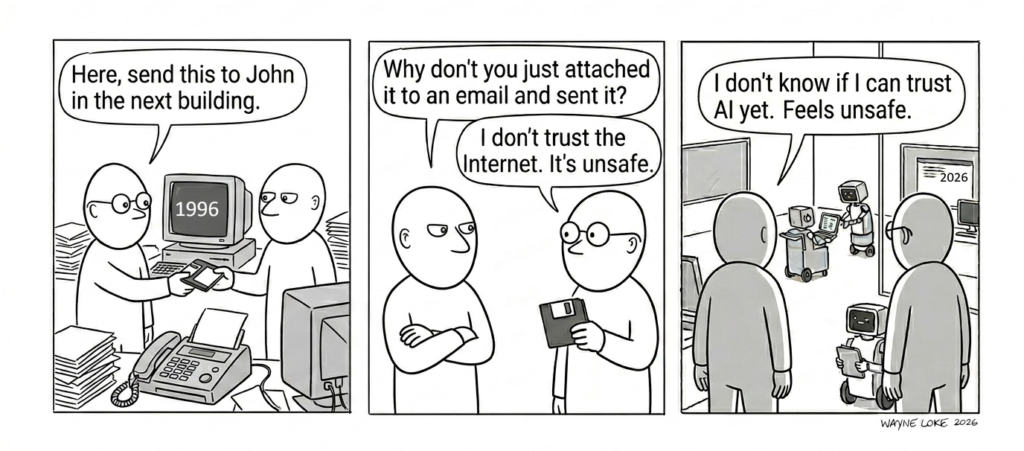
    A comic strip of how times have changed when we don't trust the internet in 1996 and now we don't trust AI in 2026.

    There is an old line I keep coming back to. There are three types of people in this world. Those who wait for things to happen. Those who do not even know that anything is happening. And those who make things happen. The technology of the day does not change those three categories one bit. The internet did not abolish the people who waited, and AI will not either. All a great change does is sort people more sharply into the bucket they were already heading toward.

    Nobody knows what happens next, and the confident ones are usually selling something. The question you can actually answer, because it is about you, and you are the one variable you have some say over.

    Drucker’s list, and why we forget it

    If I strip Drucker’s advice back to its bones, the most useful piece is the first one, and the rest hang off it. Stop trying to predict the future, and start understanding the impact of what has already happened. The future is fog. But the change that has already landed is sitting right in front of you, fully formed, waiting to be read. The internet had already happened by the time most companies got serious about it. AI has already happened. The work is to metabolise what is already true and act from there, which turns out to be a different muscle than forecasting, and a much more reliable one.

    The rest of his list is the same sort of unglamorous, durable common sense. Know what you are genuinely good at, and protect it, because a changing market punishes the company that forgets its own strengths and goes chasing someone else’s. Pay attention to the people who are not your customers, because the reason they stay away usually tells you more about where the world is going than the praise of the people who already love you. Treat information as the raw material it has become. Watch how new industries quietly redraw the map of who holds the power, the way the tech firms did in the 90s and the way the AI firms are doing right now, while the rest of us are still looking at where the power used to be.

    None of that is clever. That is exactly the point. It is just true, and it stays true across every turn of the cycle. We do not fail to follow it because it is hard to understand. A twelve year old could understand it. We fail to follow it because between the storms we got comfortable, we adjusted to a norm, and we forgot that the norm had an expiry date stamped on it the whole time.

    Standing on the wheel

    I do not think AI is a revolution in the breathless sense the headlines want it to be. I think it is a bicycle. It can carry you a great deal further than your own legs, much faster, and it will not get you anywhere at all if you do not know how to ride it, and it will happily tip you into a ditch if you treat it like a horse that thinks for itself. The question was always whether you would get on and pedal, and in which direction, and that question is as old as every tool humans have ever picked up.

    So when people ask me how to make sense of a world that is changing, I do not give them a forecast. I tell them to look down at the wheel they are standing on and notice that it has been here before. Read the change that has already happened. Hold on to what you are actually good at. Watch the people drifting away from you more closely than the ones cheering. And decide which of the three types of person you are going to be this time around, because the wheel does not care, it turns either way.

    I have ridden two of these turns now, the internet one and this one, and I lost a career between them and found a quieter, better-fitting life on the far side. The technology was different each time. I was not. And that, more than any prediction, is the thing that has made sense to me.

    It’s worked for me.

  • What AI Exposes – Part 1 of 6

    AI exposes organisational constraints faster.

    I’ve seen this with Agile adoption before.

    When Agile arrived in earnest, the promise was faster delivery, tighter feedback loops, smaller batches of work shipped more frequently. And to be fair, the delivery engine did get faster. Sprints ran. Stand-ups happened. Velocity metrics climbed.

    What nobody anticipated was what faster delivery would surface underneath.

    At ANZ, one of the wholesale development teams adopted Scrum to make their development work more productive. The sprints ran. The stories got written. The cadence held. And then the team hit the same wall, every cycle: the production team, the backend that actually implemented and released the code, was the bottleneck. You can’t release on a two-week cadence when the deployment pipeline is controlled by a separate team operating on a different rhythm entirely. Scrum didn’t create that constraint. It just made it impossible to ignore.

    That’s the thing about faster feedback loops. They take the problems you’d been working around and drop them onto a schedule.

    Governance bottlenecks that had been invisible suddenly became obvious, because the team was now waiting on approvals that used to take weeks, and the wait was now a sprint event. Procurement delays, executive indecision, fragmented ownership between teams, overloaded support functions, the kind of organisational friction that had always been quietly present, all of it became visible, quickly, repeatedly.

    The delivery engine ran faster than the surrounding operating model could handle, and every gap showed.

    There’s a second version of this, and it’s less about the gap between teams than about a gap inside one team, a gap between the credential and the experience.

    Back then, in the early years of Agile adoption in New Zealand, there weren’t many people who knew how to run it well. The training existed. The certifications existed. What didn’t exist yet was depth, people who’d been through a full end-to-end Scrum implementation enough times to know where it actually breaks.

    So what happened, more than once, was someone attended a few days of certification training, came back with a freshly printed credential, and was treated, by the team and often by themselves, as the expert in the room. At ANZ, I watched this directly. Two staff were sent away for a five-day Scrum course, back at their desks the following Monday, expected to design how the team would work and then run it, as if five days in a classroom had given them everything a real implementation actually needed. Nobody was bluffing. They simply hadn’t done it long enough yet to know what they didn’t know. It was truly a version of the blind leading the blind, well-meaning, certified, and still learning on the job in front of the people they were supposed to be guiding.

    There’s a third version too, and it’s less about people than about fit, a gap between the method and the work itself.

    Stats New Zealand’s technology function isn’t structured the way a bank’s is. At BNZ, BNZ Digital was purely a development outfit, building the future of online retail banking and parts of wholesale. Production issues were limited, and when they happened, they got folded into the backlog as a future release. One focus, one rhythm. The team ran a blend of Scrum and Kanban that worked because the work itself was singular: build things, ship things.

    At Stats NZ, each technology team was both a development unit and a production support unit for its own applications, at the same time, every sprint. Development work fits Scrum naturally, you can estimate it, size it, accumulate story points toward a sprint goal. Production support doesn’t work that way. An outage doesn’t wait for the next sprint planning session, and you can’t put a story point estimate on “the census database fell over at 2am.”

    So which method do you run? Scrum says commit to a sprint goal. Kanban says manage flow, work moves through states as it arrives, no fixed commitment. Both are legitimate. Neither one, on its own, matches a team that is doing both kinds of work simultaneously. What I saw at Stats NZ was teams trying to run Scrum and Kanban at the same time, in the same team, without anyone resolving which one governed which kind of work. That’s a fit problem. The method didn’t match what the team actually was.

    We did try to fix it. A Kanban coach came in to help shift the technology operation toward something more workflow-based, more suited to the support side of the work. I’m not saying it solved the problem. What it did, immediately, was create tension between the people who had built their identity around Scrum and a coach whose entire philosophy ran in a different direction, workflow versus story points, two ways of seeing the work that don’t fully reconcile. Some teams adapted well. Others carried on reluctantly, doing what they were told without believing in it, which is its own kind of cost, quieter than resistance but not really different from it.

    In the end, the team managers carried it. They were still accountable for what they’d promised the business and its customers, and that didn’t change just because the method underneath them did.

    And there was a layer above all of this that nobody at the team level controlled. Around the same time, there was pressure from outside the organisation, government agencies signalling that SAFe was the direction Agile adoption should take across the public sector. Another flavour, another framework, arriving with its own philosophy and its own assumptions about what “good” looks like, and requiring dedicated leadership to steer it properly, leadership that was already stretched thin steering the first change.

    Fixing a fit problem doesn’t happen in a vacuum. The fix creates its own friction, and external pressure arrives with its own opinion about what the fix should have been, usually without much interest in what’s already underway.

    AI is going the same way, faster than Agile did.

    AI increases analytical speed, automation, report generation, content production, decision support, all at once, across every kind of organisation, regardless of what that organisation is actually for. A bank building new digital products and a statistics agency keeping the national data infrastructure running will both get offered the same AI tools, the same vendor pitches, the same “transform your organisation” programme. Neither tool knows which kind of organisation it landed in. Neither does the implementation plan, usually, because nobody asked the question first.

    And the same expertise gap that hollowed out early Agile rollouts is already showing up here. There isn’t enough deep AI experience to go around yet, the kind built from actually deploying these tools inside a real organisation and watching what breaks. What there’s no shortage of is the credentialed version, a course completed, a badge on a LinkedIn profile, a confident voice in a steering committee. None of that is false. It’s just early, the same way Agile was early once, and the gap between the credential and the experience is exactly the gap that costs an organisation real money once the rollout actually starts.

    And when an organisation does try to course-correct, bringing in an AI lead, an AI coach, a new framework, expect the same pattern. New tension between the people who’d built expertise around the old approach and whoever’s now steering the new one. Some teams adapting well, others complying without believing it. And somewhere above all of it, an industry body, a government directive, a board that read something in the Financial Times, arriving with an opinion about which AI framework or governance model the organisation should really be using, usually with no visibility into what’s already half-built underneath.

    And AI, unlike Agile, has a bill attached to every experiment. If an organisation hasn’t worked out what it’s actually for, before it starts pointing AI at its problems, and before it layers a fix on top of a fix while external pressure adds a third opinion, it will spend heavily finding all of this out the hard way. At least a wasted Scrum sprint was just time. A wasted month of AI experimentation, run at scale across a team, shows up as a number someone in finance has to explain.

    So before any AI rollout: what is this organisation actually for? Does the thing we’re about to deploy match that? And are we steering it ourselves, or about to hand the wheel to three parties at once?

    Most organisations skip that question entirely. They go straight to the tooling.

    I’d rather know what I’m building before I see the bill for it.

  • The Coach Said Ageism is a Myth

    I’ve been on both sides of this. At Stats NZ, at ANZ, I sat in rooms where hiring decisions were made, and I listened to managers explain, without much discomfort, why certain candidates had filtered themselves out before the conversation even started. Too old. Too expensive. Too set in their ways. I filed those observations away as a feature of how organisations work, the kind of thing you absorb without examining closely when you’re on the side where it doesn’t cost you anything. I never thought I’d be the person they were describing.

    Then Te Pūkenga restructured, and I found out what the view looks like from the other direction.

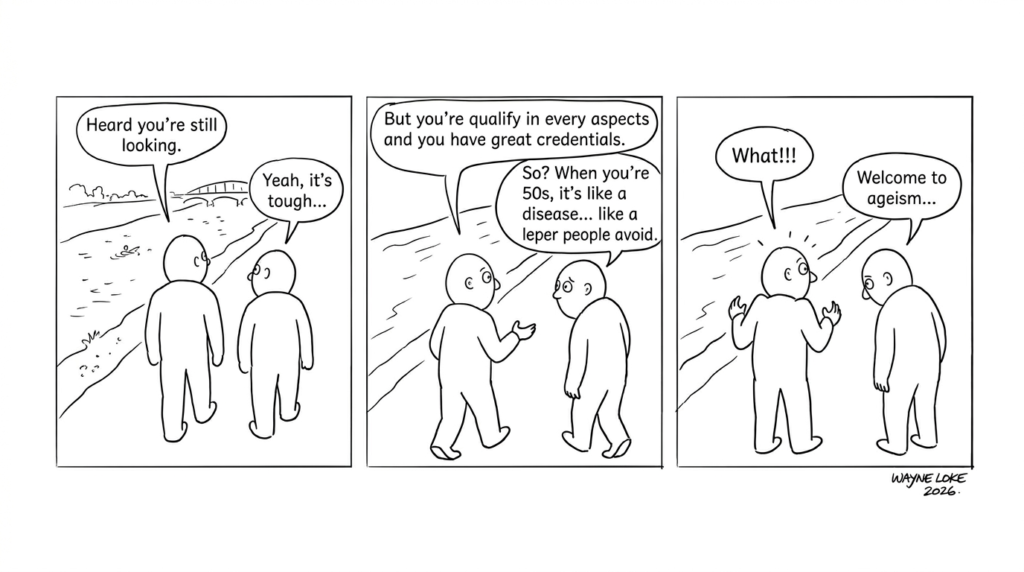
    Three-panel comic of two bald characters walking along a riverside path. One says, "Heard you're still looking." The other replies, "Yeah, it's tough..." The first says, "But you're qualify in every aspects and you have great credentials." The second answers, "So? When you're 50s, it's like a disease... like a leper people avoid." The first throws up both hands: "What!!!" The second says, "Welcome to ageism..."

    What made that redundancy different was the scale of what arrived at the same time. I had lost roles before, and so has anyone who’s spent a career moving through organisations. New Zealand’s unemployment rate was rising. SMEs were closing. Retail strips were emptying. Office blocks across Auckland and Wellington sat vacant. The government had already signalled it was disestablishing Te Pūkenga entirely. Geopolitical pressures were moving through GDP numbers, and GDP numbers were moving through hiring decisions, producing fewer roles at every level, not just at the top. A single professional or individual contributor role could attract 200 to 300 applications or more. These weren’t forces I could network or position my way around. When conditions compress that hard, across that many variables at once, you stop asking what you did wrong and you start asking what is actually happening.

    At one of the career transition forums that came with the redundancy package, I raised ageism directly. The coach running the session disagreed. Ageism is a myth, he said, because experience is value and the market rewards it. His prescription was presentation: revise the CV to be value-focused, strip graduation dates and anything older than 15 years, reframe long tenure as transferable skills, apply for roles one or two ranks below where you were, consider fractional or part-time arrangements to make yourself more affordable, offer reduced hours to lower the risk for potential employers. I’ve since seen the same prescription in outplacement guides, HR publications, YouTube channels aimed at “professionals in transition,” and LinkedIn posts about managing redundancy over 50. The advice is consistent across all its sources. It travels well because it sounds reasonable, and because it gives people something to do while they wait for the outcome to change.


    The outcome doesn’t change. The advice is solving the wrong problem.

    The moment you walk into an interview room, the CV has done its job and stopped mattering. The panel sees you, not your document. Your age is in the room whether your graduation date is on the page or not, and the panel’s response to it has already formed before you’ve opened your mouth. If the panel is younger, which it usually is, their assumptions about what you represent have been running since you came through the door. Older applicants move more slowly. Older applicants are set in their ways. Older applicants have seen too much, and “I’ve been there, I’ve done that, this won’t work” reads as obstruction in an organisation that needs to believe it’s trying something for the first time.

    The irony is plain once you see it. The pattern recognition that comes from 30 years of watching the same decisions play out, which is the thing you’re supposed to be selling as value, is exactly what reads as resistance to someone who hasn’t yet sat through the cycle. A younger hiring manager who hasn’t watched a rebranding exercise fail twice, or a restructure reduce headcount without changing anything structural, or a digital transformation stall in precisely the way the last one stalled, cannot easily distinguish between an older employee who is obstinate and one who is simply right. And here’s the part that makes this genuinely hard: they may never know the difference, because every generation of employees has to learn certain lessons by living them, regardless of what the previous generation already knows. The pattern recognition is real. The inability to transfer it is also real. So the panel defaults to the safer assumption. You get filtered out, and the exit is labelled overqualified.

    Overqualified is a polite word. In most of the cases I’ve experienced or observed, it doesn’t mean your experience exceeds what the role requires. It means the panel has run a calculation that won’t survive being said aloud. You might leave once something better surfaces. You might be harder to manage if the manager is 15 years younger. You might not adapt quickly enough to how the team prefers to work. None of those concerns appear in the feedback, because none of them would survive a formal grievance process. Overqualified covers them cleanly, and the conversation ends there.


    A better CV doesn’t reach any of this. Perception doesn’t change in a 45-minute interview, regardless of how well the transferable skills are packaged.

    Some advice goes further. Career coaches recommend working personal networks, reaching out to contacts who might know of opportunities, letting people in your industry know you’re available. I understand the theory. But what I’ve found is that professional relationships don’t carry the weight that word “network” implies. The people you work alongside are colleagues while you share the same floor. Once you leave, most of that contact fades, and fades faster than most people want to admit. And where a genuine relationship does exist, a peer-level contact inside another organisation has limited reach. The hiring decision sits with someone more senior. A peer’s recommendation rarely travels far enough up the chain to change what the panel has already decided, especially when that panel is already running the calculation I’ve just described.

    Applying a rank lower doesn’t escape it either. A junior role attracts more applicants, not fewer, both younger candidates and older ones in the same situation as yourself, and the same cost and perception logic runs again, except now you’re competing against people who represent lower salary expectations and carry none of the assumptions that follow seniority. The advice to lower your sights is framed as widening your options. In practice, it narrows the corridor and adds more people to it.

    What surprises me is how long the mechanism has been running without anyone naming it cleanly.

    At Stats NZ, I had hiring managers tell me, without lowering their voice, that certain candidates were too old and had effectively removed themselves from consideration. This wasn’t a crisis conversation. It was a routine observation, offered the way you’d note a missing qualification, and then the meeting moved on. At ANZ, I watched older employees, some past their own stated retirement age and still contributing meaningfully, get quietly sidelined before restructures arrived. The restructure wasn’t the cause. The sidelining came first, and the restructure was the instrument. In both cases, the organisation wasn’t responding to any particular economic event or technology disruption. It was running a function it runs continuously, as a matter of normal operations, well below the level of deliberate policy.

    Ageism is the current word for that function. The word is useful in the sense that it gives people a shared language for an experience that is real and measurable. Research confirms what many people already knew from inside it: across OECD countries, employment starts falling from age 50;1 older workers who lose a job stay unemployed longer and are less likely to find another;2 and employers say openly that they are less willing to hire them.3 But the word also carries an implication I find misleading, that this is a problem generated by contemporary conditions, one that could be addressed through better hiring practices, stronger legal enforcement, or, as the coaches would have it, a more strategically constructed CV.

    The function predates the word. Organisations were running it in the 1990s, in 2005, in 2015. What changes across those periods is the economic context that makes it more visible to more people at once, and the vocabulary available to describe it. The function itself is stable. It’s closer to an immune response than a crisis, the organisation’s natural mechanism for cycling through generations of people, managing cost and perception thresholds in ways that rarely get said plainly. Like most immune responses, it operates below the level of deliberate decision-making. Nobody sits in a room and decides to discriminate. They make a series of smaller judgements about fit, energy, risk, and cost, and the accumulated weight of those judgements produces a consistent result. The result has a name now. It had the same shape before it had the name.

    The coach who told me ageism is a myth wasn’t lying. He was describing the system he believed he was operating in, one where experience carries value, the market is rational, and presentation determines outcome. That version of the system does exist in certain organisations, for certain roles, under certain conditions. I’ve seen it. But it is the exception, not the default. The default is what I watched at Stats NZ and ANZ before I had any personal stake in understanding it, and what became undeniable during the Te Pūkenga redundancy when every economic force in the country arrived at the same moment and left very little room for alternative explanations.

    I’m not writing this to argue that older employees should stop applying, or that the coaching advice fails in every situation. I’m writing it because there’s a real cost to explaining a structural function as an individual presentation problem. When the mechanism operates at the level of the organisation and the advice operates at the level of the CV, the only explanation available when the advice doesn’t work is that the individual didn’t execute well enough. Try harder. Polish the story again. That conclusion suits the system perfectly.

    I’ve been on both sides of the table. I know which side has more information.


    1. Employment rates begin to decline from age 50 across OECD countries, and older workers who lose a job spend longer unemployed and are less likely to be re-employed: OECD Employment Outlook 2025, chapter 3, “Navigating the golden years”. ↩︎
    2. In New Zealand, workers aged 50 to 64 who lost a job involuntarily between 2001 and 2010 were 11 to 12 percentage points less likely to be employed four and five years later than comparable workers who kept theirs, while the effect for workers under 30 faded; the authors attribute the larger impact to older workers’ firm and industry-specific skills. Stats NZ survey and administrative data: Hyslop and Townsend, Motu Working Paper 17-12 (2017). ↩︎
    3. Survey of hiring managers in eight countries in Europe and the United States, February to March 2023: 35% would definitely hire a candidate aged 45 to 54 and 13% one aged 55 to 65, against 47% for 30 to 44: OECD and Generation, The Midcareer Opportunity (2023), Generation. ↩︎