Author: Wayne Loke

  • The Cover Story

    ABN AMRO ran a three-day programme for every officer at manager rank and above. The subject was this: what makes a bank a bank.

    I attended it in the early 2000s. The facilitator opened with a question, and answers came back the way they always do in a room full of experienced people who haven’t been asked this before. Deposits. Savings accounts. Housing loans. Payment transactions. The facilitator let the room finish, then said: No. The business of banking is brokering. You take money as intermediary, you lend long, you borrow short, and you extract the margin between. Every ratio the organisation tracks, every headcount cost you manage, every basis point on a loan portfolio, it traces back to that one mechanism. Understanding it changed how I read every decision I was part of after that, because I finally knew what the decision was in service of.

    I remember thinking: I’ve been in financial services for years, and nobody has ever explained this to me.

    This was not a welcome-to-the-company session. The room was full of ranking officers, some with years of service already behind them. ABN AMRO ran it because knowing your own function and understanding the business you’re working inside are two different things, and they had decided the second one required deliberate instruction, regardless of your tenure.

    That is what succession planning looks like: an organisation taking responsibility for making sure its people understand what they’re contributing to, how the organisation survives as a going concern, and why developing someone through the ranks is an obligation rather than an optional bet. I attended that programme once, at a Dutch bank in the early 2000s, and I have not seen anything approaching it in any organisation since.

    Every organisation I worked in after ABN AMRO shared a condition so common it stopped being remarkable. Most people had no idea what made the organisation viable. They knew the process they ran, the team they sat in, the system they operated. They did not know how the organisation generated its revenue or delivered on its purpose, what the unit economics looked like, or why any of it depended on them staying and growing rather than leaving when a better offer arrived. Nobody had explained it to them, because nobody had been tasked with doing so.

    At ANZ National the closest attempt existed. There were frameworks, names in boxes, readiness ratings reviewed on a quarterly cycle. The structure was on paper. The problem is that a real succession pipeline requires sustained capital and sustained effort, and when the cost and effort came into focus, it didn’t fly. What happened every time a senior role opened was the same: the market. External hire, premium cost, cycle repeats.

    At Stats NZ, BNZ, and Inland Revenue, the situation was simpler: there was no attempt at all. When roles opened, the organisation looked outside, paid more than an internal candidate would have cost, and called it efficient resource management. I watched that pattern hold consistently across every organisation I worked in, and the common element in each case was that nobody had ever explained to their people what business they were actually in.

    The argument against investing in people has a surface logic. You develop someone, they build capability, and then they leave. The benefit flows to whoever hires them next. So the conclusion most organisations land on is to hire capability rather than develop it: bring someone in who already knows the job, carry the salary premium, avoid the development risk.

    Follow that logic downstream and the flaw becomes visible. Workers trained somewhere, at some point, by someone. That somewhere has to exist. If every organisation applies the same reasoning and nobody trains, the pool of experienced talent available to hire from starts thinning, salaries at the experienced end inflate because demand accumulates without supply to match it, and the organisations that chose never to invest in developing people find themselves competing to pay for people that some earlier employer, somewhere, did invest in.

    There is a fear underneath this that I’ve heard stated plainly enough over the years: if I train my people, I’m training them for my competitors. That fear isn’t irrational in isolation. Acting on it at scale creates the exact problem it was trying to avoid, a labour market full of people with skills but no organisational depth, moving from role to role because no organisation has ever given them a structural reason to stay.

    The mechanism that resolves this tension does exist. Service bonds tied to development investment: the organisation funds a significant programme, the employee commits to a minimum tenure in return. Blunt instrument, but it makes the incentives match. And when an organisation does invest deliberately, people queue for it. The Department of Internal Affairs ran the GovTech Talent graduate programme across several government agencies, and I was a participating leader from Stats NZ. 15 to 20 graduates at a time, each rotating to a new agency every eight months over two years. Every intake was oversubscribed for the years we ran it.. The model works. It’s just not replicated at any scale elsewhere.

    The default everywhere else is that development happens incidentally, through work, without structure. The organisation assumes the education system has done the foundational work. Graduates arrive, enter a role, and build from there. What the education system cannot do is teach someone the specific business of the specific organisation they’ve joined. That knowledge is internal. It requires someone to take the time to explain it, the way that facilitator at ABN AMRO took three days to explain what makes a bank a bank. Without that, you get people who are technically employable and organisationally adrift, contributing to a process without understanding what the process is part of, with no reason deep enough to keep them there long enough to be developed into something the organisation actually needs.

    Youth unemployment in New Zealand sits at 15.9% as of March 2026, per Stats NZ. Three times the national rate. The explanation most prominent in media and political commentary is AI. The story is that AI is absorbing entry-level roles, particularly in office environments where decisions are process-driven and binary, and the jobs that used to give young people a first foothold are disappearing.

    There’s something in it. Roles built on processing work where the majority of decisions follow a predictable path and exceptions are all that require human judgment, those roles are genuinely exposed. Some of those positions were entry-level, and they’re thinning. That’s real.

    But AI is a convenient story. It’s external, it’s technical, and it removes the organisation from the chain of causation. The economy plays the same role. When a commenter in my LinkedIn post that prompted this piece wrote that she hadn’t seen evidence of AI replacing entry-level jobs in practice, she was pointing at something real. I asked her whether she’d ever been on a succession plan in her organisation, or whether her company simply hired someone to replace her when she left. Her answer: she had not been on any succession plan, nor seen one in any organisation she’d worked for.

    She runs her own contracting company now, which changes the equation for her. She keeps her skills current because she has to. But she had years of employment inside organisations before that, and the pattern she described is the one I’ve heard consistently across several sectors: no pipeline, no structured development, no explanation of what the organisation was actually trying to do. Just a job, adjacent to other jobs, in a structure nobody took the time to explain.

    AI and the economy are cover stories. They describe conditions that are real enough. They do not account for the pipeline that organisations chose, over decades, not to build.

    The mechanism isn’t complicated. An organisation that never explains to its people what it’s actually in the business of doing will not retain those people through difficult periods, will not develop them into the roles it needs filled at the next level, and will not be able to backfill from inside when the time comes. It will go to the market, pay the premium, and describe what follows as a talent shortage.

    There is a talent shortage. It was constructed, incrementally, by organisations that treated succession planning as a compliance exercise and development as a cost to be deferred. The young people at 15.9% unemployment are the visible end of a problem that runs through every level of the workforce. The entry-level jobs are where the pipeline starts. If they’re shrinking, some of that is economic conditions, some of it is genuine automation, and a significant portion of it is that organisations have no structural incentive to create them when they’ve never built a development pipeline to justify the investment in the first place.

    You can’t extract from the talent market indefinitely without anyone replenishing it, then reach for an external explanation when the extraction catches up with you.

    I sat in that room at ABN AMRO for three days and came out knowing what I was part of. Every organisation I joined after that, I was still asking the same question.

    Nobody offered the three days.
  • I Trained an AI to Draw My Comics

    I’ve been drawing the same characters for a few years. Bald heads, no gender, no mouths, just eyes and noses. They live inside my previous Small Simple Steps blog, mostly as cover images. One of them is sitting inside a giant jar saying “I’m stuck.” A voice from outside says: “You’re not a tree. Get moving.”

    Dry humor, organisational observations, leadership absurdities. That’s the strip.

    The ideas are never the problem. I have 10 to 20 of them sitting on paper right now, thumbnails and notes, waiting to become strips. A professor explaining that innovation is Q+A (questioning plus action), then being asked what Q minus A is. “That’s philosophy,” he says. A person standing outside the box, being told to think outside the box, while a voice from above is also being told to think outside the box. The joke writes itself. Drawing it takes time.

    Microsoft Whiteboard, Microsoft Paint, adjusting angles, getting expressions right when your characters don’t even have mouths. That’s hours per strip, sometimes more. So the backlog stays a backlog.

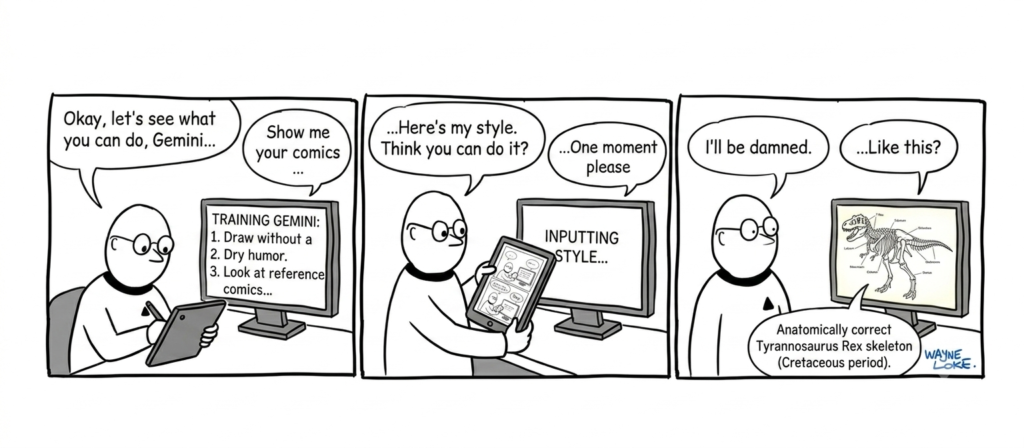
    A few weeks ago I uploaded a series of my strips to Gemini and asked it a simple question: what do you need from me to draw in this style? After a few rounds of feedback and iteration, it rendered a 3-panel strip that looked exactly like mine. Same characters, same sparse style. It had added mouths. I told it to remove them. The next render was right.

    Then the next one had mouths again. And collars. And shirt buttons on a character that wears nothing but eyes and a nose.

    Gemini forgets. It drifts back toward its training data, toward what it expects a character to look like, and I have to reload my source strips and re-edit the prompt to pull it back. A strip I’m happy enough to publish takes 5 to 6 iterations on average.

    It’s still faster than building the same panel in Microsoft Paint. And Gemini can reframe a panel’s composition quickly, repositioning objects, adjusting angles, based on how I describe what I want. The back-and-forth is productive.

    That’s the experiment. Here’s what it means.

    The production gap closed. The 10 to 20 ideas on paper now have a path to 10 to 20 strips. The thinking part, the theme, the dry humor, the character dialogue, the punchline, none of that came from Gemini. That part is still mine. What Gemini removed was the rendering work sitting between the idea and the finished image.

    But I noticed something else worth naming. Gemini is a good imitator. Feed it a consistent style, it replicates the style. I’ve seen someone on LinkedIn feed a child’s dinosaur drawing into the same kind of tool. The output was detailed, cinematic, the kind of thing you’d see in a film. The AI had extrapolated past the source material into its own idea of what a dinosaur should look like. The child’s version disappeared.

    Three-panel comic. A bald character with glasses sits at a computer with a drawing tablet and says, "Okay, let's see what you can do, Gemini..." The screen, headed "Training Gemini", lists: draw without a..., dry humor, look at reference comics. Gemini replies, "Show me your comics..." Holding up a tablet of sample strips, the character asks, "...Here's my style. Think you can do it?" The screen reads "Inputting style..." and Gemini says, "One moment please." In the last panel the screen shows a labelled Tyrannosaurus rex skeleton, with the caption "Anatomically correct Tyrannosaurus Rex skeleton (Cretaceous period)". Gemini asks, "...Like this?" The character says, "I'll be damned."

    That’s a different thing from what I did. My strips have a consistent style. Gemini stayed inside it, mostly, with reminding. But if the source material had problems baked into it, the output would have reproduced those problems faithfully, and faster.

    Apply that to an organisation. Feed AI your broken processes, you get faster broken processes. The tool doesn’t audit what you give it, it multiplies it. Garbage in, garbage out, just at a speed that makes the garbage harder to spot.

    I want to add something else. Drawing is meditative for me. The slow process of sketching a bald character, finding the right angle, sometimes realising mid-sketch that the idea needs sharpening, that’s part of how the strip develops. I’m not giving that up. The hand-drawn ones will still happen.

    But when the idea is clear, the message is ready, and the only thing left is hours of rendering work, that’s where Gemini earns its place. A bicycle. I still have to steer, and apparently I have to keep reminding it that my characters don’t have mouths.

    The production gap is the constraint in most creative work, the gap between having an idea and having something to show for it. If AI closes that gap without touching the thinking, the thinking gets more time. That’s the trade I keep coming back to.

    I have 10 to 20 strips waiting. I’ll let you know how many survive the experiment.

  • The Four Unwritten Rules That Keep You Employed

    The calendar invite arrives with no agenda and no attendees listed except you and your manager. By the time you notice the pattern in the building, it’s already happening. Someone in finance started the spreadsheet three weeks ago.

    That’s how economic cycles land at the individual level, and they’ve been landing that way for decades: after the 2008 financial collapse, when the Lehman Brothers bankruptcy triggered a cascade through the global banking system and redundancies spread across every sector; after COVID froze entire industries overnight; in every contraction before and after those, when credit tightened and executives started talking about efficiency and HR calendars filled up. The conditions rotate. The mechanism stays the same: organisations under pressure cut costs, and cutting staff is the fastest lever they know how to pull.

    What also stays the same is who survives it.

    A book from 2008

    In the year the GFC hit, a short book called Bulletproof Your Job appeared. Stephen Viscusi wrote it for people navigating a tight employment market, and he gave them four strategies. Simple ones.

    I read it then. I’ve shared it since with graduates starting their first job, with experienced people in mid-career drift, with team members who were quietly about to be restructured. Thirty years of organisational life across multiple companies and countries, and the advice has never once felt dated.

    The four strategies: be visible, be easy, be useful, be ready.

    Most people ignore them until the no-agenda calendar invite lands.

    Be visible

    Visibility means making your contribution legible to the people who matter: your boss, your peers, your stakeholders. What are you working on, what have you delivered, how does it connect to what the organisation actually needs. Consistently, and without blowing your own trumpet every second day.

    Agile teams do this naturally: showcases, backlogs, working-out-loud practices that make work clear not just to management but to each other. That’s career insurance as much as it’s project methodology.

    Working Out Loud, as a deliberate practice, takes it further. You share your thinking, your progress, your work in ways that invite collaboration and make your knowledge useful beyond your immediate team. You become someone others learn from, which registers differently than just completing tasks on time.

    When a restructure lands and a manager asks who they can’t afford to lose, the answer is almost never the person whose work was invisible.

    Be easy

    Being easy to work with means being dependable: following through, engaging honestly with problems, showing up without drama or defensiveness.

    The opposite is being high-maintenance, and high-maintenance is expensive. If working with you generates friction, political fallout, or extra management overhead that someone else has to clean up, that cost starts to register when budgets get squeezed.

    Ask yourself: what’s it like to work with me? Better to find out from a trusted colleague now than to discover it in a conversation you didn’t see coming.

    Be useful

    Everyone thinks they’re useful. That’s the catch.

    Ask your boss and your colleagues: do they experience you as someone who makes things better? Who runs a workshop to solve a real problem? Who teaches something new, mentors someone, transfers a skill instead of just performing it?

    And then there’s the unprompted kind. Something outside your job description is broken, and you have the skills to fix it, so you do, without being asked. You nail it. That demonstrates capacity beyond your lane, which is exactly the signal that registers when leadership is deciding who’s expendable.

    Be ready

    This is the one most people defer, because it requires effort before anything feels urgent.

    Ready for opportunity means keeping your CV current, building transferable skills, staying connected to your industry and not just your current employer. Opportunities have a short window. They don’t wait.

    Ready for adversity is mostly about finances. Six months of expenses in savings, which financial planners recommend as the floor, not the target. Having that buffer changes the psychology of a redundancy entirely. Without it, you’re making permanent decisions under temporary pressure, taking the first thing available because you can’t afford to wait. With it, you can be deliberate.

    Beyond the finances: have a backup plan. A specific one: who do you know, what skills transfer, what would you do next, how long can you sustain the gap? The people who land well after redundancies almost always had this worked out before they needed it.

    The pattern underneath

    The people who apply these four strategies when things are fine, when there’s no restructure in sight, no headcount review, no whisper of a hiring freeze, those are the ones who don’t panic when it does arrive. The visibility is already there. The reputation is already built. The financial runway exists.

    The people who start thinking about this when the news turns bad are usually starting too late. You can’t build visibility in a week. You can’t develop a reputation for dependability in a month. You can’t save six months of expenses when you’re already losing your income.

    These four strategies are habits. Viscusi framed them in a crisis context because that’s when people finally stop to listen. But the strategies themselves are for ordinary time, the long quiet stretches between downturns where nothing feels urgent and preparation feels optional.

    The unwritten rules at work haven’t changed in years. The economic conditions rotate. The technology shifts. The org charts get redrawn. The rules stay the same.

    Start now, when you’re ahead.

  • AI is a Bicycle

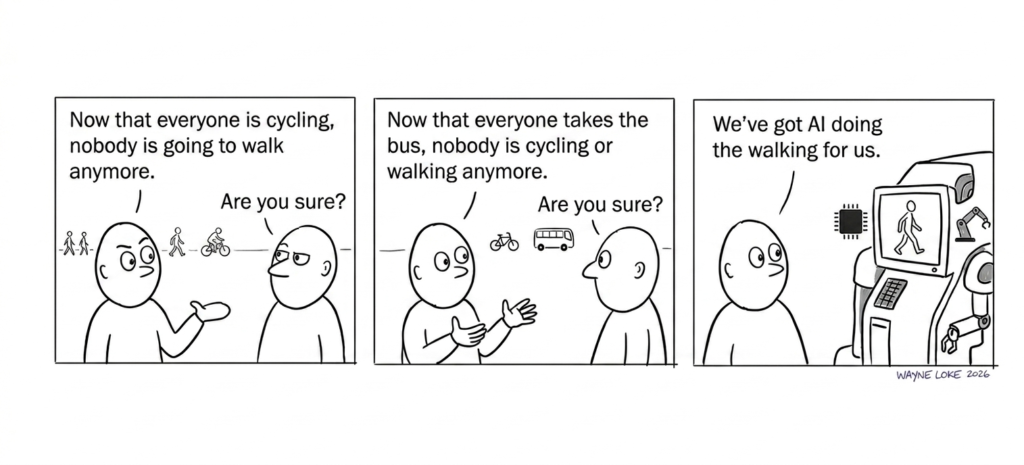
    When I was young, I walked to school. Then one day I got a bicycle. The bicycle didn’t replace walking. I still walked to the corner shop, still walked when the bike had a flat. But for the school run, it was faster and I arrived less tired.

    Then came the bus. Same route, no effort, could read on the way. And in adulthood a scooter for short stretches because it was quicker through the car park.

    None of these replaced the others. Each was a medium, a better fit for a specific job.

    I keep coming back to that image every time someone says AI is going to replace workers.

    The NZ government has announced it’s cutting 8,700 public service roles by 2029 and embedding AI “as a basic expectation” across agencies. Those two things are being discussed together, and I think that’s worth separating.

    The fiscal pressure drove the headcount decision. The AI is the bicycle. Conflating the two makes workers afraid of the tool, and a team afraid of the tool won’t use it well.

    What AI actually does in a workplace is handle the repetitive, rule-bound, high-volume work so your people can focus on the judgment-intensive work. Chatbots are a clean example. Before modern AI, a reasonable chatbot could handle maybe 40-50% of common customer queries: FAQs, status checks, simple form guidance. Route the rest to a human. The human doesn’t disappear. They stop spending half their day answering the same 5 questions.

    But, and this is a real but: you have to know who your customer is first.

    I’ve seen organisations roll out chatbots to serve a customer base that barely uses smartphones. The deployment looked impressive. Adoption was close to zero. Because the assumption that most customers are digitally comfortable wasn’t true for that particular service.

    The question before any AI implementation is simple: who are we serving, and what percentage of them can actually use this?

    If 80% of your users engage through digital channels, build for them and keep a human channel for the rest. If that ratio is flipped, the chatbot is the wrong starting point. This is a customer understanding question, and the technology just makes the gap more visible.

    What I find more interesting than chatbots is what AI does to the invisible work.

    Every organisation carries what I call shelfware. Reports no one reads. Approval chains that exist because someone once said they should. Weekly coordination meetings where 6 people watch one person talk through a slide deck that could have been an email.

    AI tools that can draft, summarise, and generate structured outputs expose this shelfware fast. When a report that used to take 3 hours takes 20 minutes with AI assistance, you have to ask whether that report was worth 3 hours of someone’s week in the first place.

    Sometimes the answer is yes. Often it isn’t.

    A comic discussing if technology like AI is replacing the things we do.

    The government’s plan calls for cloud HR, payroll automation, case management systems. That’s the back office. That’s the bus route that runs without a driver.

    What’s harder to address, and what I haven’t seen clearly articulated in the plan, is the cultural piece. Technology adoption fails when the belief system doesn’t shift.

    I saw this pattern clearly in a restructure at an education business. The service desk team was managing laptop deployments manually, staging, imaging, dispatching across 45 locations. The capability to automate most of it already existed through the hardware supplier, but the team had been doing it their way for years and didn’t fully trust that the supplier’s process would hold up.

    The turning point was a pilot. One batch, fully outsourced to the supplier, end to end. Cost about $50 per laptop, imaging and logistics included. The batch arrived on time, correctly configured, no issues.

    After that, nobody wanted to go back.

    That’s how adoption actually works. Small wins, specific demonstrations, one thing at a time. The bicycle is faster than walking, but you have to ride it once before you believe it.

    So if you’re a leader trying to navigate this: pick one process, something specific, bounded, and annoying, and make it your AI pilot. One thing.

    Show the team what the bicycle does. Let them ride it.

    AI takes the robotic work off the plate of the person who can read a room, ask the right question, and notice when the data is telling them the wrong story. That is what it buys them: time to do those things.

    The medium changes. It’s made sense to me.