I watched the internet arrive. It landed on my desk as a working problem long before it was a headline, and it rearranged how the work got done while we were still looking the other way. One year we were faxing change requests and walking floppy disks between buildings, and the next we were arguing about whether email counted as a real record, whether you could trust a document that nobody had signed. Nobody stood up and announced it. It seeped in, and by the time we noticed, the old way of working had already left the building.
Twenty something years later I am watching the same thing happen again, except the word on everyone’s lips is AI instead of internet, and the people panicking and the people cheerleading are roughly the same shape they were last time, just younger and louder and faster to post about it.
So let me say the thing this whole piece stands on. The business cycle moves in circles. We keep drawing it as a straight line, an arrow that only ever points forward, and the drawing has been wrong the whole time. Things come back around, dressed in different clothes, carrying a new acronym, and we treat each turn as if it has never happened before in the history of the world. It has. We just forgot, because in between the turns we adjusted, we adapted, we made the strange thing normal, and then somewhere along the way we mistook that normal for permanent.
When I was made redundant at 57, that was a cycle too, though it did not feel like one at the time. It felt like an ending. A career of 30 plus years in technology leadership, a last role running platform engineering with hundreds of people reporting up through me, and then redundancy, and then a very quiet Monday morning with nowhere I had to be. I have since stopped calling it retirement. I call it portfolio life, which is partly a nicer word and partly the truth, because the world did not stop turning when my old role disappeared. It just turned, the way it always does, and left me to work out where I now stood on the wheel.
So I am not predicting anything. I am useless at prediction, and so is almost everyone selling it. I am recognising something I have seen before.
The same river, a different season
In 1995 Peter Drucker published a book called Managing in a Time of Great Change. Read the title again, slowly. A time of great change. He was writing about the internet, globalisation, the early tremors of the information economy, the sense that the ground under management had shifted and the old maps no longer matched the territory. People read it then the way people read the AI commentary now, as if someone had finally found words for a feeling they could not name.
Here is what struck me when I went back to it. Almost nothing in that book was actually new in 1995. Drucker was not inventing fresh wisdom for a fresh crisis. He was reminding people of things they already knew and had stopped doing, because the long stretch of relative calm before the storm had let them get comfortable, and comfort has a way of erasing the lessons of the last storm. His advice reads as evergreen because it is. It works in 1995, it works in 2008, it works now, and it will work in whatever year the next great change arrives wearing whatever the next acronym turns out to be.
The reason it feels new each time is simple, and a little embarrassing once you see it. We adapt. We are good at adapting, it is one of the better things about us. But adaptation has a cost. Once the new technology becomes ordinary, once the new process is just how we do things now, we file away the discomfort that taught us anything, and we go back to managing the present as if the present were the permanent state of affairs. Then the wheel turns, the norm we adjusted to stops being the norm, and we stand there blinking, certain that nobody has ever been this confused before.
What actually does not change
The technology changes. The application of it spurs new processes, new business models, new centres of power. The internet gave us e-commerce and remote work and the slow hollowing of the high street. AI is busy doing its own version of that right now, and the specifics will surprise us, they always do.
But underneath the changing technology, human behaviour sits more or less still. The same fears, the same herd instincts, the same rush to either panic or worship whatever is new. The same handful of people quietly getting on with the work while everyone else argues about whether the sky is falling or ascending.
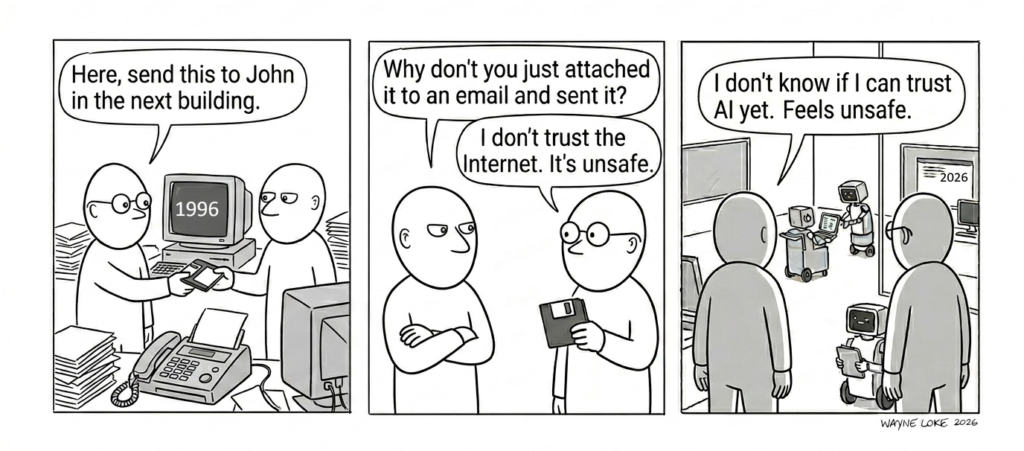
There is an old line I keep coming back to. There are three types of people in this world. Those who wait for things to happen. Those who do not even know that anything is happening. And those who make things happen. The technology of the day does not change those three categories one bit. The internet did not abolish the people who waited, and AI will not either. All a great change does is sort people more sharply into the bucket they were already heading toward.
Nobody knows what happens next, and the confident ones are usually selling something. The question you can actually answer, because it is about you, and you are the one variable you have some say over.
Drucker’s list, and why we forget it
If I strip Drucker’s advice back to its bones, the most useful piece is the first one, and the rest hang off it. Stop trying to predict the future, and start understanding the impact of what has already happened. The future is fog. But the change that has already landed is sitting right in front of you, fully formed, waiting to be read. The internet had already happened by the time most companies got serious about it. AI has already happened. The work is to metabolise what is already true and act from there, which turns out to be a different muscle than forecasting, and a much more reliable one.
The rest of his list is the same sort of unglamorous, durable common sense. Know what you are genuinely good at, and protect it, because a changing market punishes the company that forgets its own strengths and goes chasing someone else’s. Pay attention to the people who are not your customers, because the reason they stay away usually tells you more about where the world is going than the praise of the people who already love you. Treat information as the raw material it has become. Watch how new industries quietly redraw the map of who holds the power, the way the tech firms did in the 90s and the way the AI firms are doing right now, while the rest of us are still looking at where the power used to be.
None of that is clever. That is exactly the point. It is just true, and it stays true across every turn of the cycle. We do not fail to follow it because it is hard to understand. A twelve year old could understand it. We fail to follow it because between the storms we got comfortable, we adjusted to a norm, and we forgot that the norm had an expiry date stamped on it the whole time.
Standing on the wheel
I do not think AI is a revolution in the breathless sense the headlines want it to be. I think it is a bicycle. It can carry you a great deal further than your own legs, much faster, and it will not get you anywhere at all if you do not know how to ride it, and it will happily tip you into a ditch if you treat it like a horse that thinks for itself. The question was always whether you would get on and pedal, and in which direction, and that question is as old as every tool humans have ever picked up.
So when people ask me how to make sense of a world that is changing, I do not give them a forecast. I tell them to look down at the wheel they are standing on and notice that it has been here before. Read the change that has already happened. Hold on to what you are actually good at. Watch the people drifting away from you more closely than the ones cheering. And decide which of the three types of person you are going to be this time around, because the wheel does not care, it turns either way.
I have ridden two of these turns now, the internet one and this one, and I lost a career between them and found a quieter, better-fitting life on the far side. The technology was different each time. I was not. And that, more than any prediction, is the thing that has made sense to me.
It’s worked for me.