Author: Wayne Loke

  • The Same Hiring Mistake is About to Get More Expensive

    I published a version of this in 2021. It was about hiring Agile coaches. Reading it back, the argument is identical. The job titles have changed and the day rates have roughly tripled.

    Organisations are moving fast on “AI transformation leads,” “Chief AI Officers,” and consulting firms promising to compress a multi-year change into a 90-day sprint. Some of that money will produce results. Most of it will produce a very expensive lesson about organisational readiness that a two-hour conversation could have avoided.

    Four things to acknowledge before you start.

    One: No AI expert knows everything about AI transformation. They’re human, same as you. Deep capability in some areas, real gaps in others. Worth knowing before you set expectations.

    Two: Certifications tell you what someone has learned, not what they can do. I know what a cake is. I can’t bake one from scratch, and I certainly can’t show you how. I’ve watched people arrive with impressive credentials, a Scrum Master or Agile Coach cert rebranded as “Agile expertise,” a prompt engineering certificate rebranded as “AI strategy,” and struggle to apply any of it in a live organisational environment. Knowing and know-how are two different things, and the gap between them is where most hiring decisions go wrong.

    Three: What worked elsewhere won’t automatically work here. I’ve seen organisations bring in Agile coaches from European companies, expecting them to transfer the cultural and systems context from there into a New Zealand environment. It rarely worked. The organisational conditions, the regulatory environment, the pace expectations, how teams and leaders deal with each other, all of it is different. An AI expert who spent the last 5 years in a San Francisco tech company is carrying a very specific operating model in their head. That model may or may not survive contact with a NZ government agency or a regional bank that’s been running for 150 years.

    Four: Some AI experts are unicorns. By that I mean they only function in perfect conditions. They arrive with a clear picture of what the organisation should look like once they’re done with it, and they expect the organisation to submit to that vision. When the org doesn’t comply, they diagnose a culture problem or a leadership problem or a readiness problem, and they’re not entirely wrong, but they’re not useful either. An expert who can only work in conditions that already look like success is auditioning for a different organisation.

    Diagnose your organisation before you write the job description

    Answer two sets of questions, and answer them about the real situation, not the one you’d prefer.

    On AI Knowledge: Do your teams actually understand what AI can do, beyond the marketing? Have they used AI tools in their day-to-day work? What about people outside your immediate team, in Finance, HR, or the project office?

    On AI Reception: Are your people curious, or quietly resistant? Are your stakeholders and leadership actively interested, or hedging? Are other parts of the business at least open to AI affecting their workflows, their processes, their decisions?

    Rate each one: low, medium, or high. Then find your position below.

    AI Positioning Matrix
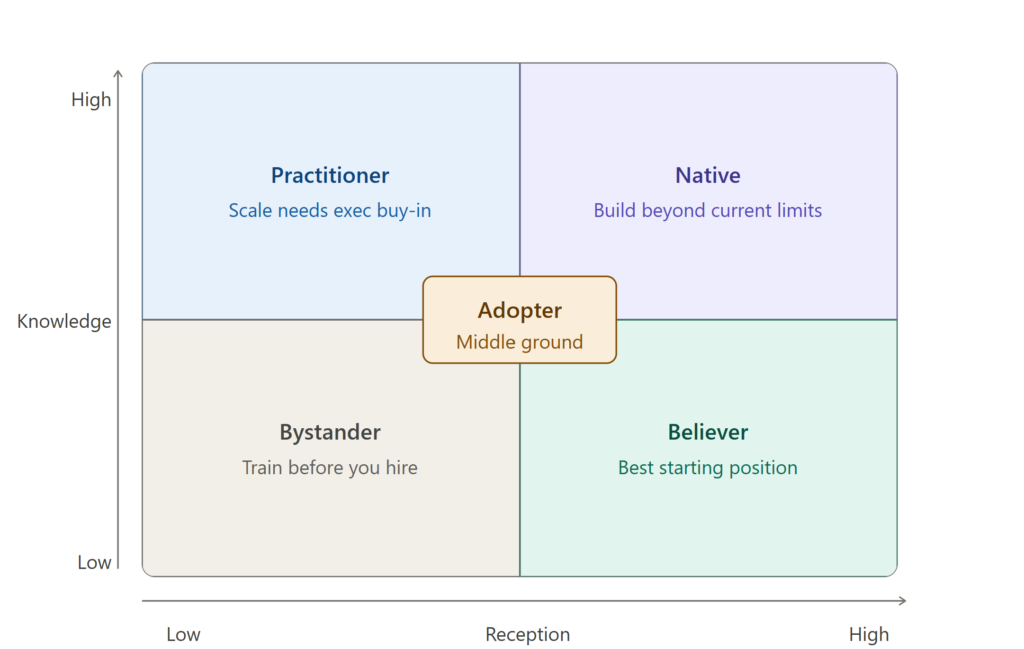
    A graphical representation of a four quadrant matrix to determine where you are in your AI positioning

    Five positions, five different problems

    Low Knowledge + Low Reception = Bystander.

    Your organisation hasn’t started, and isn’t particularly motivated to. Bringing in an AI transformation expert here will produce a unicorn problem almost every time, because the operating conditions can’t support them. There’s also a structural version of this position that’s worth naming separately.

    In some NZ government agencies, reception has nothing to do with enthusiasm and everything to do with policy. Staff can’t make decisions on behalf of their leaders. The hierarchy and accountability structures aren’t a culture problem, they’re a legal and policy architecture that nobody is dismantling regardless of how good the AI use case is.

    I watched Agile coaches walk into that environment expecting holacracy and come out confused. Anyone who walks in thinking they can see the full picture in that context is leading people toward a very expensive dead end. Train first. Run small experiments in contained spaces. Build curiosity before you bring in someone to scale it.

    Low Knowledge + High Reception = Believer.

    This is the best starting position. Leadership is bought in, which is the hardest thing to create. Use that cover. Invest in AI literacy across your teams first, practical workshops, hands-on tool exposure, small internal experiments that prove value in your specific context. Then bring in an experienced practitioner to help people apply what they’ve learned to your actual problems. In the interview, ask them to describe specifically how they’d approach your environment, not their last client’s environment. A generic answer tells you everything you need to know.

    High Knowledge + Low Reception = Practitioner.

    You have pockets of genuine capability, maybe a few teams doing interesting things, but no organisational pull to scale it. At BNZ, when I was there, we had exactly this: a traditional IT department running waterfall on one side, and a digital department on the other, its own reporting line, its own leadership, doing everything in an Agile manner to bring retail online services to market. Both existed simultaneously. The digital teams were capable and moving fast. The org-wide reception for their approach was mixed at best. An AI coach dropped into that second group can do good work, but they’ll spend half their time managing the friction at the boundary rather than coaching. The challenge in this position is political, not technical. Ask yourself whether you need executive sponsorship before you hire expertise, because without the first, you’re setting up the second to fail.

    Medium Knowledge + Medium Reception = Adopter.

    Stuck in the middle, probably frustrated, probably not getting the results you were promised. Adding more experts won’t unstick you. Decide which axis you need to move on first, because confusing an AI knowledge problem with an AI reception problem is exactly how organisations end up cycling through consultants without changing the underlying conditions.

    High Knowledge + High Reception = Native.

    You’re in the minority. You don’t need transformation expertise. You need specialists who can extend what you’re already building, people with deep domain capability in specific areas, not generalists who’ve read the same frameworks as everyone else.

    The question before the question

    The matrix is a diagnostic, not an answer. The point is to prompt this conversation:

    Does the hire you’re planning match your actual position, or the position you wish you were in?

    Most expensive AI hires are made from the second answer.

    It’s worked for me.
  • What Nobody Talks About After A Restructuring

    On 19 May, Finance Minister Nicola Willis announced the NZ public service will cut roughly 8,700 roles by 2029, taking headcount from around 64,000 down to 55,000. $2.4 billion in savings. Agencies merging. AI and digital tools named as part of how the remaining workforce will cope.

    The coverage since has been predictable. The PSA calling it reckless. Worried workers. The human cost, which is real and I won’t dismiss it.

    This is for the people who don’t lose their jobs.

    Post-restructuring is its own kind of hard. And almost nobody talks about it.

    I’ve been through enough restructures to know how this goes. The affected people get the attention, rightfully. HR runs the process. The communications go out. And then, fairly quickly, everyone turns back to the work, except now there are fewer people doing it, and the assumption, unstated but real, is that things will carry on more or less as before, just with more pressure per person.

    That assumption is wrong. And acting on it is how you burn out your best remaining people.

    The first thing I’d do is stop. Not literally, but mentally. Before you redistribute tasks, before you absorb someone’s workload, before you do anything, sit down and ask: what does this team actually need to deliver now?

    Here’s what I’ve seen in every restructure I’ve been through: organisations shrink the headcount but keep the workload intact. They split it across fewer people. That’s doing the same with less, and it collapses within a year.

    The restructure is, whether you asked for it or not, a forcing function to review everything. Use it.

    When I was at the bank, we had a report. Weekly or monthly, I can’t recall exactly. Generated by the technology team for a specific person in the CFO’s office. A proper report, formatted, tracked, sent on schedule. The kind of thing that takes someone a few hours to pull together each cycle.

    We interviewed that person. Asked what they used it for.

    They’d never actually looked at it. A safety net, they said. Just in case something came up. When we went back through the history, that something had never come up. Not once.

    That report was what I call shelfware. It looked like work, consumed resources, produced nothing. And in every organisation I’ve worked in, across 30 years, I’ve found versions of it. Reports, approval chains, coordination meetings, processes left running because stopping them would require someone to make a decision.

    The question after a restructure is whether you have the courage to find yours.

    The test I use is simple. Which 20% of what your team does actually drives 80% of the outcomes? Find that 20% and protect it. Everything else is a candidate for consolidation, elimination, or redesign.

    This isn’t easy. People are attached to their work. Some of what looks like shelfware is someone’s entire job identity. Having the straight conversation, directly, without dressing it up as anything other than a resource reality, is probably the hardest part of surviving leadership.

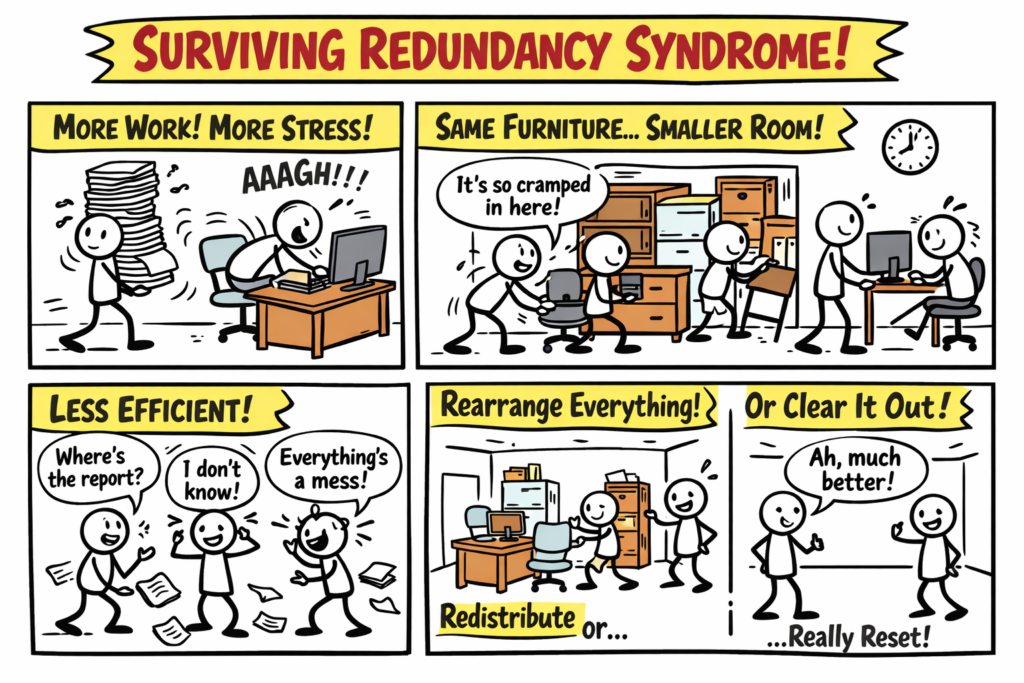
    But the alternative is distributing the same furniture across a smaller room and wondering why everyone feels crowded.

    There’s another thing worth paying attention to: the people who stayed.

    The research has a name for it, survivor syndrome, and it shows up as guilt, anxiety, low-grade dread that another round is coming. What I have watched follow it is people working harder for a few weeks, then quietly less. People feel the loss of colleagues. They feel the weight of expanded roles. They feel uncertain.

    The instinct from leadership is to focus forward. Get moving. Don’t dwell. I understand that instinct, and I’ve felt it myself.

    But skipping over it doesn’t make it go away. It surfaces later, as quiet disengagement, or as your best remaining person leaving on their own terms at the worst possible time.

    A direct conversation is better than a perky all-hands. Acknowledge what happened. Say what the plan is. Ask what people need, specifically, and then actually follow through.

    A comic strip on surviving redundancy syndrome as there is less people now to do the same amount of work. Do you rearrange everything? Redistribute or Clear it Out. Like a reset.

    Here’s what this looked like in practice for me. After a restructure at an education business, the service desk team was down to a handful of people. The old workload, staging and imaging laptops, managing logistics across 45 locations with 80 campuses nationwide, calling couriers, handling returns, would have crushed them if we’d pushed it forward unchanged.

    So we redesigned the supply chain. Partnered with the hardware supplier to do the imaging at source. Laptops arrived at users already configured. The courier handled distribution. Returns went directly back to the supplier’s offices, of which there were locations nationwide anyway.

    The cost per device for the entire arrangement, imaging, logistics, the whole thing, came out around $50. Less than 5% of the laptop price.

    The team didn’t shrink further. But what they spent their days doing got materially better. They went from robotic, time-consuming logistics to overseeing a mostly automated process and handling the exceptions that actually needed a human brain.

    That’s the opportunity inside a restructure, if you’re willing to use it. The pressure to reduce forces a review you probably should have done years earlier. Most organisations accumulate work the way houses accumulate furniture, gradually, without realising how much space it takes up.

    The question is whether you use the review to redistribute the same furniture, or to actually clear the room.

    I’ve done both. One of them works.

  • The Slow Drain You’re Not Watching

    Energy sits at the base of everything. When global oil flows get disrupted, that disruption doesn’t stay in the energy sector, it travels through the whole system: into transportation costs, which feed into food prices at the supermarket, into manufacturing, which moves through supply chains before landing on retail shelves, into LNG, which New Zealand imports. Once energy rises, everything rises. That’s just how the mechanism works.

    I’ve been watching three macro scenarios for the New Zealand economy: stagflation, inflation, and deflation. They’re easy to conflate, and the confusion matters because the responses to each are different, sometimes opposite.

    The definitions get muddled in most coverage.

    Inflation is when economic growth is rising, prices are rising, and unemployment is falling. You’re paying more, but you also have a job and likely a pay rise. Uncomfortable, but manageable if you’re positioned for it.

    Deflation is when economic growth slows, prices fall, and unemployment rises. Prices going down sounds good until you realise the economy is contracting and jobs are disappearing.

    Stagflation is the ugly one. Economic growth slows, inflation stays elevated, and unemployment rises. You get the worst of both: a contracting economy that still costs more to live in. There’s no relief valve. Slow economy, high costs, rising unemployment, all at the same time.

    That’s the scenario worth watching right now.

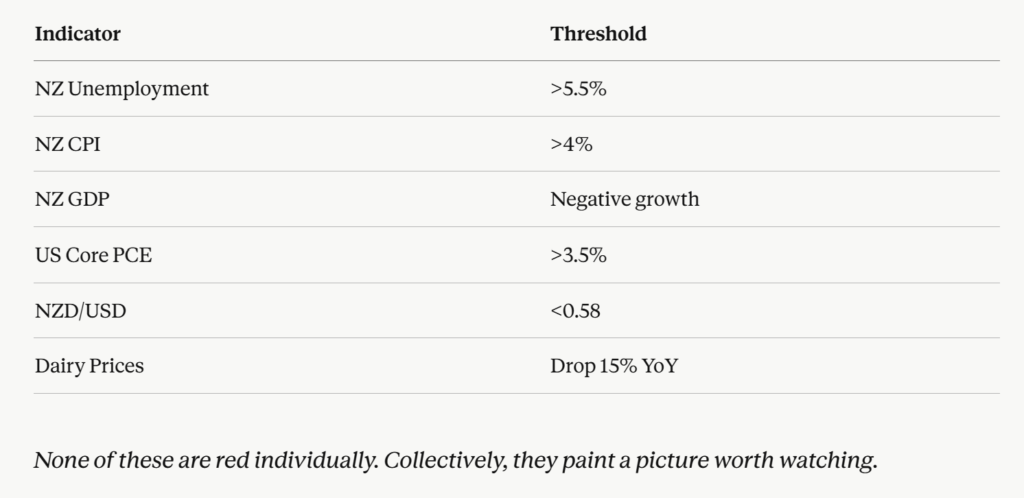
    A page to indicate 6 indicators and their thresholds for stagflation
    Stagflation Monitoring Framework

    Why New Zealand is unusually exposed

    Small open economies don’t carry many buffers, and New Zealand is about as open and as small as it gets among developed countries.

    We import energy, capital, and most manufactured goods. Our household wealth is disproportionately tied up in housing. Domestic consumption drives a large share of GDP. That combination creates a specific structural vulnerability: even when domestic demand weakens, imported inflation can stay sticky. Costs keep rising even as the economy contracts.

    A global oil disruption that barely registers for a large, diversified economy with domestic energy production lands differently here, because there’s less in the system to absorb the shock. It passes through more directly into the price of petrol, which passes into groceries, which passes into the cost of running a household.

    New Zealand’s dairy export earnings are also worth watching. Dairy is a primary current account earner. A 15% year-on-year drop in dairy prices hits the exchange rate, which hits the cost of everything we import, which hits household budgets. These things connect. Pull one and you feel the others move.

    The NZD/USD rate matters for the same reason. A weak kiwi dollar makes every imported good more expensive, and in a country as import-dependent as ours, that’s most goods.

    The 1970s rhyme

    History doesn’t repeat exactly, but it rhymes often enough to be worth paying attention to.

    Structurally, the world today is beginning to resemble the 1970s in ways that haven’t been true for 50 years: fragmented geopolitics, high commodity sensitivity, governments running large deficits while managing inflation, weakening productivity growth across developed economies. The exact causes are different. The shape is similar.

    The 1970s stagflation hit savers hard. Fixed income returns didn’t keep pace with inflation. Equities stagnated in real terms for extended periods. The people who preserved purchasing power were the ones who understood what was happening at the structural level, not the ones reacting to daily news cycles.

    We may be entering a similar period. I’m not saying it’s identical. I’m saying it’s rhyming, and that’s usually enough to be useful.

    Financial repression, quietly

    Governments carrying excessive debt have a limited menu of options. They can default outright, but advanced economies almost never do this, because central banks can print money to service the debt. They can cut spending dramatically, which is politically very difficult to sustain. Or they can do what actually tends to happen: allow real returns to go negative over a long period, quietly.

    Inflation erodes the real value of the debt. Currency debasement helps. Keeping interest rates below inflation suppresses borrowing costs for the government. Taxation takes its share of any nominal gains. None of it gets announced as policy. It happens through the cumulative interaction of those levers, and it slowly transfers wealth from savers to debtors, with governments being the largest debtor in the system.

    This happened after World War II. It happened through major debt crises across the 20th century. It’s a well-documented mechanism, and it tends to be the path of least political resistance when the debt load gets large enough. The process is gradual, which is exactly why most people don’t notice it until years later when they try to understand why their savings feel like they’ve shrunk.

    I think we may be entering another version of that environment.

    The maths that should concern you

    Here’s where it gets concrete.

    At current settings (April 2026):

    OCR at 2.25%. CPI at 3.1%. Assuming a 30% tax rate on interest income, which applies to most working New Zealanders.

    Work through it:

    2.25% interest earned on savings. Minus 30% tax leaves you about 1.58% net. Against 3.1% inflation.

    You’re losing roughly 1.5% purchasing power every year in a “safe” cash position. Before currency risk. Before fees. Before any consideration of whether the official CPI figure accurately captures your actual household cost of living, which, for most people, it understates, because the basket of goods they measure doesn’t weight housing and food costs the way most household budgets actually do.

    The money is still there, nominally. But it’s buying less every year. It’s a slow drain.

    In a stagflationary environment, where both inflation and currency pressures can worsen simultaneously, the erosion speeds up. The nominal number in your savings account can go up while the real number, what it actually buys, goes down. That gap is the trap.

    The instinct many people have at this point is to reach for higher yield, take on more risk to generate more return. That impulse is understandable, and it can also be exactly wrong if it leads you toward credit and duration risk you don’t fully understand. Higher-yield instruments aren’t free returns. The risk is real, and it tends to surface precisely in the kind of environment we’re discussing.

    Most of the mental models people use for financial safety were built in a different era, when real interest rates were positive, global trade was expanding, and geopolitics was relatively stable. Those conditions no longer reliably apply.

    What I’m actually watching

    Most of it is calibrated for engagement, not for helping you think clearly.

    The indicators worth tracking: the Global Shipping Cost Index, because it moves before consumer inflation does, it’s a leading indicator; NZD/USD, because our currency exposure runs directly through household costs; US Core PCE, because American monetary conditions still set the global tone, and if the Fed stays tight, the RBNZ has limited room to cut without making our currency situation worse; and dairy prices year-on-year, because that’s where NZ-specific external shock shows up first.

    The most useful thing to track is your own household cash flow. What your income actually buys, month to month. That’s where the real economy shows up, usually well before the official numbers catch up.

    If what you buy every week is noticeably more expensive than 12 months ago, and your savings return isn’t keeping up, you’re already inside the scenario I’m describing. You don’t need a macro framework to confirm what you’re already feeling in your grocery bill.

    One closing thought

    In a stagflation and geopolitical shock environment, real purchasing power erodes fast, even when the savings balance looks fine on paper.

    I’m not calling a specific outcome. I’m watching the indicators, understanding the structural conditions, and thinking about what they mean for my own financial position.

    This is not financial advice. It’s what I’m doing.

    The world looks more like the 1970s than it has in 50 years. That’s probably worth more than a passing thought.

  • When Benevolent Hegemony Turns Awry

    We all want to be the good guys. I’ve never met a person who genuinely thinks they’re the villain in their own story, not in organizational politics, not in international affairs, not anywhere.

    That instinct is mostly harmless. Where it becomes dangerous is when powerful states weaponize it as policy.

    The regime change fallacy

    For decades the tool has been the same: remove the bad actor, install something friendlier, let stability follow. The logic is clean on paper, and the intentions are often genuinely held.

    But history doesn’t support the clean version. Unintended consequences surface years later, sometimes catastrophically, and the underlying system that produced the original problem remains untouched.

    Good intentions, examined too shallowly, produce consequences nobody intended and everybody suffers. That gap between intention and action is the thing we consistently fail to examine.

    The anthropomorphic fallacy

    There’s a second pattern operating underneath the first.

    The Anthropomorphic Fallacy is the tendency to project human characteristics onto non-human entities. In geopolitics, this means demonising an entire population for the behaviour of its leadership. Label the government evil and the label migrates to the people. Once that migration happens, almost any action against them becomes justifiable.

    It bypasses analysis and activates emotion, which is why it keeps working.

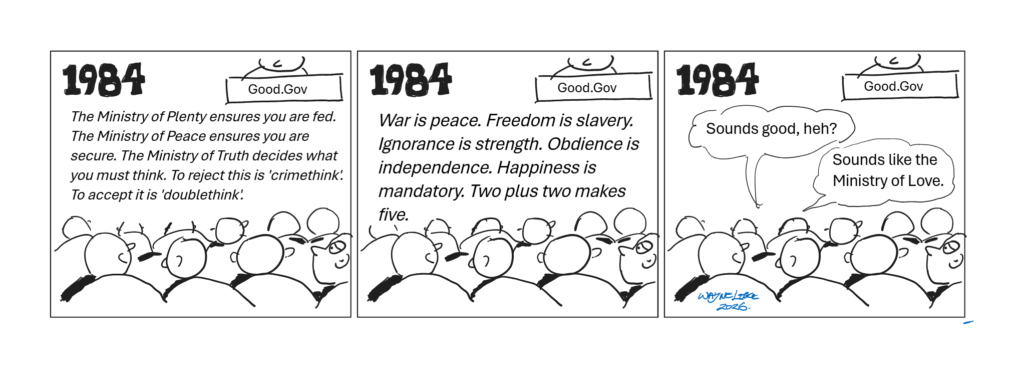
    A comic strip rendering the Good Government which was inspired by 1984.

    Why we let it happen

    The root condition is this: we’ve stopped thinking independently.

    We consume what confirms our existing beliefs, defer to whoever sits at the top of our particular tribe, and treat speed of consumption as a substitute for understanding. Ideological certainty fills the space where evidence used to sit.

    I watched this pattern in platform teams and government agencies for years, the same structure at every scale. The system drifts, leadership doubles down on the original diagnosis, the people closest to the problem say nothing because the tribe has spoken. It moves from a 50-person engineering team to a superpower without changing shape.

    What I think

    I don’t have a prescription, and I’m genuinely uncertain whether the drift reverses at the collective level.

    But individually, the path is clear enough. Ask why, more than once, until you reach the root. Seek the perspective that contradicts yours, especially when it’s uncomfortable. Demand evidence that challenges your current position, not just evidence that supports it.

    We outsourced our thinking in the name of speed and productivity. The cost of that is playing out right now.

    I don’t know whether enough people think the cost has gotten too high.