
On the morning of Thursday 27 August I opened my dashboard to see what the Americans had published overnight, and the inflation panel stayed green. Headline PCE 3.7% for July, core PCE 3.3%, both up 0.2% on the month. My threshold sits at 3.5%. Green, because the series I decided to feed that panel, back when I was building the thing, was core PCE, the number the Federal Reserve uses to set policy. Had I fed it headline PCE instead, the same release, the same morning, the panel would have gone red and I would have been working down my guardrail checklist instead of making coffee.
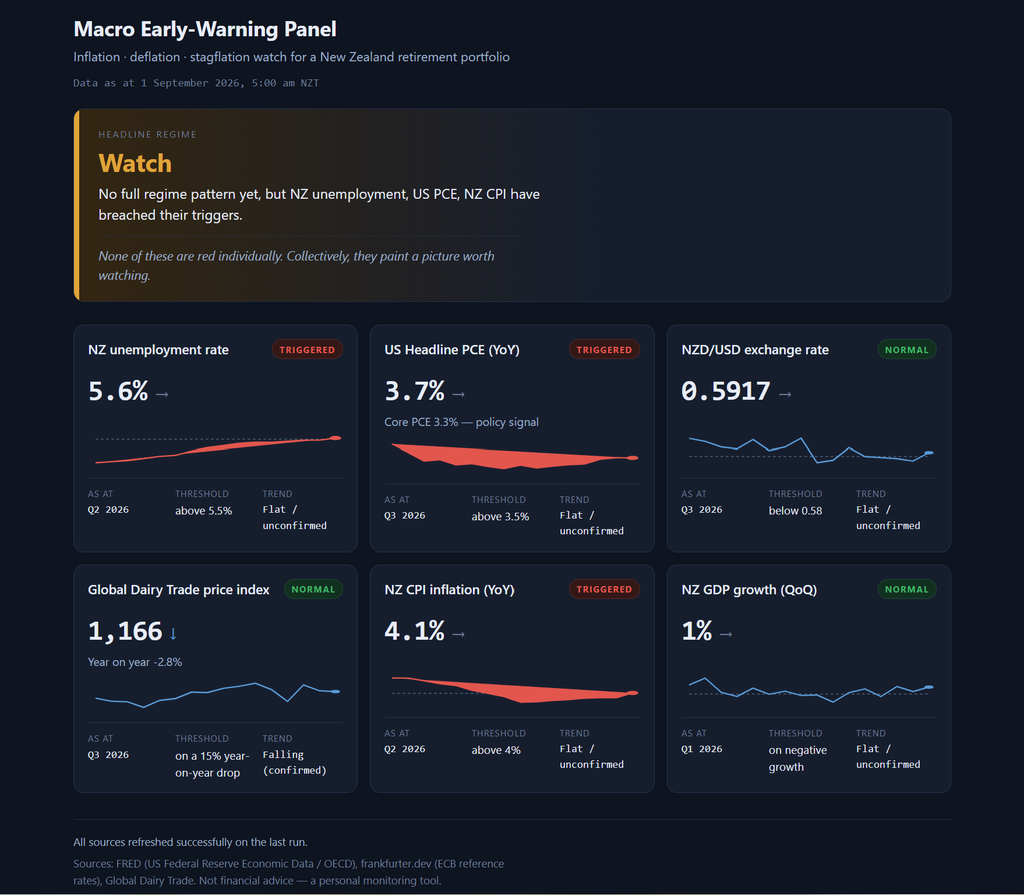
The gap between those two numbers is 0.4 percentage points. The decision that produced it took me about 1 minute, somewhere in a weekend of building, and I had not looked at it again until that morning.
I have no salary. I finished up in November 2024 and I now run a household on savings, dividends, interest and rent, against annual expenses that are mostly fixed and mostly not negotiable. So the panel is not an academic exercise; it is the thing that tells me whether to change what I am doing. Which makes the choice of series a real decision, and I want to be clear that I made it fast and I made it by copying somebody else.
Why the Fed leaves out the things I actually buy
Core inflation exists for a defensible reason, and I want to give it its due before I criticise my own use of it.
Food and energy prices swing hard on weather, on geopolitics, on shipping and on global commodity markets, and most of those swings reverse. Monetary policy works with lags of 12 to 24 months and often longer, so a central bank that moved the cash rate every time petrol jumped would be tightening into a shock that had already passed and easing into one that had not yet arrived. Stripping the two noisiest categories gives policymakers a cleaner read on the slower-moving pressures they can actually influence: labour costs, capacity, services demand. The formal target in both countries is still the full basket over time. Core is the working instrument, not the destination.
Picture a smoke alarm wired to ignore the kitchen, because the kitchen sets it off every time somebody browns onions and the false alarms train the household to pull the battery out. Ignoring the kitchen is the right engineering choice on 99 nights out of 100. It is the hundredth night that concerns me, because the fire usually starts in the kitchen.
What the kitchen looks like here
New Zealand’s CPI rose 4.1% in the year to the June 2026 quarter, and 1.5% in the quarter alone. That is a two-year high and the third straight quarter outside the Reserve Bank’s 1% to 3% band. Underneath it: petrol up 27.5%, other vehicle fuels and lubricants, mainly diesel, up 71.0%, electricity up around 12%, local authority rates up 8.8%.
Now the part that should stop anybody using a core measure in this country. Stats NZ published the counterfactual: take the fuel moves out and CPI rose 2.9%, comfortably inside the band. Which means the entire breach of the target, the whole of the gap between “on track” and “three quarters over”, sits in the category that core measures are designed to exclude.
Against that, wages. The Labour Cost Index came in at 2.0% for the year, average ordinary-time hourly earnings around 2.8%, median hourly earnings 2.7%. All of them well under 4.1%. Real incomes are falling for most people who work for a living, and for those of us who do not, the equivalent arithmetic is similar. The real return on anything held in cash or short deposits is negative once you use the number that reflects what you actually spend. The OCR went to 2.50% in July, its first rise after sitting at 2.25% since November 2025, and deposit rates are still nowhere near the 4.1%.
And the labour market kept doing what I said it would do. When I posted about unemployment reaching 5.6% in the June quarter I noted that I had bet on a further rise, and the 3-quarter and 8-quarter moving averages I run were the reason I was willing to say it out loud. The June print came in worse than every major bank’s pick; BNZ and Westpac had 5.4%, ANZ and ASB had 5.5%, Kiwibank had 5.3%. Underutilisation went from 12.9% to 13.8%. Rising unemployment with 4.1% inflation and a central bank that has just started raising again is an uncomfortable combination for anybody drawing down capital, and it is the reason I have panels at all.
The variable most people are not watching
Diesel, up 71% in a year.
Petrol is the price everybody sees, because it is on a sign at head height on the way to work, and when it falls people relax. Diesel is the one that moves through the system. It runs the trucks that bring food to the supermarket, the tractors and the harvesters, the coastal shipping, the generators, the excavators on every construction site, the freight that sits inside the price of a fridge before anybody puts a margin on it. A sustained rise in diesel does not stay in the transport line of the CPI; it turns up months later in groceries, in building costs, in the price of getting anything repaired.
We are a small open economy and a net importer, so a good deal of this arrives at the border rather than being made here. A stronger New Zealand dollar takes some of the sting out of it for a household like mine, at the cost of the exporters who earn the foreign income the country runs on. Sitting where I sit, drawing on savings and buying imported goods, I would take the stronger dollar. I recognise that is my position talking, and that the farmer down the road would tell you the opposite with equal justification.
What I changed
The panel now runs both series. The PCE threshold stays where it is, one number, at 3.5%, and headline PCE is what has to clear it from here, because the threshold exists to tell me when my own cost of living has moved enough to change my behaviour. Core sits alongside as context, because core tells me something different and something I still need: what the Reserve Bank and the Federal Reserve are likely to do next, which drives my deposit rates, my bond ladder and the discount rate on everything I own. One threshold, two series, two questions.
The rest of it is unglamorous. I plan the driving instead of taking trips as they occur to me. I shop differently, and I have become the sort of person who reads the catalogues and checks the online prices at Pak’nSave, Woolworths and New World before leaving the house, and who runs the fuel coupons, and who knows what a kilogram of chicken thighs costs at each of them. Every three weeks or so we drive up to Auckland to see our daughter, and the Costco run and the Asian grocery shopping are planned into that same trip, Foodie, Tai Ping, and now Stacks, which opened recently at Sylvia Park. One drive, the visit and the shopping both, because the fuel is being spent either way. I hold the fixed annual expenses under review even when nothing appears to be wrong, because rates, insurance and electricity have all gone up faster than the average and none of them respond to being negotiated with. And I watch diesel, weekly, the way other people watch the exchange rate.
This is not financial advice, but this is what I did.
The broader point is the one I would have missed if the July release had come in at 3.4% instead of 3.7%. A dashboard is only as good as the question you asked it, and the moment where you choose which series to plug in is the moment you decide whose question that is. I had unthinkingly adopted the Federal Reserve’s question, which is a good question, carefully constructed by people who understand the lags better than I do, and which is about managing an economy over two years. My question is whether the money lasts. Those are not the same question, and the number that answers one of them will quietly answer the other one wrong.
Most of us build our measurement systems by copying whoever seems to know what they are doing, and then we trust the output because we built it ourselves.
I changed the series this week. That took about 1 minute too.