When we moved house, the hardest part was not the lifting. It was the packing, and inside the packing, the deciding. You pick up something you have kept for years, you hold it, and you have to work out whether it comes with you or goes into the pile for the op shop, and there is no right answer available to you at that moment, only a guess you will find out about later. On moving day the fear arrives in two flavours at once: that you have brought too much, and that you have thrown away too much. Both feel true simultaneously.
Then you arrive, and it starts again. In the old house my study was on the first floor and the living area was downstairs. In this house it is the other way round, the study on the ground floor and the living upstairs, so for days I walked the wrong way out of habit. I opened the wrong drawer looking for the scissors. I could not remember which box the good knives had gone into, and I could not remember which cupboard I had decided the good knives should live in, because that decision had not actually been made yet, it was being made again every time I cooked. Then there is the street, the neighbours, the new routine, the drive to the shops that takes a different amount of time from the old one.
None of that was a disaster. All of it was uncomfortable. And that discomfort, multiplied by a few hundred or a few thousand people, is what you are asking for when you stand up in front of an organisation and say we are going to change the culture.
That is the part I did not say properly the first time I wrote about this in 2019.
What I had then
A few years ago, while I was at Stats NZ, I wrote a short piece asking why changing culture is so hard. I had the symptoms right. Not invented here, so nothing from an external origin is ever quite good enough. The organisation’s immunity system, which switches on the moment something threatens people’s influence and control, and which does not live in the leadership layer, it lives with the people who man the cogs. Culture wrapped around leadership, strategy, structure, process and people like a rubber band, so that when you pull on one part of it, the whole thing snaps back to where it started.
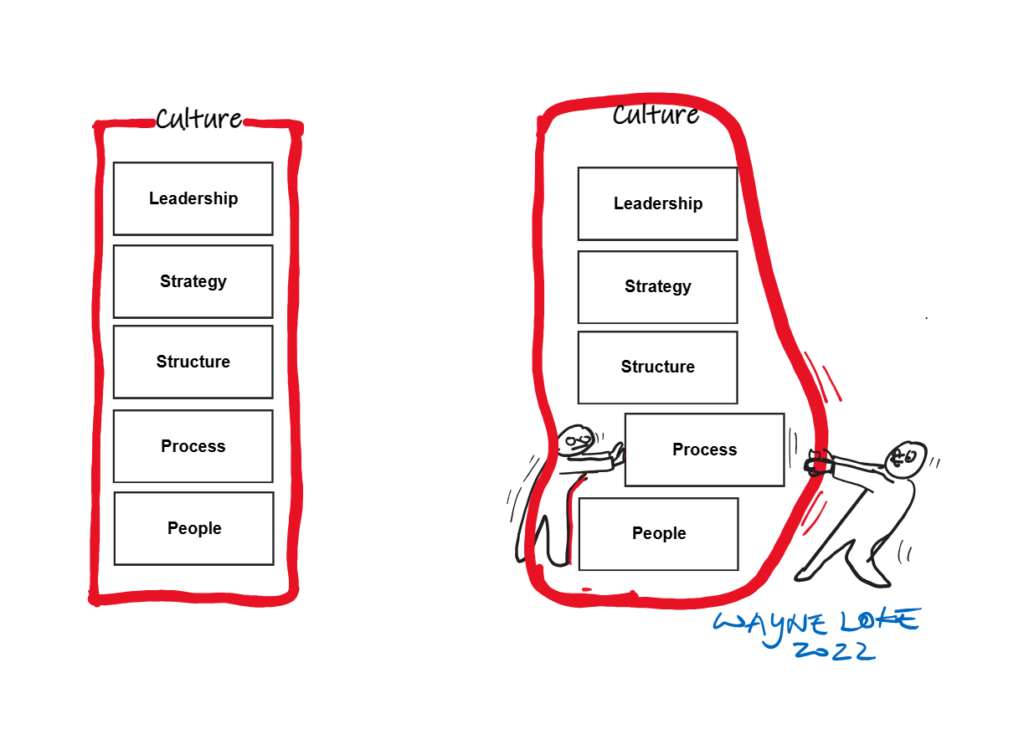
I still think that is right. But it describes the machine, not the people inside it. What I could not name then were the two things underneath, the two that decide whether anything moves at all.
Belief and fear.
Belief
The status quo is a comfort zone people have earned, day in and day out, over years of doing the same thing with no threat to their safety and no threat to their routine. Ask them to work differently and you are asking them to move house. The boxes, the wrong drawer, the scissors.
So the standard answer is that you need a visionary leader, someone who paints the picture of the future and pulls people towards it. Apple gets cited, and Steve Jobs, and the argument is not wrong, but look at the position he was standing in. He was the founder. He was also the employer. If the vision failed, he failed himself, and everybody could see he had put himself on the line to the same degree he was asking of them.
Now take a senior leader of similar seniority in a large organisation. Not the founder. Not the employer. An employee, like everyone else, with a manager above them, a contract, and a term. They can paint the same picture, with the same conviction, in the same words, and from what I have watched, belief tops out somewhere around half. Maybe 50 to 60 percent of the people underneath will take it on. The rest will not.
They will not because they have no skin in the game, and because they have seen this film before. The senior leader can leave. The senior leader can be overruled by someone more senior, a chief executive, a chair, a board, or the founder himself or herself. The vision can survive one restructure and be quietly dropped in the next. And what people are being asked to sign up to, in the meantime, is a way of working that makes their own job harder today, for a benefit that lands somewhere else, later, if it lands at all. They are reading the odds correctly.
Fear
Fear does the work belief cannot. Fear of losing your job. Fear of losing your subsistence, the mortgage, the school fees, the amount that arrives in your account every fortnight. Fear of losing your seniority, your influence, your position, the standing that took you 15 years to build and can be removed in a 20 minute meeting.
Ask why some organisations change quickly and the answer is usually sitting right there. When people genuinely believe the organisation may not be an ongoing concern, they move. Their livelihood is at stake, so they adapt, they adjust, they learn the new system, they stop arguing about whose team owns what. Belief and fear point the same way for once. And a second belief switches on alongside it, that if they do not contribute to the change, they will be as guilty as everyone else for not putting in.
Not everyone behaves rationally. Some people look at exactly the same situation and say, this ship is going down, why am I still standing on it, and they go. They are weighing a different risk, and from where they sit it is a fair call. Self-interest is part of belief too. A person who believes the effort is wishful will not spend their remaining energy on it, and they will certainly not be moved by a poster in the lift lobby.
So fear moves people. It also moves people out the door. Fear on its own, with no belief attached to it, buys you compliance and a resignation queue.
Why you cannot do it one lever at a time
Belief without fear gives you polite agreement. People nod in the workshop, they take the sticker, they go back to their desk and do what they did last week, because nothing bad happens if they do. Fear without belief gives you compliance, which looks like change for about two quarters, until people work out the minimum they can do without being noticed. You need both, pointing the same direction, at the same time.
That is why culture cannot be changed sequentially. People are programmed to do things one at a time, so we take strategy this quarter, process next quarter, technology after that, and people when the budget allows. It is orderly, it fits on a Gantt chart, and it fails, because every lever you have not pulled yet is a question you cannot answer, and every question you cannot answer is a reason not to believe.
Someone asks what happens to his or her role in the new structure, and if the structure work has not started, you have nothing to give them. Someone asks why the leadership still behaves the way it always did, and if you have changed the process but not the behaviour above them, they will believe the behaviour, because that is the part that decides their next performance review. People read what stays the same far more carefully than they read what changes.
That is the rubber band. Culture wraps around leadership, strategy, structure, process and people. Pull one of them on its own, and you feel the tension for a while, and then it snaps back, and everyone who did not move feels quietly justified for not having moved. Pull all of them together and the whole thing travels.
What is invisible from the outside is how much preparation that takes. When an organisation appears to change quickly, you are watching the last 10 percent. The other 90 percent happened before anything was announced: the sequencing, the deciding of who can answer which question, the working out of what people will ask on day one and what the real answer to each of those is. That preparation never shows, which is exactly why the next organisation copies the visible part and wonders why it snaps back.
What I could and could not do at Stats NZ
Inside my own group, it worked. Over 2 years the engagement score in my area went from -14 percent to an NPS of +50. Not because I gave better speeches. In my own patch I could pull all of it at once, who led what, how the work was structured, how the process ran, who sat in which seat, and I could answer nearly every question a person put to me on the spot, myself, without going away to check. Belief was available because the answers were available. And fear had a floor under it, because people could see I would take the hit before they did.
Outside my patch I had none of those levers. I could influence, I could argue, I could write. The wider organisation had its own rubber band, and it snapped back, and I sat there writing a short article asking why changing culture is so hard, which is how the first version of this piece came to exist.
That is the limit of the story. I have changed the culture of a group I was accountable for. I have not changed the culture of an entire organisation from the position of an employee, and I have not met many people who have, unless the organisation was frightened enough to let them.
When the senses agree
Here is the test I use now. It is not scientific, it is just what I have watched happen. Culture has changed when what people see, what they hear, what they feel, what they taste and what they smell all agree with each other.
They see leaders doing the new thing when there is no audience in the room. They hear the same story from their manager, from the chief executive, and from the person two teams over. They feel it in what happens to them personally, their workload, their pay, their standing, whether the person who spoke up last month is still here. They taste it in the small daily things, the meeting that got shorter, the approval that took a day instead of a fortnight. And they smell it, because people can smell a change programme that is not real from a long way off, the same way you can smell a house that has been repainted to cover something.
If four of those agree and one does not, people believe the one that does not. Every time. That single disagreement is where belief leaks out, and once belief has gone, all you have left is fear, and fear on its own will get you through a transition and hollow out the place on the way.
I know where the scissors live now. It took a lot longer than I expected it to.