For 4 years those boxes sat in the closet, the filing cabinets, the shelf in the corner, and I never once opened them. I moved to Hamilton in 2022 and the paper came with me, taped up, labelled, promising to be useful one day. Now I’m moving house again in 3 weeks, so I finally cut the tape. Most of what I found was printouts. Articles from Harvard Business Review, research notes from Gartner and Forrester, journal pieces, newsletters, things I printed off before AI, before the internet was much use, and a fair bit of it from before the internet at all. I printed them because that’s what you did. You couldn’t read a Gartner report on your phone on the train back then, so you printed it, folded it into your bag, and read it on the commute, or in a meeting where you looked busy and were, occasionally, actually learning something.
People talk about hoarding as retail therapy, and I understand the pull of it: buying things with your own hard-earned money is a small hit of happiness, and there’s nothing wrong with that. My hoarding was a different animal. Mine was knowledge. Over 30-odd years across Southern Bank, ABN AMRO, the National Bank/ANZ, Inland Revenue, Stats NZ, I gathered paper the way other people gather shoes, because in my line of work the paper was the point. It was the raw material of doing the job well. So I kept it, and kept it, and moved it from house to house, and told myself I’d use it again one day.
The maybe bucket is a trap
So I did what you’re supposed to do. Three buckets. Keep, throw, and maybe. The keep pile is easy and the throw pile is easy. The maybe pile is where good decluttering quietly goes to die.
I read something years ago about the maybe bucket that stuck with me, and it turns out to be true every single time. The maybe bucket is not a decision. It’s a holding pen for your own uncertainty. You put a thing in there because you can’t decide, and when you come back to look at it again, you are exactly as undecided as you were the first time, so it lives forever. Never filter the maybe bucket. The moment you start sorting it, picking through it a second time, you’ve handed your uncertainty a way to keep everything.
My rule is blunter than the books make it sound. Hell yes, I keep it. Hell no, it’s gone. And maybe is hell no, because the hesitation is the answer. If I have to think about it, I already know. Then I run one test on the whole lot: would I miss this a month from now, 2 months from now? These boxes have been sealed in a closet for 4 years and I haven’t missed a single page. So the answer writes itself. Would I use it again? Probably not. Would I ever find it again if I wanted it, buried in a box, filed under a system I set up a decade ago and have long forgotten? No. You never find the thing you archived by hand. And if I genuinely want the idea back, well, you’ve got AI now. You’ll remember you once read it, you’ll ask, and it will hand you a better version than the yellowing page you were clinging to.
Knowledge got cheap
Here’s the thing that landed on me somewhere in the middle of the second filing cabinet, kneeling on the floor with a bin bag. Knowledge is cheap now.
When I started out at 19, people paid for what you knew. You acquired it, you studied it, you carried it around, and that accumulation was your edge. It was why you got hired, why you got promoted, why someone senior asked for your read on a problem. I made CIO at ABN AMRO in my early thirties, and a good chunk of what got me there was simply that I’d done the reading nobody else had bothered to do. The paper in my bag was professional capital. It had a price, and I’d paid it, in commutes and late nights and subscription fees.
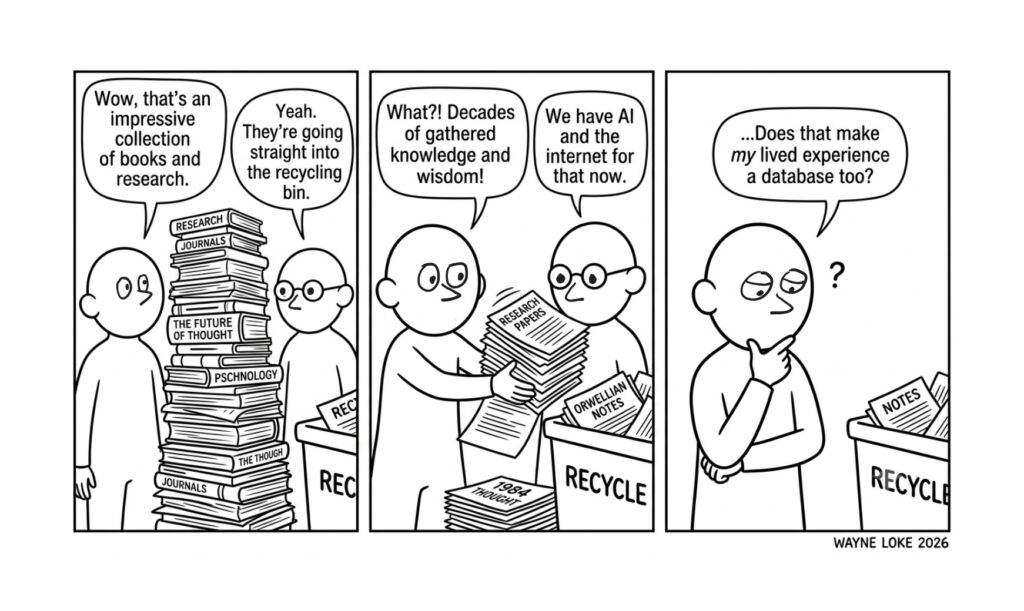
Now anyone can Google it. Better than that, they can ask an AI to do the deep dive and explain it back at whatever level suits them, like they’re 5 years old, or like they’re a corporate executive, or like they’re a CIO who needs it in the language of a board paper. The thing that took me years to gather, a curious teenager can now summon in a sentence, in better shape than I ever kept it. That paper mountain in my closet, the one that was capital once, is recycling now. I’m not being dramatic about it. I’m literally putting it in the recycling.
What I couldn’t throw out
And yet I kept some of it. Not much, but some.
I kept my own notes. The newsletters I wrote, the journals of my own thinking, the observations I jotted down over the years that were never online and never will be. That’s not knowledge I can Google, because nobody has published it, including me. It’s mine, and I keep it because it feeds what I write now on Strategic Kata. The rest, the borrowed knowledge, the reprints of other people’s cleverness, I let go, because the internet holds a better copy than my cabinet ever did.
My wife ran the same test faster than I did. She had the course materials from her Cafe Service Level 2 Certification and her Certificate in Dental Assisting from the New Zealand Dental Association. I asked if she wanted to keep them. She said, give me some time. Less than an hour later she came back and said, chuck it out, I’m not working anymore, and the information’s probably dated by now anyway. Then she said the thing that is the whole point of this piece, without meaning to say anything profound at all: the rest is in my head. The course materials went in the no bucket. The certificates she kept. The knowledge stayed exactly where it had always lived.
The information was the cheap part all along. What held its value was what we did with it, and what stayed in our heads after the paper was filed and forgotten. AI didn’t take that from anyone. It just made it obvious, by making the information itself free. The stuff that’s still worth something is the stuff that was never really on the page: the judgment, the pattern recognition, the scar tissue from having been in the room when it went wrong.
Books are where my rule breaks, and I’ll admit it plainly. I can’t part with physical books. I have a hardcover of Management Control Systems, 9th edition, Anthony and Govindarajan, from my MBA days. I read it front to back and went back to it for years. The information in it is dated now too, of course it is. That’s not why I keep it. I keep it for the earmarks, the notes crammed in the margins, the sticky tabs, the yellowing pages, the whole record of me arguing with the author across the page. Master that book and you know what to look at and what to consider, and the rest is delegation. What I value there is the layer of my own thinking sitting on top of it, and you can’t print that off Gartner.
One room at a time
Then there’s the rest of it. The extra furniture nobody sits on, the kitchen appliances we bought and used twice and left to gather dust. There’s a quiet lesson in an appliance you haven’t touched in a year. I’m a minimalist by nature, and my wife is learning to be one, though it’s taken her time and a few house moves to get there.
We’ve got 3 weeks, so we’re doing one room at a time. AI handled the checklist and the paperwork, which used to eat a weekend on its own. Thinking about it, this move is the least stressful we’ve had, and the reason is simple: we’re both home full time now. The hard moves were the ones where we both worked, packing at midnight, arguing about who booked the truck. This time we can sit on the floor with a box of old crockery and utensils and stuff we’d forgotten we owned, and talk, and laugh about where it came from. Sentimental value? Plenty. Worth keeping? Not really. So it’s sold, or given to someone who’ll use it, or dropped at the Salvation Army or the op shop.
The lawn mower and the trimmer are the last things to go, and they can’t go yet. I’ve still got to mow and trim the lawn one last time before I hand the keys back to the property manager, so those two stay until the tenancy exit is done. Small mercy on the other end: the place we’re moving to has no lawn to mow at all.
We upsized once. We downsized once. Now we downsize again. Life is good.