
One fund holds about 20% of my investment portfolio. My own limit for any single fund is 15%, and a few months ago this one was close to 25%. I’m over my own line, I know it, and I’m holding there on purpose. This is not financial advice, but this is what I did, and why.
I no longer draw a salary. Until New Zealand Superannuation starts, my portfolio has to pay the bills, and the start date isn’t as settled as it used to be: the age itself is being argued about, 65, 67, even 68 in one recent proposal, so I’m not planning on it being 65. Call it 5 to 7 years of drawing down, and you can’t keep a portfolio fixed while you’re taking money out of it and putting nothing back in.
The 15% came out of research I did with AI, Claude among others, and it’s the safe answer. Ask a financial planner and you’ll get something like it: don’t put more than a set share of your money into one product or one category, so that if it collapses it can’t take too much of you with it. Spread your money across enough things and the law of averages works for you, because one failure gets diluted by everything that didn’t fail. I agree with all of that. It’s a good rule.
Then the rule broke without me doing anything. The fund is a monthly income fund. It lends against New Zealand houses, home loans and, mostly, loans to people building them, and it pays me a return every month, like a dividend, about 6 to 7% a year before tax. Its unit price hardly moves. Everything else I hold goes up and down with the market, so whenever the rest of the portfolio dipped, the steady fund’s share of it grew. The safest-looking thing I own broke my limit by standing still, without me buying a single extra unit.
The drift showed me how little the cap looks at. It takes one holding and asks what happens if it collapses. It doesn’t ask what the holding is for, and for me this one is the income, the monthly payment that does the job a salary used to do. It doesn’t look at the economy either. A 15% cap is the same number in a boom and in a recession, for a 30-year-old adding money every month and for someone like me taking it out.
I’ve been burned enough times to know that a rule on its own won’t protect me. School didn’t teach us anything about money. When I started working I thought investing meant buying shares on someone’s tip and hoping for a quick gain, and I learned the rest the slow way, from books by the great investors, and from my own losses. I’ve held shares in a company that delisted when it was sold to a private equity buyer. I’ve held zombies, companies that look alive until you read the accounts with see-through eyes and realise they’d go bankrupt the day the funding stopped. And I held a unit trust whose manager advised investors to stay in for 5 years or more, then wound it up 3 years after I joined, because the manager wasn’t earning enough in fees to keep running it. The fund had been around for more than 5 years, so the advice to hold for 5 was true. The manager closed it anyway. Since then I watch a fund’s assets under management. Too small, and you risk it being wound up. It’s only one variable.
A prospectus is written at one point in time, mostly to sell, and it guarantees nothing about what comes next. There’s information a public investor never gets. With that kind of asymmetry, the best I can do is minimise my losses, by reading between the lines and watching closely.
Watching closely used to be hard. Now AI runs a weekly briefing on my portfolio: it scours company reports, announcements, analysis and the news, and checks whether any of my early triggers have been activated, so that I’m not making the decision at the very last minute, which is what hurt me before. The decisions are still mine. The briefing buys me time to impact. A trigger is an early warning, and I don’t want to be acting on impact, because by then it’s too late. Investment decisions move fast because the herd moves fast, other investors and the institutions all doing the same thing at the same time, so when I see a trigger I start deciding: do nothing yet, or start taking small steps to cut my losses. It works the same way on the way up. Nobody knows where the peak is, so I take small steps either way.
The trigger I watch
This fund lends on two kinds of loan, home loans and construction loans, and most of the money is in construction. In a market with inflation and rising unemployment, the people who struggle first are people with mortgages, and builders who can’t sell the houses they’ve finished, and when they miss repayments, the fund feels it. This year the numbers have been pointing that way. The Reserve Bank raised the OCR twice between July and September, from 2.25% to 2.75%, and mortgage rates have gone up. On 28 October it held at 2.75% on a 4-3 vote, when markets had priced in another rise, and said it still expects to tighten; the New Zealand dollar fell against the US dollar the moment the decision came out, and a weaker dollar makes everything we import cost more. Unemployment was 5.6% in the June quarter. Annual inflation was 4.1% in June and 3.7% in September, with petrol up 19.1% on a year earlier, imported cost we can’t do much about. Growth per person over the year to June was 0.1%. And in August the fund’s manager reported two mortgagee sales in the previous four weeks, with a third booked for September; the sales went at better prices than expected, it said, with no effect on investors’ returns.
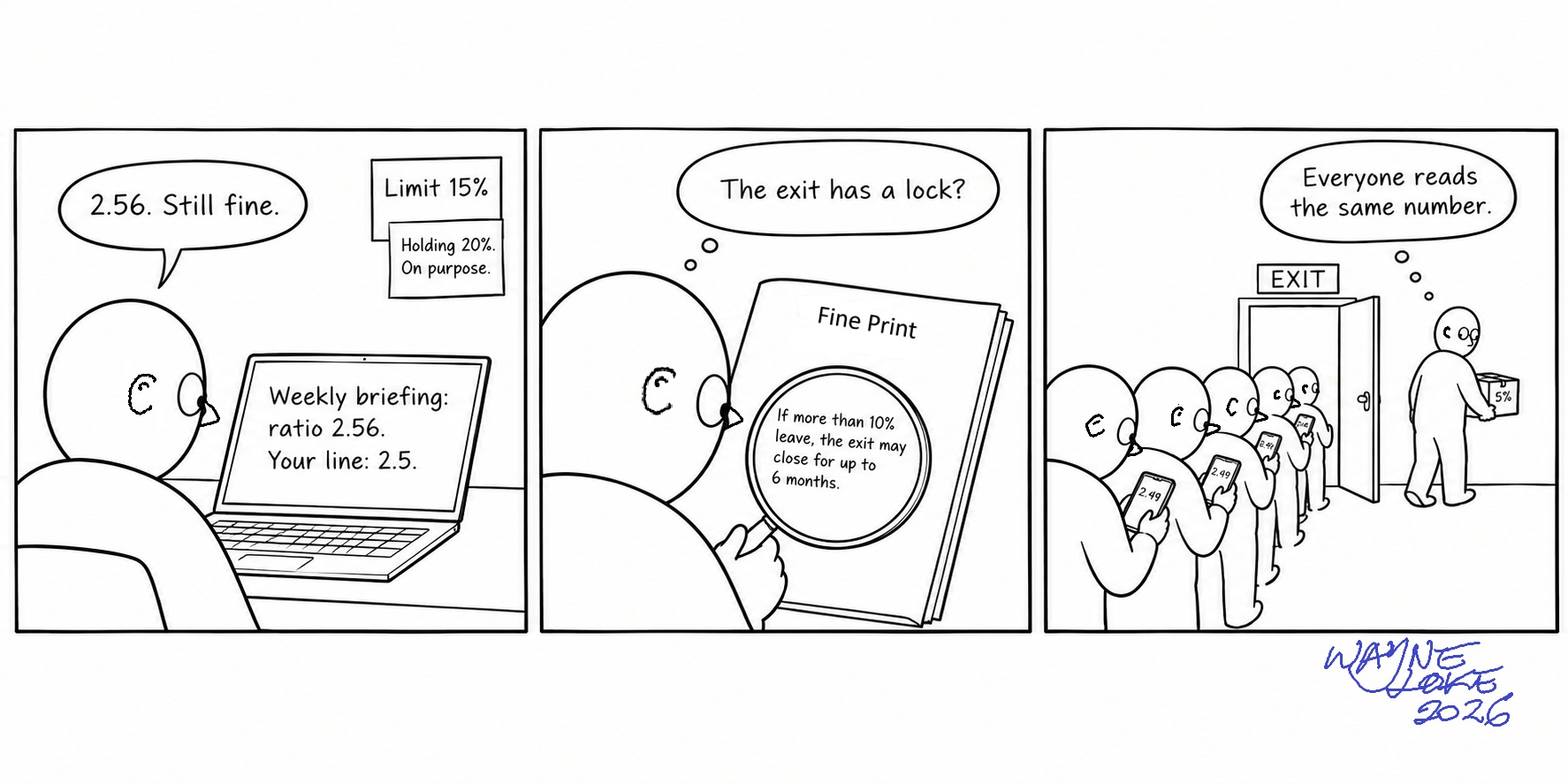
So far that’s a reason to watch. The number I watch most closely is the fund’s credit risk ratio, which tells me whether it can absorb what’s coming: the reserve set aside to cover bad loans, compared with the losses the manager expects the loans to make. On the construction loans it reads 2.56, which means the reserve covers expected losses about two and a half times. If it slips below 2.56, I watch harder. Below 2.5, or if the expected default rate on those loans, 0.84% a year now, moves towards 1%, I know it can reach its tipping point sooner, and I’m ready to start partially exiting.
I’ve already taken the first small step. When I saw mortgage rates going up and defaults starting to appear, I trimmed 5% of the portfolio out of the fund, which took it from about 25% to 20%. The fund says it endeavours to pay withdrawals within 30 days, and I had my money within a week. I put it into corporate bonds, which pay 4.5 to 5% instead of 6 to 7%, quarterly or half-yearly instead of monthly. That’s what the step cost me: less income, and lumpier. I paid it to reduce my exposure.
The clause I hadn’t read
Until I started writing this piece, I didn’t know how the exit worked. I asked Claude to check, and it found the clause in the fund’s product disclosure statement. If withdrawal requests over 60 business days add up to more than 10% of the fund, the manager can defer paying them out. If letting investors take their money out “would not be workable”, it can suspend withdrawals for up to six months. And the reserves I watch so carefully are, in the document’s own words, “not guaranteed”.
I’d learned not to trust what a fund’s documents promise. I hadn’t read what this one lets the manager do.
Anyone can read the numbers behind my triggers. The ratio is published, and everyone with money in the fund can see the same reserve figures and the same news about mortgagee sales that my briefing reads. If enough of them decide to leave in the same few weeks, the 10% gate closes, and the exit I’d planned sits in a queue. So the trigger has to fire while leaving is still cheap, before the herd acts on the same numbers. The first 5% came out before I knew the gate existed. Once the trigger fires, I won’t wait a moment longer.
The same position at work
Organisations hold positions like this all the time, mostly without the triggers. When I was appointed Solution Development Manager for Channels at ANZ, after the musical chairs reshuffle I wrote about in The Redistribution Reflex, one of my engineers was the only person configuring IBM WebSphere Message Broker. It was integration middleware, piloted a couple of years before I arrived, to cut down the point-to-point complexity of running two mainframes side by side, ANZ’s and the National Bank’s, before and after the two banks’ systems were merged. Nobody gave me the brief. In that structure I was a people manager for a large team; architecture, projects and the application layers sat outside my territory, and how things connected wasn’t mine to ask.
I could see the bottleneck straight away: a single point of dependency. Senior leadership didn’t think it was an issue, because it was a pilot and it hadn’t scaled. I asked whether the pilot was meant to become a strategic, enterprise-wide capability, or stay a small solution for one application. I was told it wasn’t relevant, and not my place. The broker had been running on one person since before I became the team’s manager.
The monitoring we had was for how the technology worked, and that’s the easy part. Nobody was monitoring whether the organisation could operate it, support it and grow it without depending on one person. I’d have added specialist coverage, backup coverage and his workload as formal measures, because when he was away for any reason, work stopped, and delivery stopped with it. He didn’t complain; being the only one gave him a sense of job security. The people who depended on his output did, because it held up their delivery. That’s where three risks begin, key-person dependency, a capacity constraint and operational resilience, and none of them was being watched. The demand wasn’t there to justify the capacity, so the capacity never came. A short-term thinking loop.
It reminds me of a fund with low assets under management. Somebody set it up with a clear intention, nobody could foresee how its purpose would change, it kept running after the reasons for it were gone, and whoever is still invested carries the loss when the manager finally decides.
I resigned not long after, so I don’t know how it ended. Demand for the service didn’t pick up. Middleware is like that: you set it up once and it keeps routing messages between applications, and unless the architecture or a schema changes, nobody touches it. I know how these stories usually end. One day the person who configured it leaves, and nobody knows how it all works. Typical.
Nobody had written down what would make them act on it, and the only gate was his notice period.
My fund is at 20%. The ratio was 2.56 when I last checked, and my line is 2.5. It’s above my limit, on purpose, for now.