Category: Strategy

Decision-making, priorities, execution, organisational direction

  • What AI Exposes – Part 3 of 6

    AI can generate strategy decks. It cannot create organisational coherence.

    One of the things I’ve come to dread is sitting on a steering committee and watching a project go AMBER, sometimes RED, and knowing I can’t ask the question that actually matters.

    The programme manager or project manager gives the update. The status is AMBER. As a committee member who isn’t in the programme day to day, I can’t ask, “What’s the smallest next step that would move this from AMBER to GREEN?” because that’s not a question the report is built to answer. The answer to that question lives with a development team somewhere, and the person presenting to the committee doesn’t have it either, not in the room. They’ll go back, check with the team, and come back to the committee, usually at the next monthly meeting, with more information.

    It’s a show. I don’t mean that unkindly, everyone in the room is doing exactly what the format asks of them. But the format itself is built for visibility, not for progress. It exists so that senior leadership is aware something is happening, and so that some form of governance can say it’s watching. It was never built to surface the bottleneck.

    I see the same instinct well beyond steering committees. When governance feels weak, the instinct is to add more governance, another sign-off, another layer of review. When accountability is unclear, the instinct is to add more reporting, more dashboards, more visibility, as if seeing a problem more clearly were the same as fixing it. Usually this comes from smart, well-intentioned people reaching for the lever that’s actually within their control, because they can’t always fix the trust deficit or the unclear ownership three layers down, but they can build a dashboard.

    I’ve sat in that room at ANZ, at Inland Revenue, at Stats NZ, and going back further, at ABN AMRO too. Different organisations, different programmes, same shape. When you’re invited as a specialist or a senior leader but you’re not in the programme itself, you are, by design, removed from the day to day. The report is the only window you get, and the report operates at a macro level because that’s the altitude the committee operates at.

    The clearest version of this for me was when Stats NZ put me forward as an external steering committee member for the Department of Corrections, on a programme migrating their infrastructure to the cloud. My role was to provide independent advice. And what I found was that the questions the committee actually spent time on were almost always about cost, where the budget sat, what the forecast was, rather than about the next concrete step that would unstick the work. Whenever the conversation drifted toward the nitty-gritty, what’s actually blocking this, the chairperson would, gently but consistently, pull us back to the governance agenda. Cost, status, risk register. Not “what do we do on Monday.”

    And to be fair to everyone involved, some of that is the nature of the work. Legacy systems, especially in government, need a lot of fine tuning and conversion effort before something genuinely moves from RED to AMBER to GREEN. That’s real. But the steering committee, as a format, has almost no line of sight into that fine tuning. It sees a colour and a sentence, once a month.

    I see the same pattern across programme management more broadly, on high-value programmes run under a formal methodology, a programme board, a risk register, stage gates, sign-off criteria at every milestone. I’ve wondered more than once whether the methodology itself is built the wrong way round. It exists to provide assurance: a defensible record that decisions were made properly, risks were logged and treated, money was spent against an approved budget. Removing the actual roadblock in front of the people doing the work was never really part of the design. The methodology can tell you, accurately, that a stage gate was passed on schedule. It has very little to say about what it took to get there, or what’s quietly still broken underneath the tick.

    None of this is a criticism of the programme managers running these things. Most are doing exactly what the methodology asks of them, properly, under real pressure. The bigger comment is about what the methodology itself was built to optimise for: assurance and audit trail on one side, delivery speed and blocker removal on the other. They aren’t the same job, and most high-value programmes are structured to do the first one well, because that’s the one funders, auditors, and boards actually ask to see evidence of.

    Here’s the part that I think matters most, and it’s the part that’s different from Agile.

    What’s actually happening on the ground moves faster than what the steering committee sees. The report is a snapshot, taken at a point in time, and by the time it’s presented, the ground has often already moved, the team has hit a different blocker, solved a different problem, found a workaround for a third thing nobody reported on. The feedback loop back to the committee is the next steering committee. A month, sometimes longer.

    In Agile, the whole design is to shorten that loop, daily stand-ups, sprint reviews every two weeks, the team surfaces blockers in near real time. Steering committees don’t work that way, and structurally can’t, because the people on them have their own jobs, their own functions, and following up between meetings isn’t something most of them have the bandwidth or the mandate to do. The exception is when a committee member has genuine skin in the game, when the outcome affects them directly enough that they chase progress between meetings rather than waiting for the next snapshot. In my experience that’s rare. It’s the exception, not the rule.

    So you end up with two timelines running in parallel. The real one, on the ground, fast, messy, full of small decisions nobody upstream sees. And the reported one, monthly, macro, AMBER-to-GREEN, cost-and-risk, several steps removed from whatever actually moved the needle that month.

    Now bring AI into this picture.

    AI is very good at producing the second timeline. Feed it the underlying data, the status updates, the risk register entries, and it will generate a steering committee pack that reads better than most humans could write under time pressure. Clean summaries. Confident language. A narrative that ties the quarter together. The report gets faster to produce and more polished to read.

    What AI cannot do is shorten the first timeline’s distance from the second. It doesn’t put the committee any closer to the ground. If anything, a more polished, more confidently-worded AMBER status is easier to nod through than a rough one, because it reads like someone has already thought it through. The committee spends the same amount of time on cost and risk register, the chairperson still pulls the conversation back when someone asks the awkward question, and now the summary in front of everyone sounds more finished than the situation actually is.

    This is the version of organisational theatre that worries me most with AI. Not that it’s used to deceive anyone, nobody sits down and decides to make AMBER sound like GREEN. It’s that AI closes the gap in how things read while leaving completely untouched the gap in how things are. The report and the reality were always two different things. AI just makes the report a much better-written version of the wrong altitude.

    I wrote in the first piece about situations where three different parties end up steering the same change, the team, the leadership that announced it, and an external mandate sitting above both. The steering committee is often where those three voices are supposed to meet. If AI is producing the pack that frames that meeting, and the pack reads more confidently than the underlying programme deserves, the committee’s already limited line of sight gets shorter still, dressed up to look longer.

    I don’t have a tidy fix for this. The steering committee format exists for a reason, visibility matters, governance matters, and most of the people in that room are doing their jobs properly. But if AI is going to sit inside that format, generating the packs, summarising the updates, someone needs to keep asking the question the format was never built to answer. What’s the smallest next step. Who’s blocked, on what, right now. Not at the next meeting. Now.

    I asked that question more than once, in more than one of those rooms. Mostly I got told we’d come back to it.
  • AI is a Bicycle, Not a Body

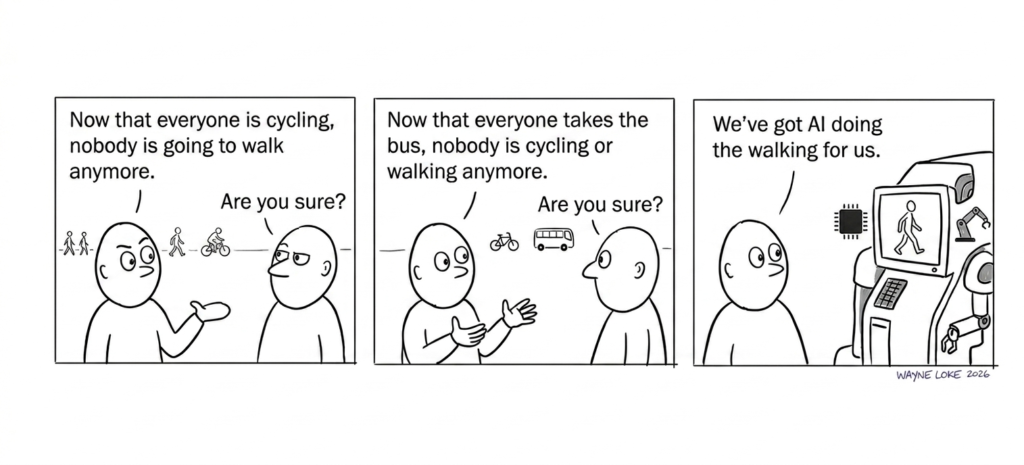
    When I was young, I walked to school. Then one day I got a bicycle. The bicycle didn’t replace walking. I still walked to the corner shop, still walked when the bike had a flat. But for the school run, it was faster and I arrived less tired.

    Then came the bus. Same route, no effort, could read on the way. And in adulthood a scooter for short stretches because it was quicker through the car park.

    None of these replaced the others. Each was a medium, a better fit for a specific job.

    I keep coming back to that image every time someone says AI is going to replace workers.

    The NZ government has announced it’s cutting 8,700 public service roles by 2029 and embedding AI “as a basic expectation” across agencies. Those two things are being discussed together, and I think that’s worth separating.

    The fiscal pressure drove the headcount decision. The AI is the bicycle. Conflating the two makes workers afraid of the tool, and a team afraid of the tool won’t use it well.

    What AI actually does in a workplace is handle the repetitive, rule-bound, high-volume work so your people can focus on the judgment-intensive work. Chatbots are a clean example. Before modern AI, a reasonable chatbot could handle maybe 40-50% of common customer queries: FAQs, status checks, simple form guidance. Route the rest to a human. The human doesn’t disappear. They stop spending half their day answering the same 5 questions.

    But, and this is a real but: you have to know who your customer is first.

    I’ve seen organisations roll out chatbots to serve a customer base that barely uses smartphones. The deployment looked impressive. Adoption was close to zero. Because the assumption that most customers are digitally comfortable wasn’t true for that particular service.

    The question before any AI implementation is simple: who are we serving, and what percentage of them can actually use this?

    If 80% of your users engage through digital channels, build for them and keep a human channel for the rest. If that ratio is flipped, the chatbot is the wrong starting point. This is a customer understanding question, and the technology just makes the gap more visible.

    What I find more interesting than chatbots is what AI does to the invisible work.

    Every organisation carries what I call shelfware. Reports no one reads. Approval chains that exist because someone once said they should. Weekly coordination meetings where 6 people watch one person talk through a slide deck that could have been an email.

    AI tools that can draft, summarise, and generate structured outputs expose this shelfware fast. When a report that used to take 3 hours takes 20 minutes with AI assistance, you have to ask whether that report was worth 3 hours of someone’s week in the first place.

    Sometimes the answer is yes. Often it isn’t.

    The government’s plan calls for cloud HR, payroll automation, case management systems. That’s the back office. That’s the bus route that runs without a driver.

    What’s harder to address, and what I haven’t seen clearly articulated in the plan, is the cultural piece. Technology adoption in organisations doesn’t fail because the technology is wrong. It fails because the belief system doesn’t shift.

    I saw this pattern clearly in a restructure at an education business. The service desk team was managing laptop deployments manually, staging, imaging, dispatching across 48 locations. The capability to automate most of it already existed through the hardware supplier, but the team had been doing it their way for years and didn’t fully trust that the supplier’s process would hold up.

    The turning point was a pilot. One batch, fully outsourced to the supplier, end to end. Cost about $50 per laptop, imaging and logistics included. The batch arrived on time, correctly configured, no issues.

    After that, nobody wanted to go back.

    That’s how adoption actually works. Small wins, specific demonstrations, one thing at a time. The bicycle is faster than walking, but you have to ride it once before you believe it.

    So if you’re a leader trying to navigate this: pick one process, something specific, bounded, and annoying, and make it your AI pilot. Not a transformation programme. One thing.

    Show the team what the bicycle does. Let them ride it.

    AI won’t replace human creativity and judgment, and it won’t replace the person who can read a room, ask the right question, or know when the data is telling you the wrong story. What it will do is take the robotic work off their plate so they have time to do those things.

    The medium changes. The destination is still yours to choose.

    It’s made sense to me.

  • The Redistribution Reflex

    Picture a company as a car.

    The executives look at the fuel gauge during a downturn, panic a little, then decide the fastest way to save money is to remove parts from the engine, a few mechanics from the workshop, maybe one of the drivers as well. On paper the numbers improve immediately, operating costs go down, shareholders relax for a quarter or two, everyone congratulates themselves for being “decisive.”

    Then the car starts rattling.

    I’ve been through four restructures personally. The first I remember clearly was at ANZ, where I was asked to reapply for my own job, then appointed to lead a team I had no technical background in, because senior leadership couldn’t find anyone else willing to take it. My predecessor had asked out of that team, which should have told me something. The team was difficult, the dynamic was already broken, and I was being slotted in as part of a musical chairs reshuffle that had nothing to do with redesigning the function and everything to do with filling a gap quickly. Whether there was a hidden agenda behind it, I never confirmed. But the pattern was visible: the organisation had shuffled people instead of addressing the problem.

    I spent the first few months just trying to understand what the team actually did. That’s time I should have spent on strategy. The organisation had removed the symptom of a leadership problem by reshuffling people around it, and created a new problem in its place.

    That’s the version of restructuring nobody draws on the whiteboard.

    I’ve watched the same pattern play out across banking, government, education, and technology for years. Different industries, same mechanics. The economic cycle turns, leadership feels immediate pressure, and redundancy becomes the lever because it is fast and measurable, politically safe to explain in a boardroom. Whether you like it or not, headcount is still the easiest number to attack when leaders run out of imagination.

    The deeper problems usually remain untouched.

    Processes still don’t flow properly. Teams still duplicate effort. Systems still create friction. Leadership still avoids the uncomfortable conversations. So the organisation removes people because the organisation cannot yet remove the causes.

    And then comes the rehire cycle.

    That part always fascinates me, because people act surprised every single time.

    Demand returns, projects restart, customer expectations rise again, remaining staff are exhausted, institutional knowledge has already walked out the door carrying a cardboard box and a farewell cake, and suddenly the same organisation is back in the market desperately trying to hire the capability it removed six months earlier. Except now salaries are higher, recruiters are involved, onboarding takes time, and morale inside the company is sitting somewhere near the basement carpark.

    I saw this directly at ANZ. People made redundant came back as contractors, sometimes within months, because the institutional knowledge and the working relationships they carried were simply irreplaceable. The organisation paid to remove them, then paid again to bring them back, usually at a higher rate, often under less favourable terms. The same thing happened at Stats New Zealand. Staff left, observed the mandatory stand-down period, then returned in a different role with a slightly different title. The knowledge never actually left. It just temporarily stopped appearing on the payroll.

    And so do people.

    That’s the part spreadsheets miss.

    After redundancies, the survivors work differently. They become careful. Meetings get quieter. Innovation slows down because nobody wants to be the next cost-saving exercise. Good people start asking themselves whether loyalty still matters, especially in countries like New Zealand where the market is small, reputations travel fast, and everybody seems to know somebody who knows somebody.

    I saw versions of this after Covid across New Zealand. Hospitality. Airlines. Retail. Healthcare. Technology. Some organisations cut deeply during uncertainty, which I understand because cashflow pressure is real. But many underestimated how hard it would be to rebuild capability once the cycle turned again. Air New Zealand was not unique. Neither were the tech companies in the US laying off thousands while quietly continuing to recruit specialist talent in parallel.

    There’s a third loop, and it’s the sneakiest one. Sometimes the person doesn’t return to the same team at all. They come back to a different business unit, doing essentially the same work under a different title, because that business unit decided the centralised function was too slow, too political, or too focused on what the organisation deems efficient rather than what the business actually needs. You could call it shadow IT. I’ve seen it in education: a staff member leaves the technology function, waits a while, then reappears in a business department doing work the technology team would have called their responsibility. The organisation hasn’t fixed anything. It has just spread the cost in ways that are harder to track and harder to challenge, because now it’s buried in a business unit budget with a different job title sitting on top of it.

    Same capability. Different org chart line. The original saving has completely evaporated.

    Meritocracy is lip-service more often than organisations want to admit.

    I’ll be honest: I have been in the 80% of organisations that acted without fully pausing. The moment of pausing was always there, somewhere in a senior leadership discussion, where someone would raise the question of whether there were alternatives. There were alternatives. But when executive pressure to reduce costs is immediate, the conversation about alternatives becomes theoretical very quickly. Someone makes a calculation about their own position, decides that recommending cuts is safer than defending complexity, and the organisation follows the path of least resistance.

    That’s a human action for self-preservation. The executive who demands the cut is usually insulated from the downstream consequences. The manager who carries out the restructure is not. So the manager recommends what’s safe, and the system continues.

    Understanding that doesn’t make it right. It explains why the same pattern repeats even when people who’ve been through it before are sitting in the room.

    There was one exception I lived through, and I had a direct part in it.

    During one of ANZ’s restructures, coinciding with the system merger between ANZ and National Bank, I was given the task of identifying which team members should be released. Long tenure, skills no longer needed after the merge, that kind of brief. My immediate response was to be transparent with the team. I told them directly what was happening, why it was happening, and what the decision process looked like. I asked for volunteers. Some team members were genuinely relieved, because the redundancy payout was something they’d been weighing anyway, or because they’d had enough. Others wanted to stay.

    What I didn’t do was manage the optics for the benefit of people above me.

    The team I was leading was punching above its weight. When the final decisions came down, the team stayed intact. Leadership didn’t want to touch it. I don’t know if that was wisdom on their part or just pragmatism, but the outcome was the same: a transparent process, a team that knew where it stood, and a result that didn’t require a rehire cycle twelve months later.

    The lesson I drew from that was simple: a team that is visibly delivering something leadership depends on is harder to cut than one that is just doing its job quietly. That sounds obvious. Fewer teams act on it than you’d think.

    I guess I did something right.

    Russell Ackoff used to talk about optimisation destroying systems when people optimise one part without understanding the whole. I think about that often during restructures, because organisations behave exactly like that. Pull one lever aggressively and something else strains downstream. Sometimes immediately. Sometimes eighteen months later when nobody connects the dots anymore, because the person who ran the original restructure has already moved to the next posting.

    The irony is that many organisations already know where the waste sits.

    I’ve seen organisations spend millions restructuring while leaving broken approval chains untouched, allowing manual workarounds to continue, tolerating duplicated reporting lines, or keeping technology platforms nobody really wanted because removing them required political capital. Cutting people is often easier than confronting organisational habits.

    Good organisations pause long enough to examine the whole system before reaching for redundancy. They review the business model honestly. They simplify the workflows, invest in capability where demand is shifting, and automate carefully, instead of blindly replacing people with software because some consultant drew three circles on a PowerPoint deck. They reduce friction before they reduce humans.

    And when redundancies genuinely become unavoidable, they handle them with clarity and dignity, because people remember how organisations behave during difficult seasons.

    Everything leaves a residue.

    Peter Drucker once said that when the environment changes, you must revisit the theory of the business. Most organisations say they believe this. Fewer actually do it. Many continue operating on assumptions built for a different economic cycle, then act shocked when the old formulas stop producing results.

    That’s usually the real problem.

    Not the people.

    It’s worked for me.