Category: Small Simple Steps

Practical reflections on progress, reinvention, and personal discipline.

  • The Four Unwritten Rules That Keep You Employed

    The calendar invite arrives with no agenda and no attendees listed except you and your manager. By the time you notice the pattern in the building, it’s already happening. Someone in finance started the spreadsheet three weeks ago.

    That’s how economic cycles land at the individual level, and they’ve been landing that way for decades: after the 2008 financial collapse, when the Lehman Brothers bankruptcy triggered a cascade through the global banking system and redundancies spread across every sector; after COVID froze entire industries overnight; in every contraction before and after those, when credit tightened and executives started talking about efficiency and HR calendars filled up. The conditions rotate. The mechanism stays the same: organisations under pressure cut costs, and cutting staff is the fastest lever they know how to pull.

    What also stays the same is who survives it.

    A book from 2008

    In the year the GFC hit, a short book called Bulletproof Your Job appeared. Stephen Viscusi wrote it for people navigating a tight employment market, and he gave them four strategies. Simple ones.

    I read it then. I’ve shared it since with graduates starting their first job, with experienced people in mid-career drift, with team members who were quietly about to be restructured. Thirty years of organisational life across multiple companies and countries, and the advice has never once felt dated.

    The four strategies: be visible, be easy, be useful, be ready.

    Most people ignore them until the no-agenda calendar invite lands.

    Be visible

    Visibility means making your contribution legible to the people who matter: your boss, your peers, your stakeholders. What are you working on, what have you delivered, how does it connect to what the organisation actually needs. Consistently, and without blowing your own trumpet every second day.

    Agile teams do this naturally: showcases, backlogs, working-out-loud practices that make work clear not just to management but to each other. That’s career insurance as much as it’s project methodology.

    Working Out Loud, as a deliberate practice, takes it further. You share your thinking, your progress, your work in ways that invite collaboration and make your knowledge useful beyond your immediate team. You become someone others learn from, which registers differently than just completing tasks on time.

    When a restructure lands and a manager asks who they can’t afford to lose, the answer is almost never the person whose work was invisible.

    Be easy

    Being easy to work with means being dependable: following through, engaging honestly with problems, showing up without drama or defensiveness.

    The opposite is being high-maintenance, and high-maintenance is expensive. If working with you generates friction, political fallout, or extra management overhead that someone else has to clean up, that cost starts to register when budgets get squeezed.

    Ask yourself honestly: what’s it like to work with me? Better to find out from a trusted colleague now than to discover it in a conversation you didn’t see coming.

    Be useful

    Everyone thinks they’re useful. That’s the catch.

    Ask your boss and your colleagues honestly: do they experience you as someone who makes things better? Who runs a workshop to solve a real problem? Who teaches something new, mentors someone, transfers a skill instead of just performing it?

    And then there’s the unprompted kind. Something outside your job description is broken, and you have the skills to fix it, so you do, without being asked. You nail it. That demonstrates capacity beyond your lane, which is exactly the signal that registers when leadership is deciding who’s expandable.

    Be ready

    This is the one most people defer, because it requires effort before anything feels urgent.

    Ready for opportunity means keeping your CV current, building transferable skills, staying connected to your industry and not just your current employer. Opportunities have a short window. They don’t wait.

    Ready for adversity is mostly about finances. Six months of expenses in savings, which financial planners recommend as the floor, not the target. Having that buffer changes the psychology of a redundancy entirely. Without it, you’re making permanent decisions under temporary pressure, taking the first thing available because you can’t afford to wait. With it, you can be deliberate.

    Beyond the finances: have a backup plan. A specific one: who do you know, what skills transfer, what would you do next, how long can you sustain the gap? The people who land well after redundancies almost always had this worked out before they needed it.

    The pattern underneath

    Here’s what I’ve observed over the years and more than one economic downturn.

    The people who apply these four strategies when things are fine, when there’s no restructure in sight, no headcount review, no whisper of a hiring freeze, those are the ones who don’t panic when it does arrive. The visibility is already there. The reputation is already built. The financial runway exists.

    The people who start thinking about this when the news turns bad are usually starting too late. You can’t build visibility in a week. You can’t develop a reputation for dependability in a month. You can’t save six months of expenses when you’re already losing your income.

    These four strategies aren’t crisis tools. They’re habits. Viscusi framed them in a crisis context because that’s when people finally stop to listen. But the strategies themselves are for ordinary time, the long quiet stretches between downturns where nothing feels urgent and preparation feels optional.

    The unwritten rules at work haven’t changed in years. The economic conditions rotate. The technology shifts. The org charts get redrawn. The rules stay the same.

    Start now, when you’re ahead. That’s the whole point.

  • The Same Hiring Mistake is About to Get More Expensive

    I published a version of this in 2021. It was about hiring Agile coaches. Reading it back, the argument is identical. The job titles have changed and the day rates have roughly tripled.

    Organisations are moving fast on “AI transformation leads,” “Chief AI Officers,” and consulting firms promising to compress a multi-year change into a 90-day sprint. Some of that money will produce results. Most of it will produce a very expensive lesson about organisational readiness that a two-hour honest conversation could have avoided.

    Four things to acknowledge before you start.

    One: No AI expert knows everything about AI transformation. They’re human, same as you. Deep capability in some areas, real gaps in others. Worth knowing before you set expectations.

    Two: Certifications tell you what someone has learned, not what they can do. I know what a cake is. I can’t bake one from scratch, and I certainly can’t show you how. I’ve watched people arrive with impressive credentials, a Scrum Master or Agile Coach cert rebranded as “Agile expertise,” a prompt engineering certificate rebranded as “AI strategy,” and struggle to apply any of it in a live organisational environment. Knowing and know-how are two different things, and the gap between them is where most hiring decisions go wrong.

    Three: What worked elsewhere won’t automatically work here. I’ve seen organisations bring in Agile coaches from European companies, expecting them to transfer the cultural and systems context from there into a New Zealand environment. It rarely worked. The organisational conditions, the regulatory environment, the pace expectations, the relationship dynamics between teams and leaders, all of it is different. An AI expert who spent the last 5 years in a San Francisco tech company is carrying a very specific operating model in their head. That model may or may not survive contact with a NZ government agency or a regional bank that’s been running for 150 years.

    Four: Some AI experts are unicorns. By that I mean they only function in perfect conditions. They arrive with a clear picture of what the organisation should look like once they’re done with it, and they expect the organisation to submit to that vision. When the org doesn’t comply, they diagnose a culture problem or a leadership problem or a readiness problem, and they’re not entirely wrong, but they’re not useful either. An expert who can only work in conditions that already look like success isn’t solving your problem. They’re auditioning for a different organisation.

    Diagnose your organisation before you write the job description

    Answer two sets of questions, and answer them about the real situation, not the one you’d prefer.

    On AI Knowledge: Do your teams actually understand what AI can do, beyond the marketing? Have they used AI tools in their day-to-day work? What about people outside your immediate team, in Finance, HR, or the project office?

    On AI Reception: Are your people curious, or quietly resistant? Are your stakeholders and leadership actively interested, or hedging? Are other parts of the business at least open to AI affecting their workflows, their processes, their decisions?

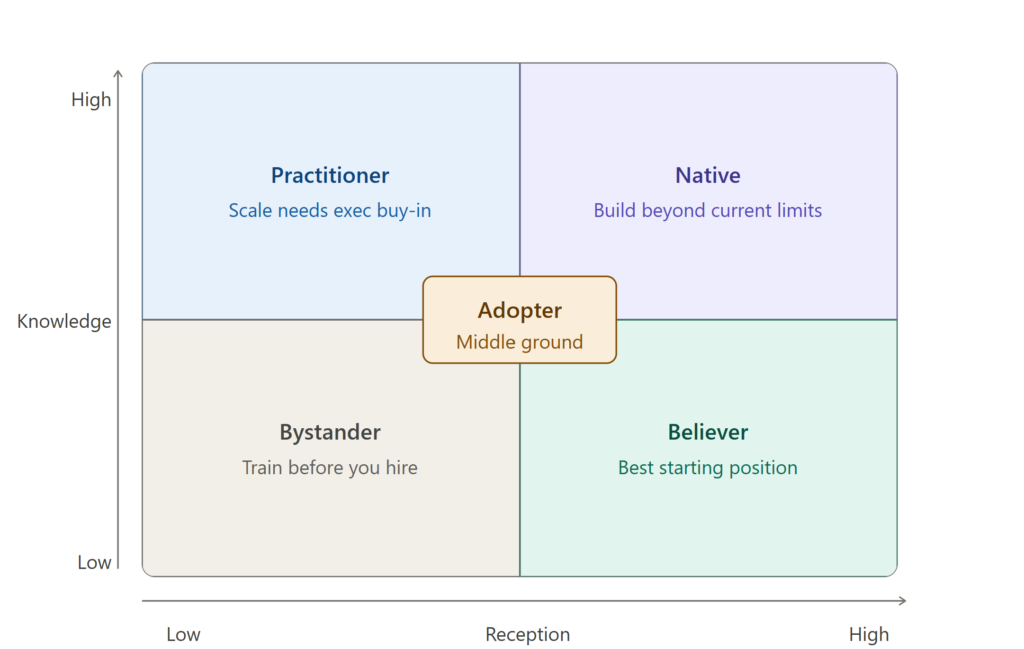
    Rate each one: low, medium, or high. Then find your position below.

    AI Positioning Matrix

    Five positions, five different problems

    Low Knowledge + Low Reception = Bystander.

    Your organisation hasn’t started, and isn’t particularly motivated to. Bringing in an AI transformation expert here will produce a unicorn problem almost every time, because the operating conditions can’t support them. There’s also a structural version of this position that’s worth naming separately.

    In some NZ government agencies, reception has nothing to do with enthusiasm and everything to do with policy. Staff aren’t empowered to make decisions on behalf of their leaders. The hierarchy and accountability structures aren’t a culture problem, they’re a legal and policy architecture that nobody is dismantling regardless of how good the AI use case is.

    I watched Agile coaches walk into that environment expecting holacracy and come out confused. It’s not blind leading the blind, exactly. It’s more that anyone who walks in thinking they can see the full picture in that context is leading people toward a very expensive dead end. Train first. Run small experiments in contained spaces. Build curiosity before you bring in someone to scale it.

    Low Knowledge + High Reception = Believer.

    Let’s face it, this is the best starting position. Leadership is bought in, which is the hardest thing to create. Use that cover. Invest in AI literacy across your teams first, practical workshops, hands-on tool exposure, small internal experiments that prove value in your specific context. Then bring in an experienced practitioner to help people apply what they’ve learned to your actual problems. In the interview, ask them to describe specifically how they’d approach your environment, not their last client’s environment. A generic answer tells you everything you need to know.

    High Knowledge + Low Reception = Practitioner.

    You have pockets of genuine capability, maybe a few teams doing interesting things, but no organisational pull to scale it. At BNZ, when I was there, we had exactly this: a traditional IT department running waterfall on one side, and a digital department on the other, its own reporting line, its own leadership, doing everything in an Agile manner to bring retail online services to market. Both existed simultaneously. The digital teams were capable and moving fast. The org-wide reception for their approach was mixed at best. An AI coach dropped into that second group can do good work, but they’ll spend half their time managing the friction at the boundary rather than coaching. The challenge in this position is political, not technical. Ask yourself whether you need executive sponsorship before you hire expertise, because without the first, you’re setting up the second to fail.

    Medium Knowledge + Medium Reception = Adopter.

    Stuck in the middle, probably frustrated, probably not getting the results you were promised. Adding more experts won’t unstick you. Decide which axis you need to move on first, because confusing an AI knowledge problem with an AI reception problem is exactly how organisations end up cycling through consultants without changing the underlying conditions.

    High Knowledge + High Reception = Native.

    You’re in the minority. You don’t need transformation expertise. You need specialists who can extend what you’re already building, people with deep domain capability in specific areas, not generalists who’ve read the same frameworks as everyone else.

    The question before the question

    The matrix is a diagnostic, not an answer. The point is to prompt this conversation:

    Does the hire you’re planning match your actual position, or the position you wish you were in?

    Most expensive AI hires are made from the second answer.

    It’s worked for me, knowing the difference before I signed the paperwork.