Category: Leadership

Teams, trust, accountability, people development.

  • The Cover Story

    ABN AMRO ran a three-day programme for every officer at manager rank and above. The subject was this: what makes a bank a bank.

    I attended it in the early 2000s. The facilitator opened with a question, and answers came back the way they always do in a room full of experienced people who haven’t been asked this before. Deposits. Savings accounts. Housing loans. Payment transactions. The facilitator let the room finish, then said: No. The business of banking is brokering. You take money as intermediary, you lend long, you borrow short, and you extract the margin between. Every ratio the organisation tracks, every headcount cost you manage, every basis point on a loan portfolio, it traces back to that one mechanism. Understanding it changed how I read every decision I was part of after that, because I finally knew what the decision was in service of.

    I remember thinking: I’ve been in financial services for years, and nobody has ever explained this to me.

    This was not a welcome-to-the-company session. The room was full of ranking officers, some with years of service already behind them. ABN AMRO ran it because knowing your own function and understanding the business you’re working inside are two different things, and they had decided the second one required deliberate instruction, regardless of your tenure.

    That is what succession planning looks like: an organisation taking responsibility for making sure its people understand what they’re contributing to, how the organisation survives as a going concern, and why developing someone through the ranks is an obligation rather than an optional bet. I attended that programme once, at a Dutch bank in the early 2000s, and I have not seen anything approaching it in any organisation since.

    Every organisation I worked in after ABN AMRO shared a condition so common it stopped being remarkable. Most people had no idea what made the organisation viable. They knew the process they ran, the team they sat in, the system they operated. They did not know how the organisation generated its revenue or delivered on its purpose, what the unit economics looked like, or why any of it depended on them staying and growing rather than leaving when a better offer arrived. Nobody had explained it to them, because nobody had been tasked with doing so.

    At ANZ National the closest attempt existed. There were frameworks, names in boxes, readiness ratings reviewed on a quarterly cycle. The structure was on paper. The problem is that a real succession pipeline requires sustained capital and sustained effort, and when the cost and effort came into focus, it didn’t fly. What happened every time a senior role opened was the same: the market. External hire, premium cost, cycle repeats.

    At Stats NZ, BNZ, and Inland Revenue, the situation was simpler: there was no attempt at all. When roles opened, the organisation looked outside, paid more than an internal candidate would have cost, and called it efficient resource management. I watched that pattern hold consistently across every organisation I worked in, and the common element in each case was that nobody had ever explained to their people what business they were actually in.

    The argument against investing in people has a surface logic. You develop someone, they build capability, and then they leave. The benefit flows to whoever hires them next. So the conclusion most organisations land on is to hire capability rather than develop it: bring someone in who already knows the job, carry the salary premium, avoid the development risk.

    Follow that logic downstream and the flaw becomes visible. Workers trained somewhere, at some point, by someone. That somewhere has to exist. If every organisation applies the same reasoning and nobody trains, the pool of experienced talent available to hire from starts thinning, salaries at the experienced end inflate because demand accumulates without supply to match it, and the organisations that chose never to invest in developing people find themselves competing to pay for people that some earlier employer, somewhere, did invest in.

    There is a fear underneath this that I’ve heard stated plainly enough over the years: if I train my people, I’m training them for my competitors. That fear isn’t irrational in isolation. Acting on it at scale creates the exact problem it was trying to avoid, a labour market full of people with skills but no organisational depth, moving from role to role because no organisation has ever given them a structural reason to stay.

    The mechanism that resolves this tension does exist. Service bonds tied to development investment: the organisation funds a significant programme, the employee commits to a minimum tenure in return. Blunt instrument, but it makes the incentives match. And when an organisation does invest deliberately, people queue for it. The Department of Internal Affairs ran the GovTech Talent graduate programme across several government agencies, and I was a participating leader from Stats NZ. 15 to 20 graduates at a time, each rotating to a new agency every eight months over two years. Every intake was oversubscribed for the years we ran it.. The model works. It’s just not replicated at any scale elsewhere.

    The default everywhere else is that development happens incidentally, through work, without structure. The organisation assumes the education system has done the foundational work. Graduates arrive, enter a role, and build from there. What the education system cannot do is teach someone the specific business of the specific organisation they’ve joined. That knowledge is internal. It requires someone to take the time to explain it, the way that facilitator at ABN AMRO took three days to explain what makes a bank a bank. Without that, you get people who are technically employable and organisationally adrift, contributing to a process without understanding what the process is part of, with no reason deep enough to keep them there long enough to be developed into something the organisation actually needs.

    Youth unemployment in New Zealand sits at 15.9% as of March 2026, per Stats NZ. Three times the national rate. The explanation most prominent in media and political commentary is AI. The story is that AI is absorbing entry-level roles, particularly in office environments where decisions are process-driven and binary, and the jobs that used to give young people a first foothold are disappearing.

    There’s something in it. Roles built on processing work where the majority of decisions follow a predictable path and exceptions are all that require human judgment, those roles are genuinely exposed. Some of those positions were entry-level, and they’re thinning. That’s real.

    But AI is a convenient story. It’s external, it’s technical, and it removes the organisation from the chain of causation. The economy plays the same role. When a commenter in my LinkedIn post that prompted this piece wrote that she hadn’t seen evidence of AI replacing entry-level jobs in practice, she was pointing at something real. I asked her whether she’d ever been on a succession plan in her organisation, or whether her company simply hired someone to replace her when she left. Her answer: she had not been on any succession plan, nor seen one in any organisation she’d worked for.

    She runs her own contracting company now, which changes the equation for her. She keeps her skills current because she has to. But she had years of employment inside organisations before that, and the pattern she described is the one I’ve heard consistently across several sectors: no pipeline, no structured development, no explanation of what the organisation was actually trying to do. Just a job, adjacent to other jobs, in a structure nobody took the time to explain.

    AI and the economy are cover stories. They describe conditions that are real enough. They do not account for the pipeline that organisations chose, over decades, not to build.

    The mechanism isn’t complicated. An organisation that never explains to its people what it’s actually in the business of doing will not retain those people through difficult periods, will not develop them into the roles it needs filled at the next level, and will not be able to backfill from inside when the time comes. It will go to the market, pay the premium, and describe what follows as a talent shortage.

    There is a talent shortage. It was constructed, incrementally, by organisations that treated succession planning as a compliance exercise and development as a cost to be deferred. The young people at 15.9% unemployment are the visible end of a problem that runs through every level of the workforce. The entry-level jobs are where the pipeline starts. If they’re shrinking, some of that is economic conditions, some of it is genuine automation, and a significant portion of it is that organisations have no structural incentive to create them when they’ve never built a development pipeline to justify the investment in the first place.

    You can’t extract from the talent market indefinitely without anyone replenishing it, then reach for an external explanation when the extraction catches up with you.

    I sat in that room at ABN AMRO for three days and came out knowing what I was part of. Every organisation I joined after that, I was still asking the same question.

    Nobody offered the three days.
  • What Nobody Talks About After A Restructuring

    On 19 May, Finance Minister Nicola Willis announced the NZ public service will cut roughly 8,700 roles by 2029, taking headcount from around 64,000 down to 55,000. $2.4 billion in savings. Agencies merging. AI and digital tools named as part of how the remaining workforce will cope.

    The coverage since has been predictable. The PSA calling it reckless. Worried workers. The human cost, which is real and I won’t dismiss it.

    This is for the people who don’t lose their jobs.

    Post-restructuring is its own kind of hard. And almost nobody talks about it.

    I’ve been through enough restructures to know how this goes. The affected people get the attention, rightfully. HR runs the process. The communications go out. And then, fairly quickly, everyone turns back to the work, except now there are fewer people doing it, and the assumption, unstated but real, is that things will carry on more or less as before, just with more pressure per person.

    That assumption is wrong. And acting on it is how you burn out your best remaining people.

    The first thing I’d do is stop. Not literally, but mentally. Before you redistribute tasks, before you absorb someone’s workload, before you do anything, sit down and ask: what does this team actually need to deliver now?

    Here’s what I’ve seen in every restructure I’ve been through: organisations shrink the headcount but keep the workload intact. They split it across fewer people. That’s doing the same with less, and it collapses within a year.

    The restructure is, whether you asked for it or not, a forcing function to review everything. Use it.

    When I was at the bank, we had a report. Weekly or monthly, I can’t recall exactly. Generated by the technology team for a specific person in the CFO’s office. A proper report, formatted, tracked, sent on schedule. The kind of thing that takes someone a few hours to pull together each cycle.

    We interviewed that person. Asked what they used it for.

    They’d never actually looked at it. A safety net, they said. Just in case something came up. When we went back through the history, that something had never come up. Not once.

    That report was what I call shelfware. It looked like work, consumed resources, produced nothing. And in every organisation I’ve worked in, across 30 years, I’ve found versions of it. Reports, approval chains, coordination meetings, processes left running because stopping them would require someone to make a decision.

    The question after a restructure is whether you have the courage to find yours.

    The test I use is simple. Which 20% of what your team does actually drives 80% of the outcomes? Find that 20% and protect it. Everything else is a candidate for consolidation, elimination, or redesign.

    This isn’t easy. People are attached to their work. Some of what looks like shelfware is someone’s entire job identity. Having the straight conversation, directly, without dressing it up as anything other than a resource reality, is probably the hardest part of surviving leadership.

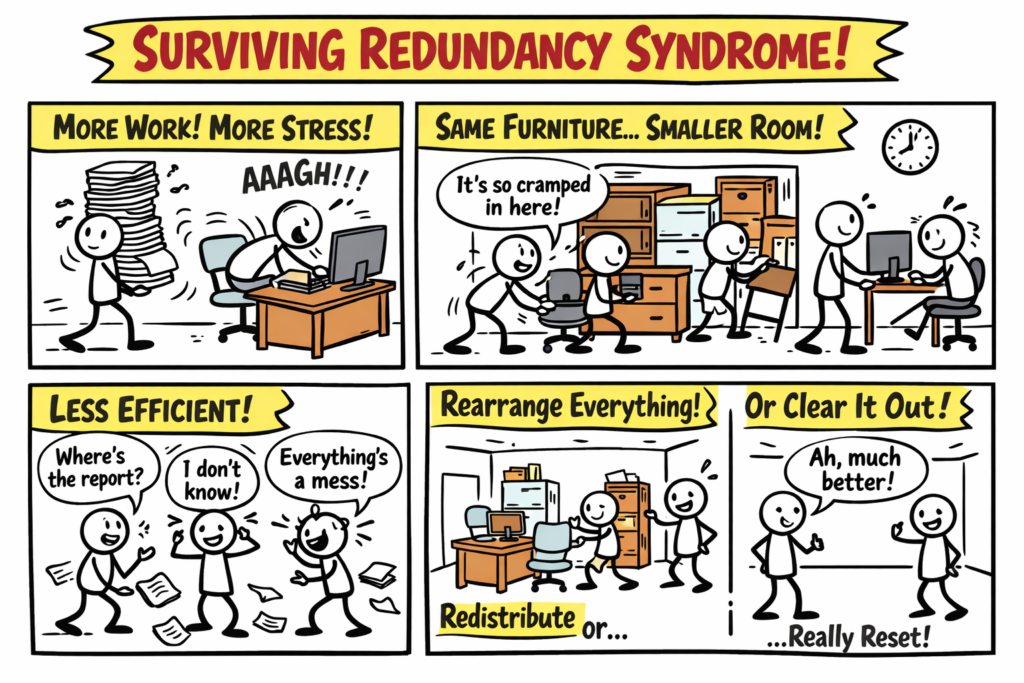
    But the alternative is distributing the same furniture across a smaller room and wondering why everyone feels crowded.

    There’s another thing worth paying attention to: the people who stayed.

    The research has a name for it, survivor syndrome, and it shows up as guilt, anxiety, low-grade dread that another round is coming. What I have watched follow it is people working harder for a few weeks, then quietly less. People feel the loss of colleagues. They feel the weight of expanded roles. They feel uncertain.

    The instinct from leadership is to focus forward. Get moving. Don’t dwell. I understand that instinct, and I’ve felt it myself.

    But skipping over it doesn’t make it go away. It surfaces later, as quiet disengagement, or as your best remaining person leaving on their own terms at the worst possible time.

    A direct conversation is better than a perky all-hands. Acknowledge what happened. Say what the plan is. Ask what people need, specifically, and then actually follow through.

    A comic strip on surviving redundancy syndrome as there is less people now to do the same amount of work. Do you rearrange everything? Redistribute or Clear it Out. Like a reset.

    Here’s what this looked like in practice for me. After a restructure at an education business, the service desk team was down to a handful of people. The old workload, staging and imaging laptops, managing logistics across 45 locations with 80 campuses nationwide, calling couriers, handling returns, would have crushed them if we’d pushed it forward unchanged.

    So we redesigned the supply chain. Partnered with the hardware supplier to do the imaging at source. Laptops arrived at users already configured. The courier handled distribution. Returns went directly back to the supplier’s offices, of which there were locations nationwide anyway.

    The cost per device for the entire arrangement, imaging, logistics, the whole thing, came out around $50. Less than 5% of the laptop price.

    The team didn’t shrink further. But what they spent their days doing got materially better. They went from robotic, time-consuming logistics to overseeing a mostly automated process and handling the exceptions that actually needed a human brain.

    That’s the opportunity inside a restructure, if you’re willing to use it. The pressure to reduce forces a review you probably should have done years earlier. Most organisations accumulate work the way houses accumulate furniture, gradually, without realising how much space it takes up.

    The question is whether you use the review to redistribute the same furniture, or to actually clear the room.

    I’ve done both. One of them works.

  • Designing Team Culture

    A leader walks into a town hall and tells the room they want everyone learning Python, that upskilling is the future, the department is going all-in on capability. Someone raises their hand. “Can we get training funding?” Leadership checks the budget. Two seats approved, 150 people waiting.

    That’s the friction. And that friction, repeated across enough decisions, is what culture actually is.

    Most leaders don’t see it that way. When people complain about culture, they reach for the hygiene factors: more communication, better coffee, birthday celebrations, quarterly get-togethers. These matter, but they’re not what I mean by culture. Culture is a set of behaviours, how people come together around a common goal, and whether leadership means what it says. You can have excellent coffee and a toxic culture. I’ve seen it.

    The mistake most organisations make is treating culture as a programme, something with milestones and colourful slide decks. Programmes feel controllable. Culture isn’t controllable. It moves through repeated human behaviour, leadership signals, budget decisions, and the distance between what leaders promise and what the system actually allows.

    When leadership closes that gap, behaviour changes. When they don’t, you get lip service with a fancy name.

    The diagnosis

    In 2017, I was leading Strategy, Planning and Performance in Digital Business Services at Stats New Zealand, about 150 people across the digital technology division. Everyone was blaming culture for why teams didn’t cooperate, why management behaved one way and staff another. Culture became the explanation for every symptom, which meant nobody was actually diagnosing it.

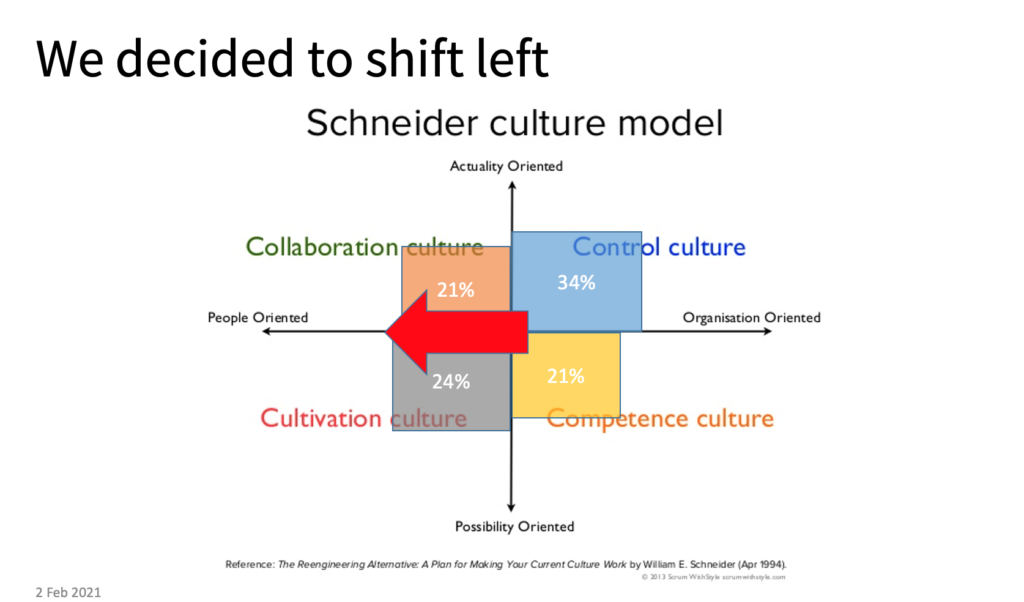
    So I found a model people could understand quickly. William Schneider’s culture model maps organisational behaviour across four quadrants: Control, Cultivation, Collaboration, and Competence. Simple enough for a frontline staff member to read, specific enough to point at real behaviour.

    We ran a survey across the whole department. The result was clear: a dominant Control culture, with a secondary Cultivation culture sitting beside it. Those two sit directly opposite each other on the model. According to Schneider, opposite cultures are in conflict.

    A graphic representation of the four quadrants of Schneider Culture model where the culture had shifted left to people orientation.

    That Python training moment is what that conflict looks like in practice. Leadership says “develop yourself, grow, we want you to be excellent,” which is Cultivation talking. The budget says “sorry, two seats,” which is Control answering. Staff hears both. They weigh both. What they believe is the one that has money behind it.

    Multiply that across every approval chain and governance decision, and you get a department where people have learned not to expect much.

    I still remember one town hall where we asked staff openly what was getting in the way. The room went quiet. Then someone said, carefully: “Customer comes first.” Everyone nodded. What they actually meant was that other business units came first, and the technology teams absorbed the pressure downstream. The phrase sounded principled on paper. In practice, people experienced it as cover for decisions that had already been made above them. That one moment of careful language told me more than any survey could.

    Making the gap visible

    The standard approach is an annual engagement survey. Stats New Zealand, as a government department, already ran one. The number comes back, the CEO says things are improving, and nothing changes until the same survey runs twelve months later. A number you only see once a year can’t tell you what happened in March.

    We used NPS instead, adapted for employee experience. Every month, one anonymous question: “How likely would you be to recommend DBS to a qualified friend or family member as a great place to work?” Score from 0 to 10.

    The key was converting the quantitative scale into something qualitative. We presented it to staff as a smiley face scale, each range corresponding to a feeling: 0 to 6 is disengaged or passive, 7 and 8 is indifferent, 9 and 10 is genuinely positive. The scale is deliberately skewed. You have to be certain of what you’re feeling to hit a 9 or 10. Passivity doesn’t count as engagement.

    We published the results on Yammer within a week of every month-end. All staff. The bad months too.

    That last part matters more than people assume. Most cultural programmes fail because staff have already survived several of them, and they know the pattern: leaders announce the initiative, run some workshops, measure activity, declare victory, and move on. By the time the next programme starts, the scepticism is already there.

    Publishing results openly, including comments, including the months where the score dropped, was the signal that something different was happening. Nothing to hide. If something was broken, it was visible to everyone, which meant it was everyone’s responsibility, not just a topic for the next leadership offsite.

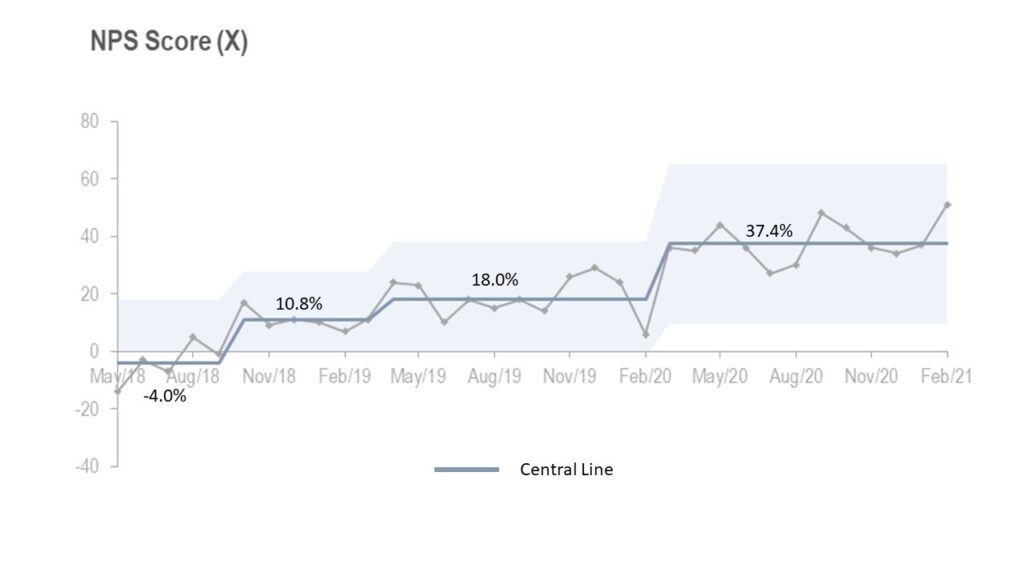
    The score lifted three times between April 2018 and February 2021, and held each time: from -14% to 11%, then to 18%, then to 37.4%. Each lift stayed long enough to become the new normal rather than a good month.

    A graph representing how the NPS had moved from -14% in 2018 to 51% in Feb 2021.

    What changed behaviour at each stage was simpler than any programme document would suggest. People watched leaders respond to the comments, not just the number. They saw the data used to hold leadership accountable as much as staff. I would take the results back to my fellow leaders and reflect it at them directly: here are which teams are struggling, everyone can see it, so what are we going to do? That creates a particular kind of pressure among leaders, the kind where difficult conversations start happening before they become crises.

    On the staff side, I watched behaviour start shifting toward the left side of the Schneider model. People began working out loud, owning their own paths, asking questions they’d stopped asking. The environment changed because the trust changed. Those two things move together, and you can’t manufacture one without the other.

    What failed, and why it matters

    One team read Holacracy, came to senior leadership, and we said yes, let’s try it.

    The idea has genuine merit: self-organising teams, distributed authority, people able to act without waiting for approval. It works somewhere. It didn’t work here.

    The problem was financial delegation. In a government department, spending authority is tied to your role. You can’t extend it informally, and we checked. HR confirmed: 150 team members cannot have financial signing authority, even at $100. Someone is accountable for the budget, and that accountability is structural. The model couldn’t survive that constraint.

    We told the team plainly: this doesn’t work in a government context, and we’re not going to run it anyway.

    Worth noting, though. The experiment taught us where the walls were, and that’s real information. Management models designed for startups with flat structures and discretionary spending don’t migrate cleanly into organisations with legislative obligations and financial controls. You can want a different culture and still operate inside a system that limits how far certain ideas can travel. Knowing that boundary saved us from chasing the model instead of the behaviour it was trying to produce.

    The Covid test

    Before 2020, DBS had been running flexible working quietly for a while. Two days from home, compressed hours, alternate Fridays off for some people. The Chief Digital Officer believed the trust was there, and high trust means people can work from wherever they’re most effective. We were already on Microsoft Teams when most of the organisation had barely heard of it.

    Other business units were unimpressed. I heard “recalcitrant” more than once. We were the department that asked too many questions, didn’t follow the standard IT playbook, apparently needed managing.

    Then Covid arrived.

    The CEO was under pressure. Most of the organisation had no remote capability, no tested platforms, no experience running a distributed team. We had been doing it for two years. We helped onboard the rest of the organisation onto Teams, ran the virtual meeting training, and kept delivering without interruption.

    Three years of trust and an investment in tools people called unnecessary both paid off in the week that most organisations remember as a crisis they barely survived. Our critics went quiet. There’s not much to say when a department you called recalcitrant already knows how to do the thing you’re scrambling to figure out.

    What the numbers confirmed

    The Schneider survey in December 2020 confirmed what we had felt for months. The organisation had moved left on the model, toward Collaboration, away from the Control-Cultivation tension that had caused the original friction in 2017.

    The NPS score that had started at -14% sat at 50% by February 2021.

    The DBS 2.0 Programme formally ended. The culture didn’t. It kept going because enough people had experienced what it felt like when leadership actually closed the gap between what it said and what it did. That experience is what people carry forward, not the programme name or the slide deck.

    Culture drifts toward entropy when leadership stops paying attention. The work is keeping better behaviour alive long enough for people to believe it’s real.

    It’s worked for me.

  • The Banana Economy

    I was walking through Universal Studios Singapore when a poster stopped me.

    Three Minions, fists raised, smiling like they had just unionised against common sense.

    “Join us. Free bananas for life.”

    The poster promised excitement, training, developmint, and fun. Yes, spelled that way. I stood there laughing for a while because, whether you like it or not, most organisations eventually produce their own version of this poster. Different branding, better spelling, more polished photography, same underlying proposition.

    Join us. The bananas are free.

    A poster of Minions recruiting for new employees with free bananas for life taken at Universal Studio Singapore

    It sounds ridiculous when Minions say it. Less ridiculous when corporations do.

    The thing about perks, culture, and “fun” workplaces is that they only exist while the economics underneath remain healthy. Once the system starts wobbling, the free coffee disappears, the learning budget gets frozen, the Friday drinks quietly stop, and suddenly everyone discovers the “family culture” was actually a cost centre with balloons.

    I’ve seen this pattern enough times across banking, government, and education sectors to know the sequence is surprisingly predictable. Revenue pressure arrives first, leadership starts using softer language to describe harder realities, restructuring rumours begin floating around corridors like cigarette smoke in an old casino, then everyone acts surprised when the layoffs finally happen.

    The signals were already there.

    But here’s what I got wrong about the Minions the first time I saw that poster.

    I assumed they were fragile because they seemed so indiscriminately loyal. Gru, then Vector, then whoever shows up with a plan and a lair. They flip-flop so fast that the obvious read is instability. The Minions survive precisely because they’re not attached to any particular boss. They carry their capabilities with them. They adapt quickly, rebuild under whoever the new leader is, and keep doing what they’ve always done: improvising, constructing things, breaking them accidentally, recovering. Their culture doesn’t live inside Gru’s lair. It travels with them.

    I’ve watched something similar play out in organisations, and it’s more instructive than it first appears.

    When I joined National Bank of New Zealand, the bank had its own distinct feel. Lloyd’s Bank in the UK was the parent company, but the place felt genuinely New Zealand throughout, in the customer service, the premises, the way people operated day to day. Then ANZ purchased it from Lloyd’s. Two cultures formed immediately, National Bank people and ANZ people, Kiwi versus Australian, and there was quiet friction about which way the merged entity would settle. The conventional expectation in any acquisition is that the larger institution absorbs the smaller one. ANZ had the capital, ANZ had the scale, ANZ held the cards.

    A few years in, ANZ adopted National Bank’s culture and processes, at least in New Zealand. The combined entity was rebranded ANZ National Bank, and when the “National” eventually got dropped, the National Bank way of operating had already absorbed much of the new structure. What tipped it was the branch rationalisation. When premises were merged, the National Bank locations were consistently preferred over the ANZ branches next door, even though they had been direct competitors. National Bank had ranked higher in customer service surveys among New Zealand banks for years. The culture had something real underneath it, and that’s why it outlasted the acquisition.

    Strong culture shows up in the survey results. The poster is decoration.

    BNZ had a similar internal split. The traditional IT department sat alongside BNZ Digital, which ran at a different pace, with different tools and a different sense of urgency. Two technology camps inside the same institution. Eventually the digital culture expanded into the broader technology function, and what tipped it was the same thing: the digital team was delivering. Mobile and desktop banking services were moving. The other side was not moving at the same rate. Cultures that produce results tend to absorb the ones that don’t, whether or not the org chart has caught up yet.

    Inland Revenue is where this became personal.

    I introduced the Toyota Production System there, quality control circles, metrics on the wall, team huddles running across the supply chain process, working out loud. A senior manager came to me directly. “Hey Wayne, we don’t do Agile here in Inland Revenue.” I said I was doing TPS, not Agile, which didn’t land the way I intended. A couple of years later that same manager was pursuing her MBA and carrying Mary Poppendieck’s book on Lean Software Development. She had converted. The person who told me not to implement Agile became its advocate, without ever quite connecting it back to what had already been running in our team. The irony was manageable. Production priority one incidents dropped while I was there. The method proved itself, and methods that actually work tend to win eventually, even if the timeline is annoying.

    Many people described me as a job hopper over those years because I moved from one organisation to another every couple of years. I understand why it reads that way from the outside. I carried a specific set of capabilities into different environments to solve particular problems, and once the problem was either solved or stuck, the case for staying weakened. This is the Minion model, whether I intended it that way or not. You accumulate skills, deploy them wherever you land, and you don’t require the organisation to validate them for you. The skills travel. The org chart doesn’t.

    Most people bind their professional identity too tightly to the employer’s brand. When that brand disappears in an acquisition or a restructure, they lose the thread of who they are professionally. The Minions never had that problem. They were always themselves, regardless of who was holding the freeze ray.

    Back at ANZ in technology, we had adopted the startup culture trappings: drinks on Friday afternoon, biscuits, coffee available throughout the day, the general ease of a place where people felt comfortable. It felt good. Then the Global Financial Crisis arrived and the budget tightened fast. The Friday drinks stopped. The biscuits stopped. The sense of shared ease got quieter without anyone announcing it.

    Same at BNZ Digital later. Things were good while they were good. Then they weren’t. The drinks dried up.

    Nothing in an organisation is actually free. The bananas are always funded from somewhere, and when that somewhere tightens, the bananas are among the first things to go. Organisations that use perks as the primary signal of culture have nothing underneath when the perks disappear. The ones that survive downturns are the ones where the culture exists in how people work, not in what they’re served on a Friday afternoon.

    I guess the deeper point is this: before accepting the bananas, spend some time understanding who is paying for them, how sustainable the system is, and what happens when conditions change. Every business cycle eventually turns. Every organisation enters a different season. Strong cultures survive because the fundamentals underneath them are real, and people who survive transitions are the ones who built something portable, not the ones who waited for the lair to stay stable.

    The Minions will probably be fine. Kevin will become a motivational speaker somehow, Stuart will join a terrible garage band, and Bob will accidentally build a successful kombucha startup without understanding basic accounting.

    Life moves on.